
Huawei nova 14 Ultra vs Oppo Find X7 Ultra: A Deep Dive into Flagship Performance
| Phones Images | |||||
|---|---|---|---|---|---|
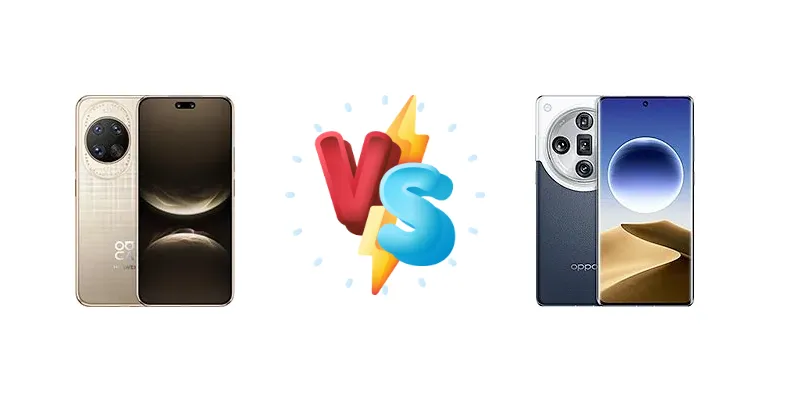
|
🏆 Quick Verdict
For most users, the Oppo Find X7 Ultra emerges as the stronger contender. Its Snapdragon 8 Gen 3 chipset provides a significant performance advantage, coupled with excellent battery life (12:47h active use). While the nova 14 Ultra offers competitive charging, it can't match the overall processing power and efficiency of its rival.
| PHONES | ||
|---|---|---|
| Phone Names | Huawei nova 14 Ultra | Oppo Find X7 Ultra |
| Network | ||
|---|---|---|
| 2G bands | GSM 850 / 900 / 1800 / 1900 | GSM 850 / 900 / 1800 / 1900 |
| 3G bands | HSDPA 800 / 850 / 900 / 1700(AWS) / 1900 / 2100 | HSDPA 800 / 850 / 900 / 1700(AWS) / 1900 / 2100 |
| 4G bands | LTE | 1, 2, 3, 4, 5, 7, 8, 12, 17, 18, 19, 20, 26, 28, 34, 38, 39, 40, 41, 66 |
| 5G bands | SA/NSA | 1, 2, 3, 5, 7, 8, 20, 28, 38, 40, 41, 66, 77, 78, 79 SA/NSA |
| Speed | HSPA, LTE, 5G | HSPA, LTE, 5G |
| Technology | GSM / CDMA / HSPA / CDMA2000 / LTE / 5G | GSM / CDMA / HSPA / CDMA2000 / LTE / 5G |
| Launch | ||
|---|---|---|
| Announced | 2025, May 19 | 2024, January 08 |
| Status | Available. Released 2025, May 19 | Available. Released 2024, January 12 |
| Body | ||
|---|---|---|
| Build | - | Glass front (Gorilla Glass Victus 2), glass back (Gorilla Glass) or eco leather back, aluminum frame |
| Dimensions | 163.4 x 75.6 x 7.8 mm (6.43 x 2.98 x 0.31 in) | 164.3 x 76.2 x 9.5 mm (6.47 x 3.00 x 0.37 in) |
| SIM | Nano-SIM + Nano-SIM | Nano-SIM + Nano-SIM |
| Weight | 204 g (7.20 oz) | 221 g (7.80 oz) |
| Display | ||
|---|---|---|
| Protection | Kunlun Glass | Corning Gorilla Glass Victus 2 |
| Resolution | 1272 x 2860 pixels, 20:9 ratio (~460 ppi density) | 1440 x 3168 pixels (~510 ppi density) |
| Size | 6.81 inches, 111.1 cm2 (~89.9% screen-to-body ratio) | 6.82 inches, 113.0 cm2 (~90.3% screen-to-body ratio) |
| Type | LTPO3 OLED, 1B colors, HDR, 120Hz, 5500 nits (peak) | LTPO AMOLED, 1B colors, 120Hz, Dolby Vision, HDR10+, 1600 nits (typ), 2600 nits (HBM), 4500 nits (peak) |
| Platform | ||
|---|---|---|
| CPU | Octa-core (1x2.29 GHz & 3x2.05 GHz & 4x1.3 GHz) | Octa-core (1x3.3 GHz Cortex-X4 & 3x3.2 GHz Cortex-A720 & 2x3.0 GHz Cortex-A720 & 2x2.3 GHz Cortex-A520) |
| Chipset | Kirin 8020 | Qualcomm SM8650-AB Snapdragon 8 Gen 3 (4 nm) |
| GPU | Maleoon 920 2cu | Adreno 750 |
| OS | HarmonyOS 5.0 | Android 14, up to 4 major Android upgrades, ColorOS 14 |
| Memory | ||
|---|---|---|
| Card slot | No | No |
| Internal | 256GB 12GB RAM, 512GB 12GB RAM, 1TB 12GB RAM | 256GB 12GB RAM, 256GB 16GB RAM, 512GB 16GB RAM |
| Main Camera | ||
|---|---|---|
| Features | Laser AF, color spectrum sensor, Dual-LED flash, panorama, HDR | Laser AF, color spectrum sensor, Hasselblad Color Calibration, LED flash, HDR, panorama |
| Quad | - | 50 MP, f/1.8, 23mm (wide), 1.0"-type, 1.6µm, dual pixel PDAF, OIS 50 MP, f/2.6, 65mm (periscope telephoto), 1/1.56", 1.0µm, 2.8x optical zoom, multi-directional PDAF (25cm - ∞), OIS 50 MP, f/4.3, 135mm (periscope telephoto), 1/2.51", 0.7µm, 6x optical zoom, dual pixel PDAF (35cm - ∞), OIS 50 MP, f/2.0, 14mm, 123˚ (ultrawide), 1/1.95", 1.0µm, PDAF |
| Triple | 50 MP, f/1.4-4.0, 24mm (wide), PDAF, OIS 50 MP, f/2.2, 88mm (periscope telephoto), PDAF, OIS, 3.7x optical zoom 13 MP, f/2.2, 13mm, 120˚ (ultrawide), AF | - |
| Video | 4K, 1080p, gyro-EIS, HDR Vivid | 4K@30/60fps, 1080p@30/60/240fps; gyro-EIS; HDR, 10‑bit video, Dolby Vision |
| Selfie camera | ||
|---|---|---|
| Dual | 8 MP, f/2.2, 52mm (telephoto), AF, 2x optical zoom 50 MP, f/2.0, (ultrawide), 1/2.5", Dual Pixel PDAF | - |
| Features | HDR, panorama | Panorama |
| Single | - | 32 MP, f/2.4, 21mm (wide), 1/2.74", 0.8µm, PDAF |
| Video | 4K, 1080p, gyro-EIS, HDR Vivid | 4K@30/60fps, 1080p@30fps, gyro-EIS |
| Sound | ||
|---|---|---|
| 35mm jack | No | No |
| Loudspeaker | Yes, with stereo speakers | Yes, with stereo speakers |
| Comms | ||
|---|---|---|
| Bluetooth | 5.2, A2DP, LE, L2HC (320-960 kbps HD audio) | 5.4, A2DP, LE, aptX HD, LHDC |
| Infrared port | Yes | Yes |
| NFC | Yes | Yes |
| Positioning | GPS (L1+L5), GLONASS (L1), BDS (B1I+B1c+B2a+B2b), GALILEO (E1+E5a+E5b), QZSS (L1+L5), NavIC | GPS (L1+L5), BDS (B1I+B1c+B2a), GALILEO (E1+E5a), QZSS (L1+L5), GLONASS |
| Radio | No | No |
| USB | USB Type-C 2.0, OTG | USB Type-C 3.2, OTG |
| WLAN | Wi-Fi 802.11 a/b/g/n/ac/6/7, dual-band, Wi-Fi Direct | Wi-Fi 802.11 a/b/g/n/ac/6e/7, dual-band, Wi-Fi Direct |
| Features | ||
|---|---|---|
| Sensors | Fingerprint (under display, optical), accelerometer, gyro, compass | Fingerprint (under display, optical), accelerometer, gyro, proximity, compass |
| Battery | ||
|---|---|---|
| Charging | 100W wired, SCP, UFCS, PD, PPS, QC 5W reverse wired | 100W wired, PD, 50% in 10 min, 100% in 26 min 50W wireless 10W reverse wireless |
| Type | 5500 mAh | 5000 mAh |
| Misc | ||
|---|---|---|
| Colors | Black, White, Purple, Gold | Black, Dark Blue, Light Brown |
| Models | MRT-AL10 | PHY110, PHY120 |
| Price | About 520 EUR | $ 546.64 |
Huawei nova 14 Ultra
- Potentially more affordable price point
- Fast 100W wired charging with multiple protocols (SCP, UFCS, PD, PPS, QC)
- Huawei ecosystem integration
- Kirin 8020 chipset is less powerful than Snapdragon 8 Gen 3
- Limited information on display specifications
Oppo Find X7 Ultra
- Superior performance with Snapdragon 8 Gen 3
- Excellent battery life (12:47h active use)
- High peak display brightness (1165 nits)
- Likely higher price tag
- Oppo’s ColorOS may not appeal to all users
Display Comparison
The Oppo Find X7 Ultra boasts a measured peak brightness of 1165 nits, suggesting a significantly more visible display in direct sunlight compared to the nova 14 Ultra (brightness data unavailable). While both likely employ high-refresh-rate AMOLED panels, the Find X7 Ultra’s higher peak brightness is a tangible advantage for outdoor usability. Details regarding panel technology (LTPO) and color accuracy are currently unavailable for the nova 14 Ultra, but the Find X7 Ultra’s display is expected to deliver excellent color reproduction and viewing angles.
Camera Comparison
Without detailed camera specifications for the nova 14 Ultra, a direct comparison is limited. However, the Oppo Find X7 Ultra is expected to feature a sophisticated camera system leveraging advanced image processing capabilities of the Snapdragon 8 Gen 3. The focus should be on the main sensor size and aperture, as these directly impact low-light performance. The Find X7 Ultra’s image processing is likely tuned for vibrant, detailed photos, while Huawei often emphasizes a more natural color profile. Ignoring the typical 2MP macro lens found on many phones, the primary camera system will be the deciding factor.
Performance
The core difference lies in the chipsets. The Oppo Find X7 Ultra’s Snapdragon 8 Gen 3 (4nm) is a powerhouse, featuring a Cortex-X4 prime core clocked at 3.3 GHz, alongside multiple Cortex-A720 and A520 cores. This architecture translates to superior CPU and GPU performance compared to the Huawei nova 14 Ultra’s Kirin 8020. The Kirin 8020’s octa-core configuration, while capable, is built on a less advanced process and features less powerful core designs. This means the Find X7 Ultra will excel in demanding applications and maintain smoother performance during prolonged use. The Find X7 Ultra’s LPDDR5x RAM further enhances its performance capabilities.
Battery Life
The Oppo Find X7 Ultra demonstrates a clear advantage in battery life, achieving 12 hours and 47 minutes of active use. While the nova 14 Ultra’s battery capacity is unknown, the Find X7 Ultra’s efficiency, stemming from the Snapdragon 8 Gen 3’s 4nm process, is a key factor. Both devices support 100W wired charging, with the Find X7 Ultra achieving 50% charge in 10 minutes and 100% in 26 minutes. The Find X7 Ultra also offers 50W wireless charging and 10W reverse wireless charging, features not fully detailed for the nova 14 Ultra (which offers 5W reverse wired).
Buying Guide
Buy the Huawei nova 14 Ultra if you prioritize a unique software experience within the Huawei ecosystem and value fast charging speeds alongside a potentially more affordable price point. Buy the Oppo Find X7 Ultra if you demand top-tier performance for demanding tasks like gaming and video editing, and require exceptional battery endurance alongside a proven, industry-leading chipset.