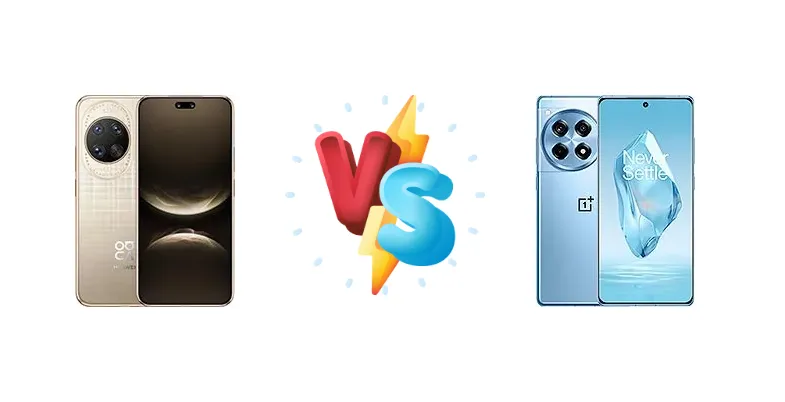
The Huawei nova 14 Ultra and OnePlus 12R represent compelling options in a crowded Android market. The nova 14 Ultra aims for a premium experience with its proprietary Kirin 8020 chipset, while the OnePlus 12R leverages the proven power of the Snapdragon 8 Gen 2, offering a balance of performance and value. This comparison dissects their key differences to determine which device best suits your needs.
🏆 Quick Verdict
For most users, the OnePlus 12R emerges as the stronger choice. Its Snapdragon 8 Gen 2 chipset delivers significantly higher performance, backed by a robust 14:32h active use battery life and 100W charging. While the nova 14 Ultra may appeal to those invested in the Huawei ecosystem, the 12R offers a more compelling overall package.
| Network |
|---|
| 2G bands | GSM 850 / 900 / 1800 / 1900 | GSM 850 / 900 / 1800 / 1900 |
| 3G bands | HSDPA 800 / 850 / 900 / 1700(AWS) / 1900 / 2100 | HSDPA 850 / 900 / 1700(AWS) / 1900 / 2100 |
| 4G bands | LTE | 1, 2, 3, 4, 5, 7, 8, 12, 17, 18, 19, 20, 26, 28, 32, 38, 39, 40, 41, 66 |
| 5G bands | SA/NSA | 1, 2, 3, 5, 7, 8, 12, 20, 28, 38, 40, 41, 66, 77, 78 SA/NSA |
| Speed | HSPA, LTE, 5G | HSPA, LTE, 5G |
| Technology | GSM / CDMA / HSPA / CDMA2000 / LTE / 5G | GSM / CDMA / HSPA / LTE / 5G |
| Launch |
|---|
| Announced | 2025, May 19 | 2024, January 23 |
| Status | Available. Released 2025, May 19 | Available. Released 2024, February 06 |
| Body |
|---|
| Build | - | Glass front (Gorilla Glass Victus 2), aluminum frame, glass back |
| Dimensions | 163.4 x 75.6 x 7.8 mm (6.43 x 2.98 x 0.31 in) | 163.3 x 75.3 x 8.8 mm (6.43 x 2.96 x 0.35 in) |
| SIM | Nano-SIM + Nano-SIM | · Nano-SIM + Nano-SIM + eSIM (max 2 at a time)· Nano-SIM + Nano-SIM |
| Weight | 204 g (7.20 oz) | 207 g (7.30 oz) |
| Display |
|---|
| Protection | Kunlun Glass | Corning Gorilla Glass Victus 2 |
| Resolution | 1272 x 2860 pixels, 20:9 ratio (~460 ppi density) | 1264 x 2780 pixels (~450 ppi density) |
| Size | 6.81 inches, 111.1 cm2 (~89.9% screen-to-body ratio) | 6.78 inches, 111.7 cm2 (~90.9% screen-to-body ratio) |
| Type | LTPO3 OLED, 1B colors, HDR, 120Hz, 5500 nits (peak) | LTPO4 AMOLED, 1B colors, 120Hz, HDR10+, Dolby Vision, 1600 nits (HBM), 4500 nits (peak) |
| Platform |
|---|
| CPU | Octa-core (1x2.29 GHz & 3x2.05 GHz & 4x1.3 GHz) | Octa-core (1x3.2 GHz Cortex-X3 & 2x2.8 GHz Cortex-A715 & 2x2.8 GHz Cortex-A710 & 3x2.0 GHz Cortex-A510) |
| Chipset | Kirin 8020 | Qualcomm SM8550-AB Snapdragon 8 Gen 2 (4 nm) |
| GPU | Maleoon 920 2cu | Adreno 740 |
| OS | HarmonyOS 5.0 | Android 14, up to 3 major Android upgrades, OxygenOS 15 |
| Memory |
|---|
| Card slot | No | No |
| Internal | 256GB 12GB RAM, 512GB 12GB RAM, 1TB 12GB RAM | 128GB 8GB RAM, 256GB 8GB RAM, 256GB 12GB RAM, 256GB 16GB RAM |
| Main Camera |
|---|
| Features | Laser AF, color spectrum sensor, Dual-LED flash, panorama, HDR | Laser AF, color spectrum sensor, LED flash, HDR, panorama |
| Triple | 50 MP, f/1.4-4.0, 24mm (wide), PDAF, OIS
50 MP, f/2.2, 88mm (periscope telephoto), PDAF, OIS, 3.7x optical zoom
13 MP, f/2.2, 13mm, 120˚ (ultrawide), AF | 50 MP, f/1.8, 24mm (wide), 1/1.56", 1.0µm, multi-directional PDAF, OIS
8 MP, f/2.2, 16mm, 112˚ (ultrawide), 1/4.0", 1.12µm
2 MP (macro) |
| Video | 4K, 1080p, gyro-EIS, HDR Vivid | 4K@30/60fps, 1080p@30/60/120/240fps, gyro-EIS, OIS |
| Selfie camera |
|---|
| Dual | 8 MP, f/2.2, 52mm (telephoto), AF, 2x optical zoom
50 MP, f/2.0, (ultrawide), 1/2.5", Dual Pixel PDAF | - |
| Features | HDR, panorama | HDR, panorama |
| Single | - | 16 MP, f/2.4, 26mm (wide), 1/3", 1.0µm |
| Video | 4K, 1080p, gyro-EIS, HDR Vivid | 1080p@30fps, gyro-EIS |
| Sound |
|---|
| 35mm jack | No | No |
| Loudspeaker | Yes, with stereo speakers | Yes, with stereo speakers |
| Comms |
|---|
| Bluetooth | 5.2, A2DP, LE, L2HC (320-960 kbps HD audio) | 5.3, A2DP, LE, aptX HD |
| Infrared port | Yes | Yes |
| NFC | Yes | Yes |
| Positioning | GPS (L1+L5), GLONASS (L1), BDS (B1I+B1c+B2a+B2b), GALILEO (E1+E5a+E5b), QZSS (L1+L5), NavIC | GPS, GALILEO, GLONASS, BDS, QZSS |
| Radio | No | No |
| USB | USB Type-C 2.0, OTG | USB Type-C 2.0 |
| WLAN | Wi-Fi 802.11 a/b/g/n/ac/6/7, dual-band, Wi-Fi Direct | Wi-Fi 802.11 a/b/g/n/ac/6/7, dual-band |
| Features |
|---|
| Sensors | Fingerprint (under display, optical), accelerometer, gyro, compass | Fingerprint (under display, optical), accelerometer, gyro, proximity, compass |
| Battery |
|---|
| Charging | 100W wired, SCP, UFCS, PD, PPS, QC
5W reverse wired | 100W wired, 100% in 26 min |
| Type | 5500 mAh | Li-Ion 5500 mAh |
| Misc |
|---|
| Colors | Black, White, Purple, Gold | Iron Gray, Cool Blue, Electric Violet, Sunset Dune |
| Models | MRT-AL10 | CPH2609, CPH2585, CPH2611 |
| Price | About 520 EUR | € 410.84 / $ 399.95 / £ 649.00 |
| SAR | - | 1.19 W/kg (head) 0.82 W/kg (body) |
Huawei nova 14 Ultra
- Fast 100W charging with multiple protocols (SCP, UFCS, PD, PPS, QC)
- Potential for strong computational photography (based on Huawei’s history)
- Huawei ecosystem integration
- Kirin 8020 chipset is less powerful than Snapdragon 8 Gen 2
- Limited information on display specifications
- Potential software restrictions due to geopolitical factors
OnePlus 12R
- Snapdragon 8 Gen 2 delivers exceptional performance
- Excellent 14:32h active use battery life
- 1181 nits peak brightness for outdoor visibility
- Display lacks LTPO for variable refresh rate efficiency
- OxygenOS may not appeal to all users
- Camera performance may not match Huawei’s computational photography
Display Comparison
The OnePlus 12R boasts a display capable of reaching 1181 nits of peak brightness, ensuring excellent visibility even in direct sunlight. While the nova 14 Ultra’s display specifications are currently unavailable, Huawei typically employs OLED panels with vibrant colors. The 12R’s brightness advantage is a tangible benefit for outdoor use. The absence of LTPO technology in the 12R, however, means it may not be as power-efficient as some competing displays when running at lower refresh rates, but the high peak brightness is a significant advantage.
Camera Comparison
Without detailed camera specifications for the nova 14 Ultra, a direct comparison is limited. However, Huawei historically focuses on computational photography and large sensor sizes. The OnePlus 12R’s camera system, while capable, likely won’t match Huawei’s image processing prowess without knowing the nova 14 Ultra’s sensor details. The absence of information regarding OIS on either device makes it difficult to assess low-light performance. It's reasonable to assume Huawei will emphasize software enhancements, while OnePlus will lean towards a more natural image profile.
Performance
The core difference lies in the chipsets. The OnePlus 12R’s Snapdragon 8 Gen 2 (4nm) is a powerhouse, featuring a Cortex-X3 prime core clocked at 3.2 GHz. This contrasts with the Huawei nova 14 Ultra’s Kirin 8020, an octa-core processor with a lower peak clock speed of 2.29 GHz. The Snapdragon 8 Gen 2’s 4nm process node provides superior thermal efficiency, minimizing throttling during sustained workloads like gaming. The 12R’s CPU architecture (Cortex-X3, A715, A710, A510) is also more modern and efficient than the Kirin 8020’s configuration, translating to faster application loading and smoother multitasking.
Battery Life
The OnePlus 12R shines in battery life, achieving an impressive 14 hours and 32 minutes of active use. Both devices support 100W wired charging, with the 12R reaching a full charge in just 26 minutes. The nova 14 Ultra also offers 5W reverse wired charging, a convenient feature for topping up accessories. While the nova 14 Ultra’s battery capacity is unknown, the 12R’s long-lasting battery, combined with its rapid charging speed, provides a significant advantage for users who prioritize all-day power.
Buying Guide
Buy the Huawei nova 14 Ultra if you prioritize a unique software experience within the Huawei ecosystem and value fast charging protocols like SCP and UFCS alongside PD and PPS. Buy the OnePlus 12R if you demand top-tier performance for gaming and demanding applications, coupled with excellent battery life and a more open Android experience. The 12R is the clear choice for power users.
Frequently Asked Questions
❓ Does the Kirin 8020 in the nova 14 Ultra struggle with demanding games like Genshin Impact?
The Kirin 8020 is a capable chipset, but the Snapdragon 8 Gen 2 in the OnePlus 12R offers a substantial performance advantage. Expect lower frame rates and potential throttling in graphically intensive games on the nova 14 Ultra, especially during extended play sessions.
❓ How does the 100W charging on the nova 14 Ultra compare to the OnePlus 12R in real-world usage?
Both phones support 100W charging, but the OnePlus 12R is confirmed to reach 100% in 26 minutes. While the nova 14 Ultra supports multiple charging protocols (SCP, UFCS, PD, PPS, QC), the actual charging speed will depend on the charger and cable used. Expect similar charging times, but the 12R’s consistency is a plus.
❓ Is the lack of Google Mobile Services (GMS) on the Huawei nova 14 Ultra a significant drawback?
Yes, the absence of GMS is a major consideration. The nova 14 Ultra relies on Huawei Mobile Services (HMS) and the AppGallery. While HMS is improving, app availability and compatibility may be limited compared to devices with GMS. Users heavily reliant on Google apps may find the experience frustrating.