
Huawei nova 14 Ultra vs Google Pixel 8 Pro: A Deep Dive into Speed, AI, and Photography
| Phones Images | |||||
|---|---|---|---|---|---|
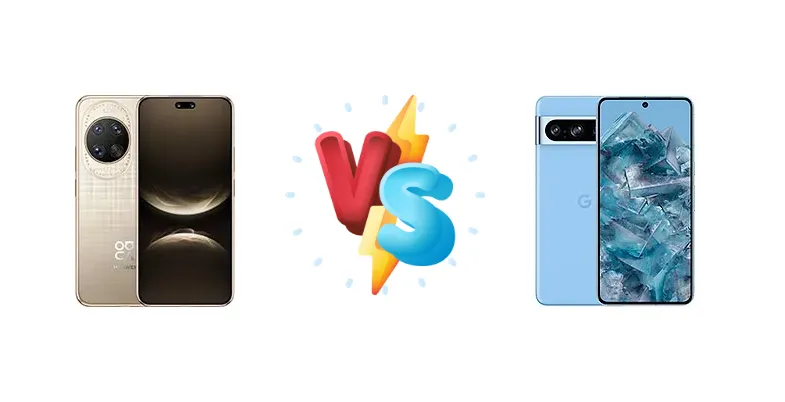
|
🏆 Quick Verdict
For users prioritizing blazing-fast charging and a potentially more versatile camera system, the Huawei nova 14 Ultra is the winner. However, the Google Pixel 8 Pro’s superior software experience, longer battery endurance, and refined AI features make it the better choice for those deeply integrated into the Google ecosystem.
| PHONES | ||
|---|---|---|
| Phone Names | Huawei nova 14 Ultra | Google Pixel 8 Pro |
| Network | ||
|---|---|---|
| 2G bands | GSM 850 / 900 / 1800 / 1900 | GSM 850 / 900 / 1800 / 1900 |
| 3G bands | HSDPA 800 / 850 / 900 / 1700(AWS) / 1900 / 2100 | HSDPA 800 / 850 / 900 / 1700(AWS) / 1900 / 2100 |
| 4G bands | LTE | 1, 2, 3, 4, 5, 7, 8, 12, 13, 14, 17, 18, 19, 20, 25, 26, 28, 29, 30, 38, 39, 40, 41, 46, 48, 66, 71 - G1MNW |
| 5G bands | SA/NSA | 1, 2, 3, 5, 7, 8, 12, 20, 25, 26, 28, 29, 30, 38, 40, 41, 48, 66, 70, 71, 77, 78, 257, 258, 260, 261 SA/NSA/Sub6/mmWave - G1MNW |
| Speed | HSPA, LTE, 5G | HSPA, LTE, 5G |
| Technology | GSM / CDMA / HSPA / CDMA2000 / LTE / 5G | GSM / HSPA / LTE / 5G |
| Launch | ||
|---|---|---|
| Announced | 2025, May 19 | 2023, October 04 |
| Status | Available. Released 2025, May 19 | Available. Released 2023, October 12 |
| Body | ||
|---|---|---|
| Build | - | Glass front (Gorilla Glass Victus 2), glass back (Gorilla Glass Victus 2), aluminum frame |
| Dimensions | 163.4 x 75.6 x 7.8 mm (6.43 x 2.98 x 0.31 in) | 162.6 x 76.5 x 8.8 mm (6.40 x 3.01 x 0.35 in) |
| SIM | Nano-SIM + Nano-SIM | Nano-SIM + eSIM |
| Weight | 204 g (7.20 oz) | 213 g (7.51 oz) |
| Display | ||
|---|---|---|
| Protection | Kunlun Glass | Corning Gorilla Glass Victus 2 |
| Resolution | 1272 x 2860 pixels, 20:9 ratio (~460 ppi density) | 1344 x 2992 pixels, 20:9 ratio (~489 ppi density) |
| Size | 6.81 inches, 111.1 cm2 (~89.9% screen-to-body ratio) | 6.7 inches, 108.7 cm2 (~87.4% screen-to-body ratio) |
| Type | LTPO3 OLED, 1B colors, HDR, 120Hz, 5500 nits (peak) | LTPO OLED, 120Hz, HDR10+, 1600 nits (HBM), 2400 nits (peak) |
| Platform | ||
|---|---|---|
| CPU | Octa-core (1x2.29 GHz & 3x2.05 GHz & 4x1.3 GHz) | Nona-core (1x3.0 GHz Cortex-X3 & 4x2.45 GHz Cortex-A715 & 4x2.15 GHz Cortex-A510) |
| Chipset | Kirin 8020 | Google Tensor G3 (4 nm) |
| GPU | Maleoon 920 2cu | Immortalis-G715s MC10 |
| OS | HarmonyOS 5.0 | Android 14, upgradable to Android 16, up to 7 major Android upgrades |
| Memory | ||
|---|---|---|
| Card slot | No | No |
| Internal | 256GB 12GB RAM, 512GB 12GB RAM, 1TB 12GB RAM | 128GB 12GB RAM, 256GB 12GB RAM, 512GB 12GB RAM, 1TB 12GB RAM |
| Main Camera | ||
|---|---|---|
| Features | Laser AF, color spectrum sensor, Dual-LED flash, panorama, HDR | Multi-zone Laser AF, Dual-LED flash, Pixel Shift, Ultra-HDR, panorama, Best Take, Zoom Enhance |
| Triple | 50 MP, f/1.4-4.0, 24mm (wide), PDAF, OIS 50 MP, f/2.2, 88mm (periscope telephoto), PDAF, OIS, 3.7x optical zoom 13 MP, f/2.2, 13mm, 120˚ (ultrawide), AF | 50 MP, f/1.7, 25mm (wide), 1/1.31", 1.2µm, dual pixel PDAF, OIS 48 MP, f/2.8, 113mm (periscope telephoto), 1/2.55", 0.7µm, dual pixel PDAF, OIS, 5x optical zoom 48 MP, f/2.0, 126˚ (ultrawide), 1/2.0", 0.8µm, dual pixel PDAF |
| Video | 4K, 1080p, gyro-EIS, HDR Vivid | 4K@30/60fps, 1080p@24/30/60/120/240fps; gyro-EIS, OIS, 10-bit HDR |
| Selfie camera | ||
|---|---|---|
| Dual | 8 MP, f/2.2, 52mm (telephoto), AF, 2x optical zoom 50 MP, f/2.0, (ultrawide), 1/2.5", Dual Pixel PDAF | - |
| Features | HDR, panorama | HDR, panorama |
| Single | - | 10.5 MP, f/2.2, 20mm (ultrawide), 1/3.1", 1.22µm, PDAF |
| Video | 4K, 1080p, gyro-EIS, HDR Vivid | 4K@24/30/60fps, 1080p@30/60fps |
| Sound | ||
|---|---|---|
| 35mm jack | No | No |
| Loudspeaker | Yes, with stereo speakers | Yes, with stereo speakers |
| Comms | ||
|---|---|---|
| Bluetooth | 5.2, A2DP, LE, L2HC (320-960 kbps HD audio) | 5.3, A2DP, LE, aptX HD |
| Infrared port | Yes | - |
| NFC | Yes | Yes |
| Positioning | GPS (L1+L5), GLONASS (L1), BDS (B1I+B1c+B2a+B2b), GALILEO (E1+E5a+E5b), QZSS (L1+L5), NavIC | GPS (L1+L5), GLONASS (G1), GALILEO (E1+E5a), QZSS (L1+L5) |
| Radio | No | No |
| USB | USB Type-C 2.0, OTG | USB Type-C 3.2 |
| WLAN | Wi-Fi 802.11 a/b/g/n/ac/6/7, dual-band, Wi-Fi Direct | Wi-Fi 802.11 a/b/g/n/ac/6e/7, tri-band, Wi-Fi Direct |
| Features | ||
|---|---|---|
| Sensors | Fingerprint (under display, optical), accelerometer, gyro, compass | Fingerprint (under display, optical), accelerometer, gyro, proximity, compass, barometer, thermometer (skin temperature) |
| Battery | ||
|---|---|---|
| Charging | 100W wired, SCP, UFCS, PD, PPS, QC 5W reverse wired | 30W wired, PD3.0, PPS, 50% in 30 min 23W wireless Reverse wireless Bypass charging |
| Type | 5500 mAh | Li-Ion 5050 mAh |
| Misc | ||
|---|---|---|
| Colors | Black, White, Purple, Gold | Obsidian, Porcelain, Bay, Mint |
| Models | MRT-AL10 | GC3VE, G1MNW |
| Price | About 520 EUR | € 362.00 / $ 289.97 / £ 329.95 / ₹ 54,999 |
Huawei nova 14 Ultra
- 100W wired charging is significantly faster than the competition.
- Potentially more versatile camera system with advanced zoom capabilities.
- Feature-rich software experience with Huawei’s customizations.
- Kirin 8020 chipset may not match the Tensor G3 in AI performance.
- Software support and updates may be less consistent than Google’s.
Google Pixel 8 Pro
- Exceptional camera quality with Google’s computational photography.
- Long-term software support and guaranteed updates from Google.
- Superior AI features and integration with the Google ecosystem.
- 30W charging is slower than the nova 14 Ultra’s 100W charging.
- May lack some of the niche features found on the Huawei nova 14 Ultra.
Display Comparison
The Pixel 8 Pro boasts a measured peak brightness of 1600 nits, ensuring excellent visibility even in direct sunlight. While the nova 14 Ultra’s display specs are not provided, Huawei typically employs OLED panels with vibrant colors. The Pixel 8 Pro’s display technology is likely LTPO, enabling variable refresh rates for improved power efficiency. Without knowing the nova 14 Ultra’s refresh rate, it’s difficult to assess its efficiency. The Pixel 8 Pro’s higher peak brightness is a clear advantage for outdoor use.
Camera Comparison
The Pixel 8 Pro is renowned for its computational photography prowess, leveraging Google’s AI algorithms to produce stunning images. While specific sensor details aren’t provided for the nova 14 Ultra, Huawei often emphasizes high megapixel counts and advanced zoom capabilities. The Pixel 8 Pro’s image processing excels in dynamic range and color accuracy. The nova 14 Ultra’s camera system likely prioritizes versatility with multiple lenses and potentially higher zoom levels. The Pixel 8 Pro’s video capabilities are also highly regarded, benefiting from advanced stabilization and cinematic modes.
Performance
The Google Pixel 8 Pro’s Google Tensor G3, a 4nm chip with a nona-core CPU configuration (1x3.0 GHz Cortex-X3, 4x2.45 GHz Cortex-A715, 4x2.15 GHz Cortex-A510), is designed for on-device AI processing. The Huawei nova 14 Ultra utilizes the Kirin 8020, an octa-core processor (1x2.29 GHz & 3x2.05 GHz & 4x1.3 GHz). While clock speeds don’t tell the whole story, the Tensor G3’s Cortex-X3 core suggests superior peak performance. The 4nm process node of the Tensor G3 also implies better thermal efficiency compared to the Kirin 8020, potentially leading to less throttling during sustained workloads. The Pixel 8 Pro’s focus on AI tasks will benefit users who heavily utilize features like Magic Eraser and real-time translation.
Battery Life
The Google Pixel 8 Pro achieves an impressive 11:14h of active use and an endurance rating of 90 hours, indicating excellent battery life. The Huawei nova 14 Ultra compensates for a potentially smaller battery with its 100W wired charging, significantly faster than the Pixel 8 Pro’s 30W charging (50% in 30 minutes). The nova 14 Ultra also offers 5W reverse wired charging, while the Pixel 8 Pro provides 23W wireless charging and reverse wireless charging. The nova 14 Ultra’s charging speed is a major advantage for users who need to quickly top up their battery, while the Pixel 8 Pro offers superior overall endurance.
Buying Guide
Buy the Huawei nova 14 Ultra if you need the absolute fastest charging available, frequently capture photos and videos, and value a feature-packed experience. Buy the Google Pixel 8 Pro if you prefer a seamless software experience, prioritize long-term software support, and want a phone that excels in computational photography and AI-powered features.