
Huawei nova 14 Ultra vs. Apple iPhone 15 Pro Max: A Deep Dive Comparison
| Phones Images | |||||
|---|---|---|---|---|---|
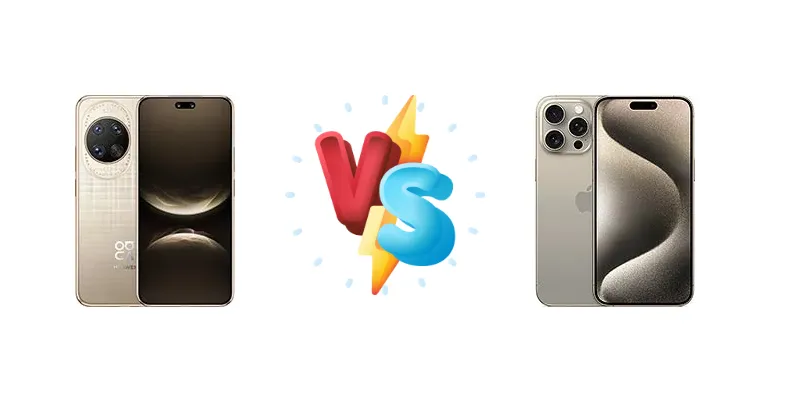
|
🏆 Quick Verdict
For the average user prioritizing long-term software support, ecosystem integration, and consistently excellent performance, the Apple iPhone 15 Pro Max is the superior choice. However, the Huawei nova 14 Ultra’s blazing-fast 100W charging and potentially more aggressive pricing make it a strong contender for those seeking rapid power-ups and aren't tied to the Apple ecosystem.
| PHONES | ||
|---|---|---|
| Phone Names | Huawei nova 14 Ultra | Apple iPhone 15 Pro Max |
| Network | ||
|---|---|---|
| 2G bands | GSM 850 / 900 / 1800 / 1900 | GSM 850 / 900 / 1800 / 1900 |
| 3G bands | HSDPA 800 / 850 / 900 / 1700(AWS) / 1900 / 2100 | HSDPA 850 / 900 / 1700(AWS) / 1900 / 2100 |
| 4G bands | LTE | 1, 2, 3, 4, 5, 7, 8, 12, 13, 17, 18, 19, 20, 25, 26, 28, 30, 32, 34, 38, 39, 40, 41, 42, 46, 48, 53, 66 - A3106 |
| 5G bands | SA/NSA | 1, 2, 3, 5, 7, 8, 12, 20, 25, 26, 28, 30, 38, 40, 41, 48, 53, 66, 70, 77, 78, 79 SA/NSA/Sub6 - A3106 |
| Speed | HSPA, LTE, 5G | HSPA, LTE, 5G, EV-DO Rev.A 3.1 Mbps |
| Technology | GSM / CDMA / HSPA / CDMA2000 / LTE / 5G | GSM / CDMA / HSPA / EVDO / LTE / 5G |
| Launch | ||
|---|---|---|
| Announced | 2025, May 19 | 2023, September 12 |
| Status | Available. Released 2025, May 19 | Available. Released 2023, September 22 |
| Body | ||
|---|---|---|
| Build | - | Glass front, glass back, titanium frame (grade 5) |
| Dimensions | 163.4 x 75.6 x 7.8 mm (6.43 x 2.98 x 0.31 in) | 159.9 x 76.7 x 8.3 mm (6.30 x 3.02 x 0.33 in) |
| SIM | Nano-SIM + Nano-SIM | · Nano-SIM + eSIM + eSIM (max 2 at a time; International)· eSIM + eSIM (8 or more, max 2 at a time; USA)· Nano-SIM + Nano-SIM (China) |
| Weight | 204 g (7.20 oz) | 221 g (7.80 oz) |
| Display | ||
|---|---|---|
| Protection | Kunlun Glass | Ceramic Shield glass |
| Resolution | 1272 x 2860 pixels, 20:9 ratio (~460 ppi density) | 1290 x 2796 pixels, 19.5:9 ratio (~460 ppi density) |
| Size | 6.81 inches, 111.1 cm2 (~89.9% screen-to-body ratio) | 6.7 inches, 110.2 cm2 (~89.8% screen-to-body ratio) |
| Type | LTPO3 OLED, 1B colors, HDR, 120Hz, 5500 nits (peak) | LTPO Super Retina XDR OLED, 120Hz, HDR10, Dolby Vision, 1000 nits (typ), 2000 nits (HBM) |
| Platform | ||
|---|---|---|
| CPU | Octa-core (1x2.29 GHz & 3x2.05 GHz & 4x1.3 GHz) | Hexa-core (2x3.78 GHz + 4x2.11 GHz) |
| Chipset | Kirin 8020 | Apple A17 Pro (3 nm) |
| GPU | Maleoon 920 2cu | Apple GPU (6-core graphics) |
| OS | HarmonyOS 5.0 | iOS 17, upgradable to iOS 26.1 |
| Memory | ||
|---|---|---|
| Card slot | No | No |
| Internal | 256GB 12GB RAM, 512GB 12GB RAM, 1TB 12GB RAM | 256GB 8GB RAM, 512GB 8GB RAM, 1TB 8GB RAM |
| Main Camera | ||
|---|---|---|
| Features | Laser AF, color spectrum sensor, Dual-LED flash, panorama, HDR | Dual-LED dual-tone flash, HDR (photo/panorama) |
| Triple | 50 MP, f/1.4-4.0, 24mm (wide), PDAF, OIS 50 MP, f/2.2, 88mm (periscope telephoto), PDAF, OIS, 3.7x optical zoom 13 MP, f/2.2, 13mm, 120˚ (ultrawide), AF | 48 MP, f/1.8, 24mm (wide), 1/1.28", 1.22µm, dual pixel PDAF, sensor-shift OIS 12 MP, f/2.8, 120mm (periscope telephoto), 1/3.06", 1.12µm, dual pixel PDAF, 3D sensor‑shift OIS, 5x optical zoom 12 MP, f/2.2, 13mm, 120˚ (ultrawide), 1/2.55", 1.4µm, dual pixel PDAF TOF 3D LiDAR scanner (depth) |
| Video | 4K, 1080p, gyro-EIS, HDR Vivid | 4K@24/25/30/60fps, 1080p@25/30/60/120/240fps, 10-bit HDR, Dolby Vision HDR (up to 60fps), ProRes, 3D (spatial) video, stereo sound rec. |
| Selfie camera | ||
|---|---|---|
| Dual | 8 MP, f/2.2, 52mm (telephoto), AF, 2x optical zoom 50 MP, f/2.0, (ultrawide), 1/2.5", Dual Pixel PDAF | - |
| Features | HDR, panorama | HDR, Dolby Vision HDR |
| Single | - | 12 MP, f/1.9, 23mm (wide), 1/3.6", 1.0µm, PDAF, OIS SL 3D, (depth/biometrics sensor) |
| Video | 4K, 1080p, gyro-EIS, HDR Vivid | 4K@24/25/30/60fps, 1080p@25/30/60/120fps, gyro-EIS |
| Sound | ||
|---|---|---|
| 35mm jack | No | No |
| Loudspeaker | Yes, with stereo speakers | Yes, with stereo speakers |
| Comms | ||
|---|---|---|
| Bluetooth | 5.2, A2DP, LE, L2HC (320-960 kbps HD audio) | 5.3, A2DP, LE |
| Infrared port | Yes | - |
| NFC | Yes | Yes |
| Positioning | GPS (L1+L5), GLONASS (L1), BDS (B1I+B1c+B2a+B2b), GALILEO (E1+E5a+E5b), QZSS (L1+L5), NavIC | GPS (L1+L5), GLONASS, GALILEO, BDS, QZSS, NavIC |
| Radio | No | No |
| USB | USB Type-C 2.0, OTG | USB Type-C 3.2 Gen 2, DisplayPort |
| WLAN | Wi-Fi 802.11 a/b/g/n/ac/6/7, dual-band, Wi-Fi Direct | Wi-Fi 802.11 a/b/g/n/ac/6e, tri-band, hotspot |
| Features | ||
|---|---|---|
| Sensors | Fingerprint (under display, optical), accelerometer, gyro, compass | Face ID, accelerometer, gyro, proximity, compass, barometer |
| Battery | ||
|---|---|---|
| Charging | 100W wired, SCP, UFCS, PD, PPS, QC 5W reverse wired | Wired, PD2.0, 50% in 30 min 15W wireless (MagSafe) 15W wireless (Qi2) - requires iOS 17.2 update 4.5W reverse wired |
| Type | 5500 mAh | Li-Ion 4441 mAh |
| Misc | ||
|---|---|---|
| Colors | Black, White, Purple, Gold | Black Titanium, White Titanium, Blue Titanium, Natural Titanium |
| Models | MRT-AL10 | A2849, A3105, A3106, A3108, iPhone16,2 |
| Price | About 520 EUR | € 758.79 / $ 579.87 / £ 628.29 |
| SAR | - | 1.07 W/kg (head) 1.11 W/kg (body) |
| SAR EU | - | 0.98 W/kg (head) 0.98 W/kg (body) |
Huawei nova 14 Ultra
- 100W SuperCharge for incredibly fast charging
- Potentially more affordable price point
- Open Android ecosystem with customization options
- Software support and updates may be limited
- Chipset performance lags behind the A17 Pro
- Camera performance may be inconsistent compared to iPhone
Apple iPhone 15 Pro Max
- Industry-leading A17 Pro processor for exceptional performance
- Long-term software support and updates
- Excellent camera system with advanced video capabilities
- Slower charging speeds compared to Huawei
- Higher price tag
- Closed ecosystem with limited customization
Display Comparison
The iPhone 15 Pro Max boasts a peak brightness of 1787 nits, ensuring excellent visibility even in direct sunlight. While the nova 14 Ultra’s display specs aren’t provided, Huawei typically employs OLED panels with vibrant colors. The iPhone’s ProMotion technology (LTPO) dynamically adjusts the refresh rate up to 120Hz for smoother scrolling and animations, a feature likely absent on the nova 14 Ultra. The iPhone’s superior brightness and adaptive refresh rate provide a more fluid and visually engaging experience.
Camera Comparison
Without detailed camera specs for the nova 14 Ultra, a direct comparison is challenging. However, Huawei historically focuses on high-megapixel sensors and advanced computational photography. The iPhone 15 Pro Max excels in both photo and video capture, leveraging its advanced image processing pipeline and sensor-shift optical image stabilization. The iPhone’s video capabilities are particularly strong, offering ProRes recording and cinematic mode. While the nova 14 Ultra may offer unique camera features, the iPhone 15 Pro Max provides a more consistently reliable and polished camera experience.
Performance
The core difference lies in the chipsets: Apple’s A17 Pro (3nm) versus Huawei’s Kirin 8020. The A17 Pro’s 3nm process offers significant efficiency gains and raw power, evidenced by its hexa-core CPU configuration with peak clock speeds of 3.78 GHz. The Kirin 8020, while an octa-core processor, operates at lower clock speeds (up to 2.29 GHz). This translates to a noticeable performance advantage for the iPhone 15 Pro Max in demanding tasks like video rendering and graphically intensive games. The iPhone’s LPDDR5X RAM further enhances performance, while the nova 14 Ultra’s RAM specification is unknown, potentially impacting multitasking capabilities.
Battery Life
The iPhone 15 Pro Max delivers an impressive 16:01 hours of active use, backed by an endurance rating of 118 hours. The nova 14 Ultra’s battery capacity is unknown, but its 100W wired charging is a significant advantage. This allows for a full charge in a fraction of the time compared to the iPhone’s wired charging (50% in 30 minutes). The nova 14 Ultra also offers 5W reverse wired charging, while the iPhone provides 15W wireless charging via MagSafe and Qi2 (requiring iOS 17.2). The nova 14 Ultra prioritizes charging speed, while the iPhone focuses on overall battery endurance.
Buying Guide
Buy the Huawei nova 14 Ultra if you need exceptionally fast charging – 100W is a game-changer for minimizing downtime – and prefer a more open Android experience. You’ll also likely benefit if you prioritize camera versatility and are comfortable with potential software limitations. Buy the Apple iPhone 15 Pro Max if you prefer a seamless, polished user experience, guaranteed software updates for years to come, and a powerful processor optimized for demanding tasks like video editing and gaming, all within a tightly integrated ecosystem.