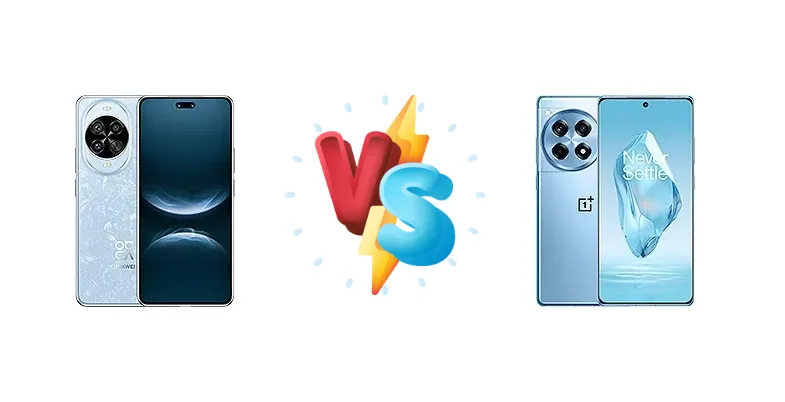
The Huawei nova 14 Pro and OnePlus 12R represent compelling options in the increasingly competitive mid-range smartphone market. The nova 14 Pro brings Huawei’s in-house Kirin 8020 chipset to the table, while the 12R leverages the proven power of Qualcomm’s Snapdragon 8 Gen 2. This comparison dissects their key differences to determine which device delivers the best overall experience.
🏆 Quick Verdict
For most users, the OnePlus 12R emerges as the stronger choice. Its Snapdragon 8 Gen 2 chipset provides significantly superior processing power and GPU performance, translating to smoother multitasking and a better gaming experience. While the nova 14 Pro offers competitive charging, the 12R’s combination of performance and battery life is more compelling.
| Network |
|---|
| 2G bands | GSM 850 / 900 / 1800 / 1900 | GSM 850 / 900 / 1800 / 1900 |
| 3G bands | HSDPA 800 / 850 / 900 / 1700(AWS) / 1900 / 2100 | HSDPA 850 / 900 / 1700(AWS) / 1900 / 2100 |
| 4G bands | LTE | 1, 2, 3, 4, 5, 7, 8, 12, 17, 18, 19, 20, 26, 28, 32, 38, 39, 40, 41, 66 |
| 5G bands | SA/NSA | 1, 2, 3, 5, 7, 8, 12, 20, 28, 38, 40, 41, 66, 77, 78 SA/NSA |
| Speed | HSPA, LTE, 5G | HSPA, LTE, 5G |
| Technology | GSM / CDMA / HSPA / CDMA2000 / LTE / 5G | GSM / CDMA / HSPA / LTE / 5G |
| Launch |
|---|
| Announced | 2025, May 19 | 2024, January 23 |
| Status | Available. Released 2025, May 19 | Available. Released 2024, February 06 |
| Body |
|---|
| Build | - | Glass front (Gorilla Glass Victus 2), aluminum frame, glass back |
| Dimensions | 163.4 x 75 x 7.8 mm (6.43 x 2.95 x 0.31 in) | 163.3 x 75.3 x 8.8 mm (6.43 x 2.96 x 0.35 in) |
| SIM | Nano-SIM + Nano-SIM | · Nano-SIM + Nano-SIM + eSIM (max 2 at a time)· Nano-SIM + Nano-SIM |
| Weight | 207 g (7.30 oz) | 207 g (7.30 oz) |
| Display |
|---|
| Protection | Aluminosilicate glass (256/512GB); Kunlun Glass edition (512GB only) | Corning Gorilla Glass Victus 2 |
| Resolution | 1224 x 2776 pixels (~447 ppi density) | 1264 x 2780 pixels (~450 ppi density) |
| Size | 6.78 inches, 109.5 cm2 (~89.3% screen-to-body ratio) | 6.78 inches, 111.7 cm2 (~90.9% screen-to-body ratio) |
| Type | LTPO OLED, 1B colors, HDR, 120Hz, 1200 nits (HBM) | LTPO4 AMOLED, 1B colors, 120Hz, HDR10+, Dolby Vision, 1600 nits (HBM), 4500 nits (peak) |
| Platform |
|---|
| CPU | Octa-core (1x2.29 GHz & 3x2.05 GHz & 4x1.3 GHz) | Octa-core (1x3.2 GHz Cortex-X3 & 2x2.8 GHz Cortex-A715 & 2x2.8 GHz Cortex-A710 & 3x2.0 GHz Cortex-A510) |
| Chipset | Kirin 8020 | Qualcomm SM8550-AB Snapdragon 8 Gen 2 (4 nm) |
| GPU | Maleoon 920 2cu | Adreno 740 |
| OS | HarmonyOS 5.0 | Android 14, up to 3 major Android upgrades, OxygenOS 15 |
| Memory |
|---|
| Card slot | No | No |
| Internal | 256GB 12GB RAM, 512GB 12GB RAM | 128GB 8GB RAM, 256GB 8GB RAM, 256GB 12GB RAM, 256GB 16GB RAM |
| Main Camera |
|---|
| Features | Laser AF, color spectrum sensor, Dual-LED flash, panorama, HDR | Laser AF, color spectrum sensor, LED flash, HDR, panorama |
| Triple | 50 MP, f/1.4-4.0, 24mm (wide), PDAF, OIS
12 MP, f/2.4, 69mm (telephoto), PDAF, OIS, 3x optical zoom
8 MP, f/2.2, 16mm, 112˚ (ultrawide), AF | 50 MP, f/1.8, 24mm (wide), 1/1.56", 1.0µm, multi-directional PDAF, OIS
8 MP, f/2.2, 16mm, 112˚ (ultrawide), 1/4.0", 1.12µm
2 MP (macro) |
| Video | 4K, 1080p, gyro-EIS, HDR Vivid | 4K@30/60fps, 1080p@30/60/120/240fps, gyro-EIS, OIS |
| Selfie camera |
|---|
| Dual | 8 MP, f/2.2, 52mm (telephoto), AF, 2x optical zoom
50 MP, f/2.0, (ultrawide), PDAF | - |
| Features | HDR, panorama | HDR, panorama |
| Single | - | 16 MP, f/2.4, 26mm (wide), 1/3", 1.0µm |
| Video | 4K, 1080p, gyro-EIS, HDR Vivid | 1080p@30fps, gyro-EIS |
| Sound |
|---|
| 35mm jack | No | No |
| Loudspeaker | Yes, with stereo speakers | Yes, with stereo speakers |
| Comms |
|---|
| Bluetooth | 5.2, A2DP, LE, L2HC (320-960 kbps HD audio) | 5.3, A2DP, LE, aptX HD |
| Infrared port | Yes | Yes |
| NFC | Yes | Yes |
| Positioning | GPS (L1+L5), GLONASS (L1), BDS (B1I+B1c+B2a+B2b), GALILEO (E1+E5a+E5b), QZSS (L1+L5), NavIC | GPS, GALILEO, GLONASS, BDS, QZSS |
| Radio | No | No |
| USB | USB Type-C 2.0, OTG | USB Type-C 2.0 |
| WLAN | Wi-Fi 802.11 a/b/g/n/ac/6/7, dual-band, Wi-Fi Direct | Wi-Fi 802.11 a/b/g/n/ac/6/7, dual-band |
| Features |
|---|
| Sensors | Fingerprint (under display, optical), accelerometer, gyro, compass | Fingerprint (under display, optical), accelerometer, gyro, proximity, compass |
| Battery |
|---|
| Charging | 100W wired, SCP, UFCS, PD, PPS, QC
5W reverse wired | 100W wired, 100% in 26 min |
| Type | 5500 mAh | Li-Ion 5500 mAh |
| Misc |
|---|
| Colors | Black, White, Purple, Blue | Iron Gray, Cool Blue, Electric Violet, Sunset Dune |
| Models | MIA-AL00 | CPH2609, CPH2585, CPH2611 |
| Price | About 430 EUR | € 410.84 / $ 399.95 / £ 649.00 |
| SAR | - | 1.19 W/kg (head) 0.82 W/kg (body) |
Huawei nova 14 Pro
- Potentially faster transfer speeds within the Huawei ecosystem.
- Competitive 100W charging support.
- Huawei’s software optimizations (for those within the ecosystem).
- Kirin 8020 chipset is significantly less powerful than Snapdragon 8 Gen 2.
- Limited information on display specifications.
- Potential software restrictions due to geopolitical factors.
OnePlus 12R
- Snapdragon 8 Gen 2 delivers flagship-level performance.
- Excellent battery life (14:32h active use).
- Fast 100W charging (26 minutes to full).
- OxygenOS may not appeal to all users.
- Camera performance details are limited.
- May be slightly more expensive than the nova 14 Pro.
Display Comparison
The OnePlus 12R boasts a display capable of reaching 1181 nits of peak brightness, ensuring excellent visibility even in direct sunlight. While the nova 14 Pro’s display specifications are currently unavailable, Huawei typically employs OLED panels with vibrant colors. However, without knowing its peak brightness or refresh rate, the 12R holds a clear advantage in this category. The 12R’s panel likely benefits from the Snapdragon 8 Gen 2’s superior image signal processor for enhanced color accuracy and dynamic range.
Camera Comparison
Without detailed camera specifications for the nova 14 Pro, a direct comparison is challenging. However, Huawei historically focuses on computational photography. The OnePlus 12R’s camera system, while not explicitly detailed in the provided data, likely benefits from the Snapdragon 8 Gen 2’s advanced ISP for improved image processing. The absence of sensor size information for the nova 14 Pro makes it difficult to assess its low-light performance relative to the 12R. We can assume both phones will include standard wide, ultrawide, and potentially macro lenses, but the image quality will heavily depend on sensor size and software optimization.
Performance
The core difference lies in the chipsets. The OnePlus 12R’s Snapdragon 8 Gen 2 (4nm) is a flagship-level processor featuring a Cortex-X3 prime core clocked at 3.2 GHz, offering a substantial performance leap over the Huawei nova 14 Pro’s Kirin 8020. The Kirin 8020’s octa-core configuration, while capable, is built on a less efficient process and lacks the raw horsepower of the Snapdragon. This translates to faster app loading times, smoother multitasking, and significantly better gaming performance on the 12R. The 12R’s LPDDR5x RAM further enhances performance, while the Kirin 8020’s RAM specifications are unknown.
Battery Life
The OnePlus 12R shines in battery endurance, achieving an active use score of 14 hours and 32 minutes. Both devices support 100W wired charging, with the 12R reaching a full charge in just 26 minutes. The nova 14 Pro also supports SCP, UFCS, PD, PPS, and QC, offering broad compatibility, but the 12R’s faster charging speed and longer battery life provide a more convenient user experience. While the nova 14 Pro offers 5W reverse wired charging, the 12R’s battery capacity is unknown, making a direct comparison difficult.
Buying Guide
Buy the Huawei nova 14 Pro if you prioritize a sleek design and are deeply embedded within the Huawei ecosystem, benefiting from its software optimizations and potentially faster transfer speeds with Huawei devices. Buy the OnePlus 12R if you demand raw performance for gaming and demanding applications, coupled with excellent battery life and a more open Android experience. The 12R is the clear choice for power users.
Frequently Asked Questions
❓ Does the Kirin 8020 in the nova 14 Pro struggle with graphically intensive games like Genshin Impact?
Yes, the Kirin 8020 is likely to exhibit noticeable frame drops and throttling in demanding games like Genshin Impact, especially at higher settings. The Snapdragon 8 Gen 2 in the OnePlus 12R is far better equipped to handle such titles consistently, thanks to its more powerful GPU and efficient thermal design.
❓ Is the 100W charging on both phones equally effective in practice?
While both support 100W charging, the OnePlus 12R achieves a full charge in 26 minutes, suggesting a more optimized charging implementation. The nova 14 Pro’s charging speed may vary depending on the charger and cable used, and the presence of multiple charging standards (SCP, UFCS, PD, PPS, QC) could introduce slight inefficiencies.
❓ Will I experience significant software limitations using the Huawei nova 14 Pro outside of China?
Huawei phones have faced restrictions regarding Google Mobile Services (GMS) due to geopolitical factors. This means you may not have access to the full suite of Google apps and services without workarounds. The OnePlus 12R, running OxygenOS, offers a full Android experience with GMS readily available.
❓ How does the thermal management of the Snapdragon 8 Gen 2 in the OnePlus 12R compare to the Kirin 8020?
The Snapdragon 8 Gen 2, built on a 4nm process, is inherently more thermally efficient than the Kirin 8020. This means the OnePlus 12R is less likely to experience significant throttling during prolonged gaming sessions or demanding tasks, maintaining consistent performance for longer periods.