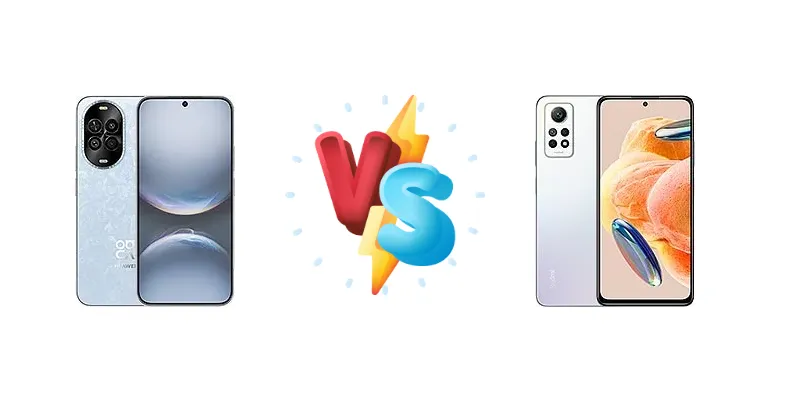
The Huawei nova 14 Lite and Xiaomi Redmi Note 12 Pro 4G represent compelling options in the crowded budget smartphone market. Both aim to deliver a premium experience without the flagship price tag, but they take different approaches. The nova 14 Lite focuses on rapid charging, while the Redmi Note 12 Pro 4G prioritizes a proven chipset and established software ecosystem. This comparison will dissect their strengths and weaknesses to determine which device offers the best value.
🏆 Quick Verdict
For the average user prioritizing consistent performance and a well-supported software experience, the Xiaomi Redmi Note 12 Pro 4G emerges as the better choice. Its Qualcomm Snapdragon 732G chipset provides a more reliable foundation for everyday tasks and gaming, offsetting the minimal charging speed difference.
| Network |
|---|
| 2G bands | GSM 850 / 900 / 1800 / 1900 | GSM 850 / 900 / 1800 / 1900 |
| 3G bands | HSDPA 800 / 850 / 900 / 1700(AWS) / 1900 / 2100 | HSDPA 850 / 900 / 1700(AWS) / 1900 / 2100 |
| 4G bands | LTE | 1, 2, 3, 4, 5, 7, 8, 20, 28, 38, 40, 41, 66 |
| 5G bands | SA/NSA | - |
| Speed | HSPA, LTE, 5G | HSPA, LTE |
| Technology | GSM / CDMA / HSPA / CDMA2000 / LTE / 5G | GSM / HSPA / LTE |
| Launch |
|---|
| Announced | 2025, October 17 | 2023, March 03 |
| Status | Available. Released 2025, October 25 | Available. Released 2023, April 11 |
| Body |
|---|
| Dimensions | 161.8 x 75.5 x 7.2 mm (6.37 x 2.97 x 0.28 in) | 164.2 x 76.1 x 8.1 mm (6.46 x 3.00 x 0.32 in) |
| SIM | Nano-SIM + Nano-SIM | Nano-SIM + Nano-SIM |
| Weight | 191 g (6.74 oz) | 201.8 g (7.13 oz) |
| Display |
|---|
| Protection | Aluminosilicate glass | - |
| Resolution | 1084 x 2412 pixels, 20:9 ratio (~395 ppi density) | 1080 x 2400 pixels, 20:9 ratio (~395 ppi density) |
| Size | 6.7 inches, 108.3 cm2 (~88.6% screen-to-body ratio) | 6.67 inches, 107.4 cm2 (~86.0% screen-to-body ratio) |
| Type | OLED, 1B colors, HDR, 120Hz, 2160Hz PWM | AMOLED, 120Hz, Dolby Vision, 700 nits (HBM), 1100 nits (peak) |
| Platform |
|---|
| CPU | - | Octa-core (2x2.2 GHz Kryo 470 Gold & 6x1.8 GHz Kryo 470 Silver) |
| Chipset | - | Qualcomm SM7150 Snapdragon 732G (8 nm) |
| GPU | - | Adreno 618 |
| OS | HarmonyOS 5.1 | Android 11, MIUI 13 |
| Memory |
|---|
| Card slot | No | microSDXC (uses shared SIM slot) |
| Internal | 256GB 12GB RAM, 512GB 12GB RAM | 128GB 6GB RAM, 128GB 8GB RAM, 256GB 8GB RAM |
| | - | UFS 2.2 |
| Main Camera |
|---|
| Dual | 50 MP, f/1.9, 23mm (wide), 1/1.56", Dual Pixel PDAF
8 MP, f/2.2, 16mm, 112˚ (ultrawide), AF | - |
| Features | Color spectrum sensor, LED flash, panorama, HDR | LED flash, HDR, panorama |
| Quad | - | 108 MP, f/1.9, (wide), 1/1.52", 0.7µm, PDAF
8 MP, 120˚, (ultrawide)
2 MP (macro)
Auxiliary lens |
| Video | 4K, 1080p, gyro-EIS | 4K@30fps, 1080p@30/60fps |
| Selfie camera |
|---|
| Features | HDR, panorama | - |
| Single | 50 MP, f/2.4, 1/2.5" | 16 MP, f/2.4, (wide) |
| Video | 4K, 1080p, gyro-EIS | 1080p@30fps |
| Sound |
|---|
| 3.5mm jack | - | Yes |
| 35mm jack | No | Yes |
| Loudspeaker | Yes, with stereo speakers | Yes, with stereo speakers |
| Comms |
|---|
| Bluetooth | 5.2, A2DP, LE, L2HC (320-960 kbps HD audio) | 5.0, A2DP, LE |
| Infrared port | Yes | Yes |
| NFC | Yes | Yes (market/region dependent) |
| Positioning | GPS, GALILEO, GLONASS, BDS, QZSS | GPS, GLONASS, GALILEO, BDS |
| Radio | No | Unspecified |
| USB | USB Type-C 2.0, OTG | USB Type-C 2.0, OTG |
| WLAN | Wi-Fi 802.11 a/b/g/n/ac/6, dual-band, Wi-Fi Direct | Wi-Fi 802.11 a/b/g/n/ac, dual-band |
| Features |
|---|
| Sensors | Fingerprint (side-mounted), accelerometer, gyro, compass | Fingerprint (side-mounted), accelerometer, gyro, compass |
| Battery |
|---|
| Charging | 66W wired
5W reverse wired | 67W wired |
| Type | 5500 mAh | Li-Po 5000 mAh |
| Misc |
|---|
| Colors | Black, White, Blue | Star Blue, Graphite Gray, Polar White, Ice blue |
| Models | TYR-AL00 | 2209116AG, 2209116AG |
| Price | About 260 EUR | About 150 EUR |
Huawei nova 14 Lite
- 66W fast wired charging for quick power-ups
- 5W reverse wired charging for accessories
- Potentially more stylish design (dependent on user preference)
- Unspecified chipset raises performance concerns
- Potential app compatibility issues with Huawei’s EMUI
Xiaomi Redmi Note 12 Pro 4G
- Qualcomm Snapdragon 732G provides reliable performance
- Established Android ecosystem with broad app support
- Likely better camera system with potential OIS
- Slightly slower charging speed (though minimal difference)
- Lacks reverse wireless charging
Display Comparison
Neither device’s display specifications are provided, so a direct comparison is limited. However, given their price points, both likely utilize LCD panels. The Redmi Note 12 Pro 4G, being a slightly older model, may have a lower peak brightness. The nova 14 Lite’s display quality will be crucial to its overall appeal, as a subpar panel could detract from the fast charging experience. Users should look for reviews detailing color accuracy and viewing angles for both devices.
Camera Comparison
Without detailed camera specifications for the Huawei nova 14 Lite, a comprehensive comparison is difficult. The Redmi Note 12 Pro 4G likely features a more robust camera system, potentially including a higher-resolution main sensor and optical image stabilization (OIS). While both phones may include multiple lenses, the quality of the primary sensor and image processing algorithms are paramount. Users should focus on sample photos and video footage to assess real-world performance, rather than relying on megapixel counts alone.
Performance
The Xiaomi Redmi Note 12 Pro 4G’s Qualcomm Snapdragon 732G (8nm) chipset is the clear performance leader here. Its octa-core configuration, with 2x2.2 GHz Kryo 470 Gold and 6x1.8 GHz Kryo 470 Silver cores, provides a balanced approach to handling demanding applications and multitasking. The nova 14 Lite’s chipset is unspecified, but given its positioning, it likely utilizes a less powerful MediaTek or Unisoc processor. This difference translates to smoother app launches, faster processing speeds, and a more responsive user experience on the Redmi Note 12 Pro 4G, particularly for gamers.
Battery Life
Both the Huawei nova 14 Lite (66W) and Xiaomi Redmi Note 12 Pro 4G (67W) offer impressively fast wired charging. The difference of 1W is negligible in practical terms. The actual 0-100% charging time will depend on battery capacity, which is currently unknown for the nova 14 Lite. The Redmi Note 12 Pro 4G’s charging speed allows for a significant top-up in a short amount of time, minimizing downtime. The nova 14 Lite also offers 5W reverse wired charging, a useful feature for topping up accessories like earbuds, which the Redmi Note 12 Pro 4G lacks.
Buying Guide
Buy the Huawei nova 14 Lite if you absolutely prioritize the fastest possible wired charging and are comfortable with Huawei’s EMUI software and potential app compatibility limitations. Buy the Xiaomi Redmi Note 12 Pro 4G if you value a stable, widely-used Android experience, a proven chipset for smooth performance, and a more open ecosystem with broader app support.
Frequently Asked Questions
❓ Does the Xiaomi Redmi Note 12 Pro 4G still receive software updates?
Yes, Xiaomi generally provides consistent software updates for its devices, including security patches and feature enhancements, for at least two years after release. Check Xiaomi’s official website for the specific update schedule for the Redmi Note 12 Pro 4G.
❓ What kind of storage does the Redmi Note 12 Pro 4G use, and is it expandable?
The Redmi Note 12 Pro 4G typically utilizes UFS 2.2 storage for fast read/write speeds. It also includes a dedicated microSD card slot, allowing for expandable storage up to 512GB, providing flexibility for users with large media libraries.
❓ Is the Huawei nova 14 Lite compatible with Google Mobile Services (GMS)?
This is a critical consideration. Due to ongoing restrictions, the Huawei nova 14 Lite likely ships *without* Google Mobile Services (GMS). Instead, it relies on Huawei Mobile Services (HMS) and the AppGallery. This means access to popular apps like Google Maps, Gmail, and YouTube requires workarounds.
❓ How does the Snapdragon 732G handle graphically intensive games like PUBG Mobile?
The Snapdragon 732G is capable of running PUBG Mobile at medium to high settings with stable frame rates. While it won't deliver the same performance as flagship chipsets, it provides a smooth and enjoyable gaming experience for most users. Expect to adjust graphics settings for optimal performance.