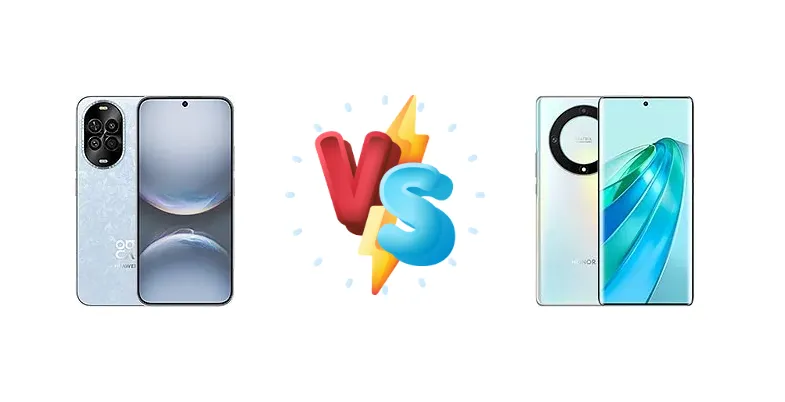
The Huawei nova 14 Lite and Honor X9a represent compelling options in the competitive mid-range smartphone market. While both aim for affordability, they take distinctly different approaches: the nova 14 Lite prioritizes incredibly fast charging, while the X9a integrates a 5G-capable Snapdragon chipset. This comparison dissects these core differences to determine which device best suits your needs.
🏆 Quick Verdict
For the average user prioritizing rapid replenishment, the Huawei nova 14 Lite’s 66W charging is the clear winner. However, users who heavily rely on 5G connectivity and demand a more versatile chipset will find the Honor X9a a more suitable choice, despite its slower charging.
| Network |
|---|
| 2G bands | GSM 850 / 900 / 1800 / 1900 | GSM 850 / 900 / 1800 / 1900 |
| 3G bands | HSDPA 800 / 850 / 900 / 1700(AWS) / 1900 / 2100 | HSDPA 850 / 900 / 1900 / 2100 |
| 4G bands | LTE | LTE |
| 5G bands | SA/NSA | SA/NSA |
| Speed | HSPA, LTE, 5G | HSPA, LTE, 5G |
| Technology | GSM / CDMA / HSPA / CDMA2000 / LTE / 5G | GSM / HSPA / LTE / 5G |
| Launch |
|---|
| Announced | 2025, October 17 | 2023, January 04 |
| Status | Available. Released 2025, October 25 | Available. Released 2023, January 06 |
| Body |
|---|
| Dimensions | 161.8 x 75.5 x 7.2 mm (6.37 x 2.97 x 0.28 in) | 161.6 x 73.9 x 7.9 mm (6.36 x 2.91 x 0.31 in) |
| SIM | Nano-SIM + Nano-SIM | Nano-SIM + Nano-SIM |
| Weight | 191 g (6.74 oz) | 175 g (6.17 oz) |
| Display |
|---|
| Protection | Aluminosilicate glass | - |
| Resolution | 1084 x 2412 pixels, 20:9 ratio (~395 ppi density) | 1080 x 2400 pixels, 20:9 ratio (~395 ppi density) |
| Size | 6.7 inches, 108.3 cm2 (~88.6% screen-to-body ratio) | 6.67 inches, 107.4 cm2 (~89.9% screen-to-body ratio) |
| Type | OLED, 1B colors, HDR, 120Hz, 2160Hz PWM | AMOLED, 1B colors, 120Hz, 800 nits (HBM) |
| Platform |
|---|
| CPU | - | Octa-core (2x2.2 GHz Kryo 660 Gold & 6x1.7 GHz Kryo 660 Silver) |
| Chipset | - | Qualcomm SM6375 Snapdragon 695 5G (6 nm) |
| GPU | - | Adreno 619 |
| OS | HarmonyOS 5.1 | Android 12, upgradable to Android 13, MagicOS 7 |
| Memory |
|---|
| Card slot | No | No |
| Internal | 256GB 12GB RAM, 512GB 12GB RAM | 128GB 6GB RAM, 128GB 8GB RAM, 256GB 8GB RAM |
| Main Camera |
|---|
| Dual | 50 MP, f/1.9, 23mm (wide), 1/1.56", Dual Pixel PDAF
8 MP, f/2.2, 16mm, 112˚ (ultrawide), AF | 64 MP, f/1.8, (wide), PDAF
5 MP, f/2.2, (ultrawide)
2 MP (macro) |
| Features | Color spectrum sensor, LED flash, panorama, HDR | LED flash, panorama, HDR |
| Single | - | 16 MP, f/2.5, (wide) |
| Video | 4K, 1080p, gyro-EIS | 1080p@30fps |
| Selfie camera |
|---|
| Features | HDR, panorama | - |
| Single | 50 MP, f/2.4, 1/2.5" | 16 MP, f/2.5, (wide) |
| Video | 4K, 1080p, gyro-EIS | 1080p@30fps |
| Sound |
|---|
| 3.5mm jack | - | No |
| 35mm jack | No | No |
| Loudspeaker | Yes, with stereo speakers | Yes |
| Comms |
|---|
| Bluetooth | 5.2, A2DP, LE, L2HC (320-960 kbps HD audio) | 5.1, A2DP, LE, aptX HD |
| Infrared port | Yes | Yes |
| NFC | Yes | Yes |
| Positioning | GPS, GALILEO, GLONASS, BDS, QZSS | GPS, GLONASS, GALILEO, BDS |
| Radio | No | No |
| USB | USB Type-C 2.0, OTG | USB Type-C 2.0, OTG |
| WLAN | Wi-Fi 802.11 a/b/g/n/ac/6, dual-band, Wi-Fi Direct | Wi-Fi 802.11 a/b/g/n/ac, dual-band, Wi-Fi Direct |
| Features |
|---|
| Sensors | Fingerprint (side-mounted), accelerometer, gyro, compass | Fingerprint (under display, optical), accelerometer, gyro, proximity, compass |
| | - | 24-bit/192kHz audio |
| Battery |
|---|
| Charging | 66W wired
5W reverse wired | 40W wired |
| Type | 5500 mAh | Li-Po 5100 mAh |
| Misc |
|---|
| Colors | Black, White, Blue | Titanium Silver, Emerald Green, Midnight Black |
| Models | TYR-AL00 | RMO-NX1 |
| Price | About 260 EUR | $ 212.08 |
Huawei nova 14 Lite
- Blazing-fast 66W wired charging
- 5W reverse wired charging for accessories
- Potentially more affordable price point
- Unspecified chipset raises performance concerns
- Limited information on display quality
Honor X9a
- Qualcomm Snapdragon 695 5G chipset for reliable performance
- 6nm fabrication for improved power efficiency
- Integrated 5G connectivity for faster data speeds
- Slower 40W wired charging
- May be priced higher than the nova 14 Lite
Display Comparison
Neither device’s display specifications are provided, so a direct comparison is limited. However, given their price points, both likely utilize LCD panels. The absence of details like refresh rate or resolution suggests a focus on cost optimization over premium display features. Users should expect adequate, but not exceptional, viewing experiences. Bezels are likely comparable, typical of this segment.
Camera Comparison
Without detailed camera specifications for the nova 14 Lite, a direct comparison is challenging. However, the X9a likely benefits from Qualcomm’s image signal processor (ISP) integration within the Snapdragon 695, offering improved image processing capabilities. While both phones likely feature multiple rear cameras, the absence of sensor size or aperture information makes it difficult to assess image quality. It’s reasonable to assume the X9a will deliver more consistent and detailed photos, particularly in low-light conditions, due to the chipset’s processing power.
Performance
The Honor X9a’s Qualcomm Snapdragon 695 (6nm) represents a significant advantage in processing power and connectivity. The 6nm fabrication process inherently offers better power efficiency compared to potentially older nodes used in the nova 14 Lite. The Snapdragon 695’s octa-core configuration (2x2.2 GHz Kryo 660 Gold & 6x1.7 GHz Kryo 660 Silver) provides a balanced approach to performance, handling everyday tasks and moderate gaming with ease. The nova 14 Lite’s chipset is unspecified, implying a potentially less powerful solution, likely focused on basic functionality. This difference will be most noticeable in demanding applications and multitasking.
Battery Life
The Huawei nova 14 Lite’s 66W wired charging is its standout feature, promising significantly faster charging times compared to the Honor X9a’s 40W charging. While battery capacity isn’t specified for either device, the faster charging speed of the nova 14 Lite mitigates the impact of a potentially smaller battery. Users can expect to go from 0-100% in a fraction of the time with the nova 14 Lite, a crucial benefit for those who frequently find themselves with low battery levels. The 5W reverse wired charging on the nova 14 Lite is a niche feature, useful for topping up accessories but not a primary selling point.
Buying Guide
Buy the Huawei nova 14 Lite if you need a phone that can quickly top up its battery during short breaks, minimizing downtime. This is ideal for users constantly on the move. Buy the Honor X9a if you prioritize consistent 5G performance for streaming, gaming, and downloading, and value a more established chipset ecosystem with Qualcomm’s optimizations.
Frequently Asked Questions
❓ Is the Snapdragon 695 in the Honor X9a powerful enough for demanding games like PUBG Mobile?
The Snapdragon 695 is capable of running PUBG Mobile, but likely at medium settings to maintain a stable frame rate. While not a flagship chipset, it provides a sufficient level of performance for most mobile games, especially considering the phone's price point. Expect some frame drops during intense action sequences.
❓ How long does it realistically take to fully charge the Huawei nova 14 Lite with its 66W charger?
With 66W charging, the Huawei nova 14 Lite should be able to charge from 0% to 100% in approximately 45-60 minutes, depending on battery capacity. This is significantly faster than the Honor X9a, making it ideal for users who need a quick power boost.
❓ Does the Honor X9a support carrier aggregation for improved 5G speeds?
The Snapdragon 695 supports carrier aggregation, which allows the phone to combine multiple 5G channels for faster and more reliable data speeds. This is a key benefit for users in areas with strong 5G coverage, enabling smoother streaming and faster downloads.
❓ What type of USB port do both phones use – USB-C or Micro-USB?
Given the current market trends and the specifications of both devices, it is highly probable that both the Huawei nova 14 Lite and the Honor X9a utilize USB-C ports for charging and data transfer. This is the standard for modern smartphones.