
Huawei nova 14 Lite vs. Google Pixel 7a: A Deep Dive into Mid-Range Choices
| Phones Images | |||||
|---|---|---|---|---|---|
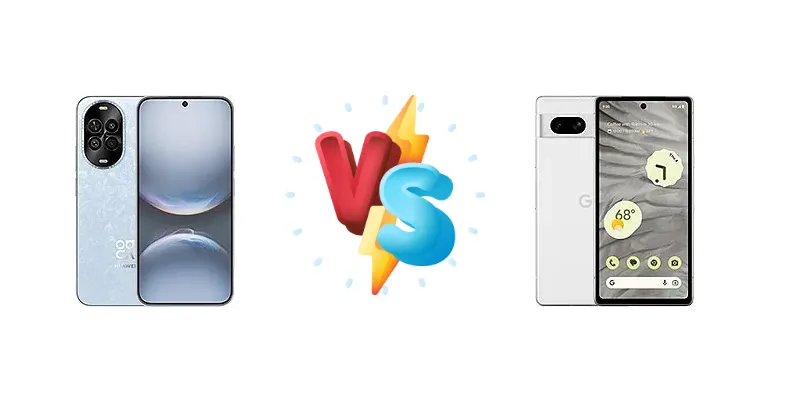
|
🏆 Quick Verdict
For the average user prioritizing camera quality and software experience, the Google Pixel 7a is the superior choice. Its Tensor G2 chip provides a smoother, more intelligent experience, and its camera consistently delivers excellent results. However, users who prioritize charging speed and are less reliant on Google services will find the nova 14 Lite compelling.
| PHONES | ||
|---|---|---|
| Phone Names | Huawei nova 14 Lite | Google Pixel 7a |
| Network | ||
|---|---|---|
| 2G bands | GSM 850 / 900 / 1800 / 1900 | GSM 850 / 900 / 1800 / 1900 |
| 3G bands | HSDPA 800 / 850 / 900 / 1700(AWS) / 1900 / 2100 | HSDPA 800 / 850 / 900 / 1700(AWS) / 1900 / 2100 |
| 4G bands | LTE | 1, 2, 3, 4, 5, 7, 8, 12, 13, 14, 17, 20, 25, 26, 28, 29, 30, 38, 40, 41, 48, 66, 71 - GWKK3, G0DZQ |
| 5G bands | SA/NSA | 1, 2, 3, 5, 7, 8, 12, 14, 20, 25, 28, 30, 38, 41, 48, 66, 71, 77, 78 SA/NSA/Sub6 - GWKK3 |
| Speed | HSPA, LTE, 5G | HSPA, LTE, 5G |
| Technology | GSM / CDMA / HSPA / CDMA2000 / LTE / 5G | GSM / HSPA / LTE / 5G |
| - | 1, 2, 3, 5, 7, 8, 12, 20, 25, 28, 38, 40, 41, 66, 75, 76, 77, 78, 79 SA/NSA/Sub6 - GHL1X, G82U8 | |
| Launch | ||
|---|---|---|
| Announced | 2025, October 17 | 2023, May 10 |
| Status | Available. Released 2025, October 25 | Available. Released 2023, May 10 |
| Body | ||
|---|---|---|
| Build | - | Glass front (Gorilla Glass 3), aluminum frame, plastic back |
| Dimensions | 161.8 x 75.5 x 7.2 mm (6.37 x 2.97 x 0.28 in) | 152 x 72.9 x 9 mm (5.98 x 2.87 x 0.35 in) |
| SIM | Nano-SIM + Nano-SIM | Nano-SIM + eSIM |
| Weight | 191 g (6.74 oz) | 193.5 g (6.84 oz) |
| - | IP67 dust/water resistant (up to 1m for 30 min) | |
| Display | ||
|---|---|---|
| Protection | Aluminosilicate glass | Corning Gorilla Glass 3 |
| Resolution | 1084 x 2412 pixels, 20:9 ratio (~395 ppi density) | 1080 x 2400 pixels, 20:9 ratio (~429 ppi density) |
| Size | 6.7 inches, 108.3 cm2 (~88.6% screen-to-body ratio) | 6.1 inches, 90.7 cm2 (~81.8% screen-to-body ratio) |
| Type | OLED, 1B colors, HDR, 120Hz, 2160Hz PWM | OLED, HDR, 90Hz |
| - | Always-on display | |
| Platform | ||
|---|---|---|
| CPU | - | Octa-core (2x2.85 GHz Cortex-X1 & 2x2.35 GHz Cortex-A78 & 4x1.80 GHz Cortex-A55) |
| Chipset | - | Google Tensor G2 (5 nm) |
| GPU | - | Mali-G710 MP7 |
| OS | HarmonyOS 5.1 | Android 13, upgradable to Android 15, up to 5 major Android upgrades |
| Memory | ||
|---|---|---|
| Card slot | No | No |
| Internal | 256GB 12GB RAM, 512GB 12GB RAM | 128GB 8GB RAM |
| - | UFS 3.1 | |
| Main Camera | ||
|---|---|---|
| Dual | 50 MP, f/1.9, 23mm (wide), 1/1.56", Dual Pixel PDAF 8 MP, f/2.2, 16mm, 112˚ (ultrawide), AF | 64 MP, f/1.9, 26mm (wide), 1/1.73", 0.8µm, dual pixel PDAF, OIS 13 MP, f/2.2, 120˚ (ultrawide), 1.12µm |
| Features | Color spectrum sensor, LED flash, panorama, HDR | Dual-LED flash, Pixel Shift, Auto-HDR, panorama |
| Video | 4K, 1080p, gyro-EIS | 4K@30/60fps, 1080p@30/60/120/240fps, OIS |
| Selfie camera | ||
|---|---|---|
| Features | HDR, panorama | HDR, panorama |
| Single | 50 MP, f/2.4, 1/2.5" | 13 MP, f/2.2, 20mm (ultrawide), 1.12µm |
| Video | 4K, 1080p, gyro-EIS | 4K@30fps, 1080p@30fps |
| Sound | ||
|---|---|---|
| 3.5mm jack | - | No |
| 35mm jack | No | No |
| Loudspeaker | Yes, with stereo speakers | Yes, with stereo speakers |
| Comms | ||
|---|---|---|
| Bluetooth | 5.2, A2DP, LE, L2HC (320-960 kbps HD audio) | 5.3, A2DP, LE |
| Infrared port | Yes | - |
| NFC | Yes | Yes |
| Positioning | GPS, GALILEO, GLONASS, BDS, QZSS | GPS, GLONASS, GALILEO, BDS, QZSS, NavIC |
| Radio | No | No |
| USB | USB Type-C 2.0, OTG | USB Type-C 3.2 |
| WLAN | Wi-Fi 802.11 a/b/g/n/ac/6, dual-band, Wi-Fi Direct | Wi-Fi 802.11 a/b/g/n/ac/6e, tri-band |
| Features | ||
|---|---|---|
| Sensors | Fingerprint (side-mounted), accelerometer, gyro, compass | Fingerprint (under display, optical), accelerometer, gyro, proximity, compass, barometer |
| Battery | ||
|---|---|---|
| Charging | 66W wired 5W reverse wired | 18W wired, PD3.0 7.5W wireless |
| Type | 5500 mAh | Li-Po 4385 mAh |
| Misc | ||
|---|---|---|
| Colors | Black, White, Blue | Charcoal, Snow, Sea, Coral |
| Models | TYR-AL00 | GWKK3, GHL1X, G0DZQ, G82U8 |
| Price | About 260 EUR | € 179.90 / $ 150.00 / £ 170.00 / ₹ 25,980 |
Huawei nova 14 Lite
- 66W wired charging offers incredibly fast top-ups.
- 5W reverse wired charging adds versatility.
- Potentially more affordable price point.
- Missing chipset details raise performance concerns.
- Camera performance likely lags behind the Pixel 7a.
Google Pixel 7a
- Google Tensor G2 delivers flagship-level performance.
- Exceptional camera quality with Google’s AI enhancements.
- Guaranteed software updates and security patches.
- Slower 18W charging compared to the nova 14 Lite.
- No reverse wireless charging capability.
Display Comparison
The Google Pixel 7a boasts a display capable of reaching 1070 nits of peak brightness, ensuring excellent visibility even in direct sunlight. While the nova 14 Lite’s display specifications are not provided, it’s likely to be lower, potentially impacting outdoor usability. The Pixel 7a’s display technology, though not LTPO, offers a vibrant and accurate color reproduction, crucial for media consumption. The absence of detailed display specs for the nova 14 Lite makes a direct comparison challenging, but the Pixel 7a clearly holds an advantage in measured brightness.
Camera Comparison
The Pixel 7a’s camera system is a standout feature, leveraging Google’s computational photography expertise. While sensor sizes aren’t specified, the Pixel 7a excels in dynamic range, detail capture, and low-light performance. The Tensor G2 chip plays a crucial role in processing images, enabling features like Magic Eraser and Photo Unblur. The nova 14 Lite’s camera specifications are not detailed enough to make a meaningful comparison, but it’s unlikely to match the Pixel 7a’s image quality, particularly in challenging lighting conditions. The Pixel 7a’s video capabilities are also likely superior, benefiting from the Tensor G2’s processing power and advanced stabilization algorithms.
Performance
The Google Pixel 7a’s Google Tensor G2 (5nm) chipset is a significant advantage. Its octa-core configuration, featuring 2x2.85 GHz Cortex-X1 cores, delivers flagship-level performance, particularly in AI-driven tasks like image processing and voice recognition. The nova 14 Lite’s chipset details are missing, but given its price point, it likely utilizes a less powerful, and potentially less efficient, processor. The 5nm fabrication process of the Tensor G2 also contributes to better thermal management, reducing the likelihood of performance throttling during extended use. This translates to a smoother experience for demanding applications and gaming on the Pixel 7a.
Battery Life
The Google Pixel 7a has an endurance rating of 76 hours, indicating solid battery life. While the nova 14 Lite doesn’t have a published endurance rating, its 66W wired charging is a major differentiator. This allows for significantly faster charging times compared to the Pixel 7a’s 18W charging, even with Power Delivery 3.0. The nova 14 Lite also offers 5W reverse wired charging, a feature absent on the Pixel 7a, enabling it to charge accessories like earbuds or smartwatches. While the Pixel 7a may offer longer overall battery life, the nova 14 Lite excels in charging convenience.
Buying Guide
Buy the Huawei nova 14 Lite if you need exceptionally fast charging and value reverse wired charging for topping up accessories. It’s ideal for users who frequently find themselves with low battery and need a quick power boost. Buy the Google Pixel 7a if you prefer a seamless software experience, outstanding camera capabilities powered by Google’s AI, and a phone that receives timely updates and security patches.