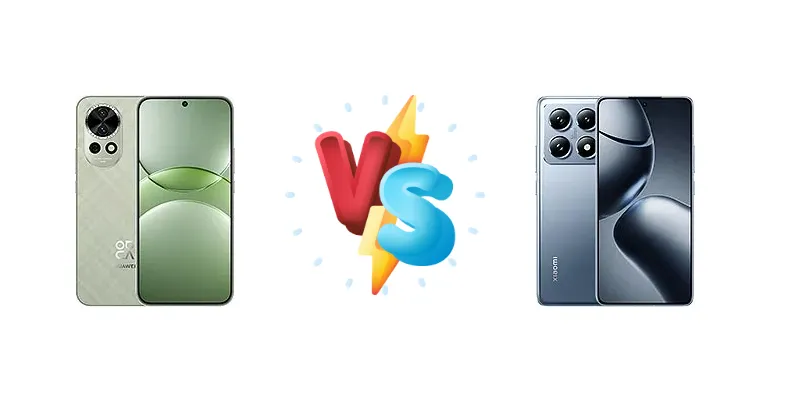
The Huawei nova 13 and Xiaomi 14T Pro represent compelling options in the increasingly competitive mid-range to upper-mid-range smartphone market. While both aim to deliver a premium experience, they take distinctly different approaches – Huawei focusing on refined design and efficient power management, while Xiaomi prioritizes raw performance and cutting-edge charging technology. This comparison dissects their key differences to help you choose the right device.
🏆 Quick Verdict
For the average user prioritizing speed and future-proofing, the Xiaomi 14T Pro emerges as the winner. Its Mediatek Dimensity 9300+ chipset and 120W charging significantly outperform the Huawei nova 13, offering a smoother, faster experience. However, Huawei's 100W charging is still very competitive and may appeal to those valuing a more balanced approach.
| Network |
|---|
| 2G bands | GSM 850 / 900 / 1800 / 1900 | GSM 850 / 900 / 1800 / 1900 |
| 3G bands | HSDPA 800 / 850 / 900 / 1700(AWS) / 1900 / 2100 | HSDPA 800 / 850 / 900 / 1700(AWS) / 1900 / 2100 |
| 4G bands | LTE | 1, 2, 3, 4, 5, 7, 8, 12, 13, 17, 18, 19, 20, 25, 26, 28, 32, 38, 39, 40, 41, 42, 48, 66 |
| 5G bands | SA/NSA | 1, 2, 3, 5, 7, 8, 12, 20, 25, 26, 28, 38, 40, 41, 48, 66, 75, 77, 78 SA/NSA |
| Speed | HSPA, LTE, 5G | HSPA, LTE, 5G |
| Technology | GSM / CDMA / HSPA / CDMA2000 / LTE / 5G | GSM / HSPA / LTE / 5G |
| Launch |
|---|
| Announced | 2024, October 22 | 2024, September 26 |
| Status | Available. Released 2024, October 25 | Available. Released 2024, September 26 |
| Body |
|---|
| Build | - | Glass front (Gorilla Glass 5), aluminum frame, glass back (Panda X) |
| Dimensions | 161.4 x 75.3 x 7 mm (6.35 x 2.96 x 0.28 in) | 160.4 x 75.1 x 8.4 mm (6.31 x 2.96 x 0.33 in) |
| SIM | Nano-SIM + Nano-SIM | · Nano-SIM + eSIM· eSIM + eSIM· Nano-SIM + Nano-SIM |
| Weight | 195 g (6.88 oz) | 209 g (7.37 oz) |
| Display |
|---|
| Protection | Aluminosilicate glass | Corning Gorilla Glass 5 |
| Resolution | 1084 x 2412 pixels, 20:9 ratio (~395 ppi density) | 1220 x 2712 pixels, 20:9 ratio (~446 ppi density) |
| Size | 6.7 inches, 108.3 cm2 (~89.1% screen-to-body ratio) | 6.67 inches, 107.4 cm2 (~89.1% screen-to-body ratio) |
| Type | OLED, 1B colors, HDR, 120Hz | AMOLED, 68B colors, 144Hz, 3840Hz PWM, Dolby Vision, HDR10+, 1600 nits (HBM), 4000 nits (peak) |
| Platform |
|---|
| CPU | - | Octa-core (1x3.4 GHz Cortex-X4 & 3x2.85 GHz Cortex-X4 & 4x2.0 GHz Cortex-A720) |
| Chipset | - | Mediatek Dimensity 9300+ (4 nm) |
| GPU | - | Immortalis-G720 MC12 |
| OS | HarmonyOS 4.2 | Android 14, HyperOS |
| Memory |
|---|
| Card slot | No | No |
| Internal | 256GB 12GB RAM, 512GB 12GB RAM, 1TB 12GB RAM | 256GB 12GB RAM, 512GB 12GB RAM, 512GB 16GB RAM, 1TB 12GB RAM |
| Main Camera |
|---|
| Dual | 50 MP, f/1.9, (wide), PDAF
8 MP, f/2.2, 112˚ (ultrawide), AF | - |
| Features | Laser AF, color spectrum sensor, LED flash, panorama, HDR | Leica lens, Ultra HDR, LED flash, HDR, panorama |
| Triple | - | 50 MP, f/1.6, 23mm (wide), 1/1.31", 1.2µm, PDAF, OIS
50 MP, f/2.0, 60mm (telephoto), 1/2.88", 0.61µm, PDAF, 2.6x optical zoom
12 MP, f/2.2, 15mm (ultrawide), 1/3.06", 1.12µm |
| Video | 4K, 1080p, gyro-EIS | 8K@24/30fps, 4K@24/30/60fps, 1080p@30/60/120/240/960fps, gyro-EIS, 10-bit Rec. 2020, HDR10+ |
| Selfie camera |
|---|
| Features | HDR, panorama | HDR |
| Single | 60 MP, f/2.4, 17mm, 100˚ (ultrawide) | 32 MP, f/2.0, 25mm (wide), 1/3.44", 0.64µm |
| Video | 4K@30fps, 1080p@30fps, gyro-EIS | 4K@30fps, 1080p@30/60fps, HDR10+ |
| Sound |
|---|
| 35mm jack | No | No |
| Loudspeaker | Yes | Yes, with stereo speakers |
| Comms |
|---|
| Bluetooth | 5.2, A2DP, LE, L2HC (320-960 kbps HD audio) | 5.4, A2DP, LE, LHDC |
| Infrared port | Yes | Yes |
| NFC | Yes | Yes (market/region dependent) |
| Positioning | GPS, GALILEO, GLONASS, BDS, QZSS | GPS (L1+L5), BDS (B1I+B1C+B2a+B2b), GALILEO (E1+E5a+E5b), QZSS (L1+L5), NavIC (L5), GLONASS |
| Radio | No | No |
| USB | USB Type-C 2.0, OTG | USB Type-C 2.0, OTG |
| WLAN | Wi-Fi 802.11 a/b/g/n/ac/6, dual-band, Wi-Fi Direct | Wi-Fi 802.11 a/b/g/n/ac/6e/7, dual-band, Wi-Fi Direct |
| Features |
|---|
| Sensors | Fingerprint (under display, optical), accelerometer, gyro, compass | Fingerprint (under display, optical), accelerometer, gyro, proximity, compass |
| Battery |
|---|
| Charging | 100W wired, 3-50% in 10 min
5W reverse wired | 120W wired, PD3.0, QC4, 100% in 19 min
50W wireless, 100% in 45 min |
| Type | 5000 mAh | Li-Po 5000 mAh |
| Misc |
|---|
| Colors | Black, White, Purple, Green | Titan Gray, Titan Blue, Titan Black |
| Models | BLK-AL80, BLK-LX9 | 2407FPN8EG |
| Price | About 350 EUR | $ 550.00 / £ 498.00 / € 539.99 |
| SAR EU | - | 0.99 W/kg (head) 1.00 W/kg (body) |
Huawei nova 13
- Potentially more efficient power management
- Sleek and refined design (assumed based on Huawei's brand image)
- 100W fast charging is still very competitive
- Likely less powerful chipset than the Xiaomi 14T Pro
- Missing detailed specifications hinder a full assessment
Xiaomi 14T Pro
- Blazing-fast 120W wired and 50W wireless charging
- Powerful Mediatek Dimensity 9300+ chipset
- High display brightness for excellent outdoor visibility
- Potentially higher power consumption
- May run warmer under sustained load
Display Comparison
The Xiaomi 14T Pro boasts a significantly brighter display, reaching a measured peak of 1228 nits. This is crucial for outdoor visibility, a clear advantage over the nova 13 (brightness data unavailable). While both likely employ OLED panels, the 14T Pro’s higher brightness suggests a more advanced panel technology. The absence of refresh rate data for the nova 13 makes a direct comparison difficult, but the 14T Pro’s brightness alone makes it the superior choice for media consumption in bright environments.
Camera Comparison
Without detailed camera specifications for the Huawei nova 13, a direct comparison is limited. However, the Xiaomi 14T Pro’s camera system is expected to benefit from the chipset’s powerful image signal processor (ISP). The focus should be on the main sensor resolution and aperture, as these are key determinants of image quality. The absence of information regarding OIS on either device makes it difficult to assess low-light performance. It's reasonable to assume the 14T Pro's ISP will provide more advanced computational photography features.
Performance
The Xiaomi 14T Pro’s Mediatek Dimensity 9300+ chipset, fabricated on a 4nm process, represents a substantial leap in performance over what is expected in the nova 13. The Dimensity 9300+’s octa-core configuration – featuring a 3.4 GHz Cortex-X4 prime core alongside three 2.85 GHz Cortex-X4 cores and four 2.0 GHz Cortex-A720 cores – promises exceptional CPU and GPU performance. The 4nm node also contributes to improved thermal efficiency, potentially mitigating throttling during sustained workloads. While the nova 13’s chipset is not specified, it’s unlikely to match the raw power of the Dimensity 9300+.
Battery Life
The Xiaomi 14T Pro’s 120W wired charging is a standout feature, achieving a full charge in just 19 minutes. This is significantly faster than the Huawei nova 13’s 100W charging, which takes 10 minutes to reach 30-50%. Furthermore, the 14T Pro adds 50W wireless charging, a feature absent in the nova 13. The 14T Pro’s active use score of 12:32h demonstrates strong battery life despite the power-hungry chipset, suggesting efficient power management. While the nova 13’s battery capacity is unknown, the 14T Pro’s charging speed and endurance provide a clear advantage.
Buying Guide
Buy the Huawei nova 13 if you need a phone with a focus on efficient power usage and a streamlined user experience, potentially benefiting from Huawei’s software optimizations. Buy the Xiaomi 14T Pro if you prefer uncompromising performance, incredibly fast charging speeds, and a device geared towards demanding tasks like gaming and content creation. The 14T Pro is the clear choice for power users.
Frequently Asked Questions
❓ Does the Xiaomi 14T Pro's Dimensity 9300+ chipset get excessively hot during prolonged gaming sessions?
While the Dimensity 9300+ is a powerful processor, its 4nm fabrication process and Xiaomi's thermal management solutions are designed to mitigate overheating. However, some throttling is possible during extended, graphically intensive gaming. Expect warm temperatures, but not to the point of significant performance degradation.
❓ How does the 100W charging on the Huawei nova 13 compare to the 120W charging on the Xiaomi 14T Pro in real-world usage?
While both are fast charging solutions, the Xiaomi 14T Pro’s 120W charging is demonstrably quicker, achieving a full charge in 19 minutes compared to the nova 13’s 30-50% in 10 minutes. This translates to significantly less time tethered to a charger, especially for users who frequently need to top up their battery.
❓ Is the 50W wireless charging on the Xiaomi 14T Pro a practical feature?
Yes, 50W wireless charging is a significant convenience. It allows for relatively fast charging without the need for cables, making it ideal for overnight charging or quick top-ups. It takes 45 minutes to fully charge, which is still faster than many other wireless charging solutions.