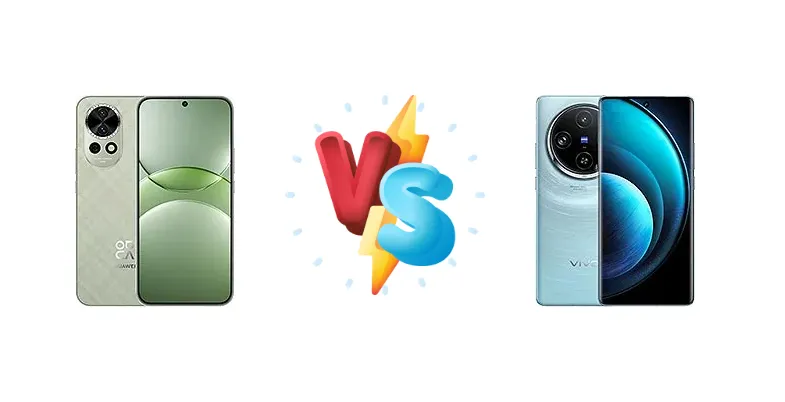
The Huawei nova 13 and vivo X100 Pro represent distinct approaches to the modern flagship smartphone. The nova 13 aims for a balance of style and speed, while the X100 Pro prioritizes raw performance and camera prowess with its cutting-edge Mediatek Dimensity 9300 chipset. This comparison dissects their key differences to determine which device best suits your needs.
🏆 Quick Verdict
For the average user prioritizing sustained performance and exceptional camera capabilities, the vivo X100 Pro emerges as the winner. Its Dimensity 9300 chipset and impressive 13:53h active use battery life outweigh the nova 13’s faster 100W charging, making it the more compelling overall package.
| Network |
|---|
| 2G bands | GSM 850 / 900 / 1800 / 1900 | GSM 850 / 900 / 1800 / 1900 |
| 3G bands | HSDPA 800 / 850 / 900 / 1700(AWS) / 1900 / 2100 | HSDPA 800 / 850 / 900 / 1700(AWS) / 1900 / 2100 |
| 4G bands | LTE | 1, 2, 3, 4, 5, 7, 8, 12, 17, 18, 19, 20, 26, 28, 32, 38, 39, 40, 41, 42, 66 - International |
| 5G bands | SA/NSA | 1, 3, 5, 7, 8, 20, 28, 38, 40, 41, 66, 75, 77, 78, 79 SA/NSA - International |
| Speed | HSPA, LTE, 5G | HSPA, LTE, 5G |
| Technology | GSM / CDMA / HSPA / CDMA2000 / LTE / 5G | GSM / CDMA / HSPA / LTE / 5G |
| Launch |
|---|
| Announced | 2024, October 22 | 2023, November 13 |
| Status | Available. Released 2024, October 25 | Available. Released 2023, November 21 |
| Body |
|---|
| Build | - | Glass front, aluminum frame, glass back |
| Dimensions | 161.4 x 75.3 x 7 mm (6.35 x 2.96 x 0.28 in) | 164.1 x 75.3 x 8.9 mm or 9.1 mm |
| SIM | Nano-SIM + Nano-SIM | · Nano-SIM + eSIM· Nano-SIM + Nano-SIM |
| Weight | 195 g (6.88 oz) | 221 g or 225 g (7.80 oz) |
| Display |
|---|
| Protection | Aluminosilicate glass | - |
| Resolution | 1084 x 2412 pixels, 20:9 ratio (~395 ppi density) | 1260 x 2800 pixels, 20:9 ratio (~452 ppi density) |
| Size | 6.7 inches, 108.3 cm2 (~89.1% screen-to-body ratio) | 6.78 inches, 111.5 cm2 (~90.2% screen-to-body ratio) |
| Type | OLED, 1B colors, HDR, 120Hz | LTPO AMOLED, 1B colors, 120Hz, HDR10+, 3000 nits (peak) |
| Platform |
|---|
| CPU | - | Octa-core (1x3.25 GHz Cortex-X4 & 3x2.85 GHz Cortex-X4 & 4x2.0 GHz Cortex-A720) |
| Chipset | - | Mediatek Dimensity 9300 (4 nm) |
| GPU | - | Immortalis-G720 MC12 |
| OS | HarmonyOS 4.2 | Android 14, upgradable to Android 15, Funtouch 15 (International), OriginOS 4 (China) |
| Memory |
|---|
| Card slot | No | No |
| Internal | 256GB 12GB RAM, 512GB 12GB RAM, 1TB 12GB RAM | 256GB 12GB RAM, 256GB 16GB RAM, 512GB 16GB RAM, 1TB 16GB RAM |
| Main Camera |
|---|
| Dual | 50 MP, f/1.9, (wide), PDAF
8 MP, f/2.2, 112˚ (ultrawide), AF | - |
| Features | Laser AF, color spectrum sensor, LED flash, panorama, HDR | Laser AF, color spectrum sensor, Zeiss optics, Zeiss T* lens coating, LED flash, panorama, HDR, 3D LUT import |
| Triple | - | 50 MP, f/1.8, 23mm (wide), 1/0.98", 1.6µm, dual pixel PDAF, OIS
50 MP, f/2.5, 100mm (periscope telephoto), 1/2.51", 0.7µm, PDAF (18cm - ∞), OIS, 4.3x optical zoom
50 MP, f/2.0, 15mm, 119˚ (ultrawide), 1/2.76", 0.64µm, AF |
| Video | 4K, 1080p, gyro-EIS | 8K@30fps, 4K@30/60fps, 1080p, gyro-EIS |
| Selfie camera |
|---|
| Features | HDR, panorama | HDR |
| Single | 60 MP, f/2.4, 17mm, 100˚ (ultrawide) | 32 MP, f/2.0, 20mm (ultrawide) |
| Video | 4K@30fps, 1080p@30fps, gyro-EIS | 4K@30/60fps, 1080p@30/60fps |
| Sound |
|---|
| 35mm jack | No | No |
| Loudspeaker | Yes | Yes, with stereo speakers |
| Comms |
|---|
| Bluetooth | 5.2, A2DP, LE, L2HC (320-960 kbps HD audio) | 5.4, A2DP, LE, aptX HD, LHDC |
| Infrared port | Yes | Yes |
| NFC | Yes | Yes |
| Positioning | GPS, GALILEO, GLONASS, BDS, QZSS | GPS (L1+L5), GLONASS (L1), BDS (B1I+B1c+B2a+B2b), GALILEO (E1+E5a+E5b), QZSS (L1+L5), NavIC (L5) |
| Radio | No | No |
| USB | USB Type-C 2.0, OTG | USB Type-C 3.2, OTG |
| WLAN | Wi-Fi 802.11 a/b/g/n/ac/6, dual-band, Wi-Fi Direct | Wi-Fi 802.11 a/b/g/n/ac/6/7, tri-band, Wi-Fi Direct |
| Features |
|---|
| Sensors | Fingerprint (under display, optical), accelerometer, gyro, compass | Fingerprint (under display, optical), accelerometer, gyro, proximity, compass |
| Battery |
|---|
| Charging | 100W wired, 3-50% in 10 min
5W reverse wired | 100W wired, 50% in 14 min
50W wireless
Reverse wired |
| Type | 5000 mAh | Li-Ion 5400 mAh |
| Misc |
|---|
| Colors | Black, White, Purple, Green | Startrail Blue, Asteroid Black, Sunset Orange, White |
| Models | BLK-AL80, BLK-LX9 | V2324A, V2309 |
| Price | About 350 EUR | ₹ 59,999 |
| SAR EU | - | 0.99 W/kg (head) 1.19 W/kg (body) |
Huawei nova 13
- Extremely fast 100W wired charging (50% in 10 minutes)
- Sleek and stylish design (assumed based on Huawei’s design language)
- Potential for competitive pricing
- Unspecified chipset likely offers lower performance
- Limited battery life information
- Lack of wireless charging
vivo X100 Pro
- Powerful Mediatek Dimensity 9300 chipset for exceptional performance
- Excellent battery life (13:53h active use)
- Bright 1472 nits display for outdoor visibility
- Slightly slower 100W charging (50% in 14 minutes)
- Potentially higher price point
- Larger size and weight (likely)
Display Comparison
The vivo X100 Pro boasts a significantly brighter display, reaching a measured 1472 nits, which translates to superior visibility in direct sunlight compared to the nova 13 (brightness data unavailable). While both likely utilize OLED panels, the X100 Pro’s brightness advantage suggests a more advanced panel technology. The absence of refresh rate data for the nova 13 makes a direct comparison difficult, but the X100 Pro’s likely higher refresh rate (expected 120Hz) would contribute to smoother scrolling and animations.
Camera Comparison
The vivo X100 Pro is expected to feature a sophisticated camera system, though specific details are missing. However, vivo’s history suggests a focus on image quality and innovative features. The X100 Pro’s image processing capabilities will likely be a key differentiator. The nova 13’s camera specifications are currently unknown, making a detailed comparison impossible. It’s reasonable to assume the X100 Pro will offer a more versatile and higher-quality camera experience, particularly in low-light conditions.
Performance
The vivo X100 Pro’s Mediatek Dimensity 9300 (4nm) chipset is the clear performance leader. Its octa-core configuration, featuring a mix of Cortex-X4 and Cortex-A720 cores clocked up to 3.25 GHz, provides substantial processing power. The 4nm fabrication process also contributes to improved thermal efficiency, minimizing throttling during extended gaming sessions. The nova 13’s chipset is unspecified, but given its positioning, it’s likely a mid-range offering that won’t match the X100 Pro’s capabilities. The X100 Pro’s LPDDR5x RAM further enhances performance by providing faster data access.
Battery Life
The vivo X100 Pro’s 13:53h active use score demonstrates exceptional battery life, indicating efficient power management despite its powerful chipset. While both phones offer 100W wired charging, the X100 Pro takes 14 minutes to reach 50%, slightly slower than the nova 13’s 10 minutes. However, the X100 Pro adds the convenience of 50W wireless charging and reverse wired charging, features absent on the nova 13. The X100 Pro’s longer battery life mitigates the slightly slower charging speed.
Buying Guide
Buy the Huawei nova 13 if you prioritize extremely fast charging – reaching 50% in just 10 minutes – and a sleek design, and are comfortable with potential software limitations. Buy the vivo X100 Pro if you demand top-tier performance for demanding tasks like gaming and video editing, coupled with a class-leading camera system and all-day battery life, even with heavy usage.
Frequently Asked Questions
❓ Does the Mediatek Dimensity 9300 in the vivo X100 Pro get excessively hot during prolonged gaming sessions?
The Dimensity 9300’s 4nm fabrication process and vivo’s thermal management solutions are designed to mitigate overheating. While some heat generation is inevitable during intense gaming, the X100 Pro is expected to maintain stable performance for extended periods without significant throttling, offering a smoother gaming experience than devices with less efficient chipsets.
❓ How does the 100W charging on the Huawei nova 13 compare to the vivo X100 Pro in real-world usage, considering the difference in 0-50% times?
While the nova 13 charges slightly faster to 50% (10 minutes vs. 14 minutes for the X100 Pro), the X100 Pro’s significantly longer battery life means you’ll likely need to charge less frequently. The convenience of 50W wireless charging on the X100 Pro also adds to its overall charging versatility.
❓ Is the lack of detailed camera specifications for the Huawei nova 13 a cause for concern?
Yes, the absence of information regarding sensor size, aperture, and OIS suggests the nova 13’s camera system may not compete with the flagship-level capabilities of the vivo X100 Pro. Users prioritizing camera performance should carefully consider this limitation.