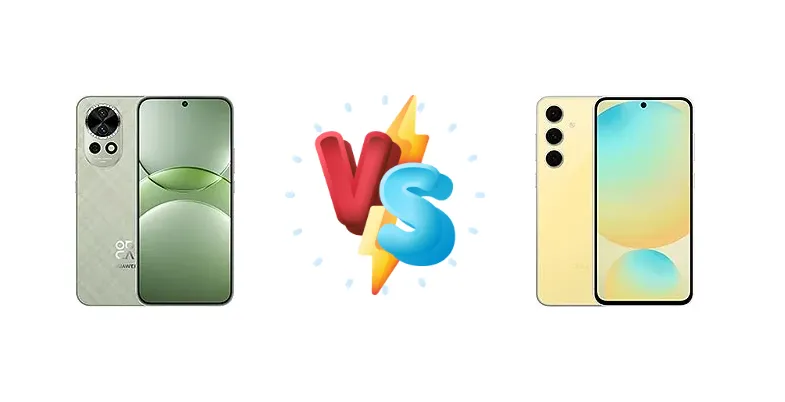
The Huawei nova 13 and Samsung Galaxy S24 FE represent compelling options in the increasingly competitive mid-range to upper-mid-range smartphone market. The nova 13 aggressively targets users prioritizing rapid charging, while the S24 FE focuses on delivering a well-rounded experience with a strong emphasis on battery endurance and a more established software ecosystem.
🏆 Quick Verdict
For the average user, the Samsung Galaxy S24 FE emerges as the more practical choice. Its 42-hour battery endurance and robust Exynos 2400e chipset provide a consistently reliable experience, outweighing the nova 13’s faster charging if you aren't constantly power-hungry.
| Network |
|---|
| 2G bands | GSM 850 / 900 / 1800 / 1900 | GSM 850 / 900 / 1800 / 1900 |
| 3G bands | HSDPA 800 / 850 / 900 / 1700(AWS) / 1900 / 2100 | HSDPA 850 / 900 / 1700(AWS) / 1900 / 2100 |
| 4G bands | LTE | 1, 2, 3, 4, 5, 7, 8, 12, 17, 18, 19, 20, 25, 26, 28, 32, 38, 40, 41, 66 - International |
| 5G bands | SA/NSA | 1, 2, 3, 5, 7, 8, 12, 20, 25, 26, 28, 38, 40, 41, 66, 75, 77, 78 SA/NSA/Sub6 - International |
| Speed | HSPA, LTE, 5G | HSPA, LTE, 5G |
| Technology | GSM / CDMA / HSPA / CDMA2000 / LTE / 5G | GSM / HSPA / LTE / 5G |
| Launch |
|---|
| Announced | 2024, October 22 | 2024, September 26 |
| Status | Available. Released 2024, October 25 | Available. Released 2024, October 03 |
| Body |
|---|
| Build | - | Glass front (Gorilla Glass Victus+), glass back (Gorilla Glass Victus+), aluminum frame |
| Dimensions | 161.4 x 75.3 x 7 mm (6.35 x 2.96 x 0.28 in) | 162 x 77.3 x 8 mm (6.38 x 3.04 x 0.31 in) |
| SIM | Nano-SIM + Nano-SIM | · Nano-SIM· Nano-SIM + Nano-SIM· Nano-SIM + eSIM· eSIM + eSIM |
| Weight | 195 g (6.88 oz) | 213 g (7.51 oz) |
| Display |
|---|
| Protection | Aluminosilicate glass | Corning Gorilla Glass Victus+, Mohs level 5 |
| Resolution | 1084 x 2412 pixels, 20:9 ratio (~395 ppi density) | 1080 x 2340 pixels, 19.5:9 ratio (~385 ppi density) |
| Size | 6.7 inches, 108.3 cm2 (~89.1% screen-to-body ratio) | 6.7 inches, 110.2 cm2 (~88.0% screen-to-body ratio) |
| Type | OLED, 1B colors, HDR, 120Hz | Dynamic AMOLED 2X, 120Hz, HDR10+, 1900 nits (peak) |
| Platform |
|---|
| CPU | - | 10-core (1x3.1 GHz + 2x2.9 GHz + 3x2.6 GHz + 4x1.95 GHz) |
| Chipset | - | Exynos 2400e (4 nm) |
| GPU | - | Xclipse 940 |
| OS | HarmonyOS 4.2 | Android 14, up to 7 major Android upgrades, One UI 8.0 |
| Memory |
|---|
| Card slot | No | No |
| Internal | 256GB 12GB RAM, 512GB 12GB RAM, 1TB 12GB RAM | 128GB 8GB RAM, 256GB 8GB RAM, 512GB 8GB RAM |
| Main Camera |
|---|
| Dual | 50 MP, f/1.9, (wide), PDAF
8 MP, f/2.2, 112˚ (ultrawide), AF | - |
| Features | Laser AF, color spectrum sensor, LED flash, panorama, HDR | LED flash, HDR, panorama |
| Triple | - | 50 MP, f/1.8, 24mm (wide), 1/1.57", 1.0µm, dual pixel PDAF, OIS
8 MP, f/2.4, 75mm (telephoto), 1/4.4", 1.0µm, PDAF, OIS, 3x optical zoom
12 MP, f/2.2, 13mm, 123˚ (ultrawide), 1/3.0", 1.12µm |
| Video | 4K, 1080p, gyro-EIS | 8K@30fps, 4K@30/60/120fps, 1080p@30/60/120/240fps |
| Selfie camera |
|---|
| Features | HDR, panorama | - |
| Single | 60 MP, f/2.4, 17mm, 100˚ (ultrawide) | 10 MP, f/2.4, 26mm (wide), 1/3.0", 1.22µm |
| Video | 4K@30fps, 1080p@30fps, gyro-EIS | 4K@30/60fps, 1080p@30/60fps; gyro-EIS |
| Sound |
|---|
| 35mm jack | No | No |
| Loudspeaker | Yes | Yes, with stereo speakers |
| Comms |
|---|
| Bluetooth | 5.2, A2DP, LE, L2HC (320-960 kbps HD audio) | 5.3, A2DP, LE |
| Infrared port | Yes | - |
| NFC | Yes | Yes |
| Positioning | GPS, GALILEO, GLONASS, BDS, QZSS | GPS, GLONASS, GALILEO, BDS |
| Radio | No | Unspecified |
| USB | USB Type-C 2.0, OTG | USB Type-C 3.2, OTG |
| WLAN | Wi-Fi 802.11 a/b/g/n/ac/6, dual-band, Wi-Fi Direct | Wi-Fi 802.11 a/b/g/n/ac/6e, dual-band or tri-band (market/region dependent), Wi-Fi Direct |
| Features |
|---|
| Sensors | Fingerprint (under display, optical), accelerometer, gyro, compass | Fingerprint (under display, optical), accelerometer, gyro, compass |
| Battery |
|---|
| Charging | 100W wired, 3-50% in 10 min
5W reverse wired | 25W wired, PD, QC2, 50% in 30 min
15W wireless
Reverse wireless |
| Type | 5000 mAh | 4700 mAh |
| Misc |
|---|
| Colors | Black, White, Purple, Green | Blue, Graphite, Gray, Mint, Yellow |
| Models | BLK-AL80, BLK-LX9 | SM-S721B, SM-S721B/DS, SM-S721U1, SM-S721U, SM-S721W, SM-S7210, SM-S721N |
| Price | About 350 EUR | $ 249.74 / C$ 498.99 / £ 335.00 / € 387.00 / ₹ 34,180 |
| SAR | - | 0.94 W/kg (head) 0.71 W/kg (body) |
| SAR EU | - | 0.86 W/kg (head) 1.29 W/kg (body) |
| EU LABEL |
|---|
| Battery | - | 42:00h endurance, 2000 cycles |
| Energy | - | Class B |
| Free fall | - | Class A (270 falls) |
| Repairability | - | Class C |
Huawei nova 13
- Extremely fast 100W wired charging
- 5W reverse wired charging for accessories
- Potentially competitive price point (depending on region)
- Limited information on chipset and camera specs
- Software ecosystem may be less mature than Samsung's
Samsung Galaxy S24 FE
- Exceptional 42-hour battery endurance
- Powerful Exynos 2400e (4nm) chipset
- Bright and vibrant display (1372 nits)
- Wireless and reverse wireless charging
- 25W charging is slower than the nova 13’s 100W
- May be slightly more expensive than the nova 13
Display Comparison
The Samsung Galaxy S24 FE boasts a significantly brighter display, reaching a measured peak of 1372 nits. This translates to superior visibility outdoors under direct sunlight. While the nova 13’s display specs are not provided, Samsung’s panel technology and brightness advantage are substantial. The S24 FE’s display is likely to offer better color accuracy and viewing angles, contributing to a more immersive experience. The S24 FE's display is also likely to have a higher refresh rate, contributing to smoother scrolling and animations.
Camera Comparison
Without detailed camera specifications for the nova 13, a direct comparison is limited. However, Samsung typically focuses on delivering versatile camera systems. The S24 FE likely features a more sophisticated image processing pipeline and potentially larger sensor sizes for improved low-light performance. The absence of details regarding the nova 13’s main sensor size and optical image stabilization (OIS) suggests the S24 FE holds an advantage in image quality and stability. We can assume the nova 13 will have a multi-camera setup, but the S24 FE’s overall camera system is likely more refined.
Performance
The Galaxy S24 FE is powered by the Exynos 2400e, a 4nm chipset featuring a 10-core CPU configuration (1x3.1 GHz + 2x2.9 GHz + 3x2.6 GHz + 4x1.95 GHz). This architecture provides a strong balance of performance and efficiency. The 4nm process node is crucial, offering better thermal management compared to older, larger nodes. While the nova 13’s chipset is unspecified, the S24 FE’s Exynos 2400e is expected to deliver superior sustained performance, particularly in demanding tasks like gaming and video editing. The S24 FE’s LPDDR5x RAM further enhances responsiveness.
Battery Life
The Samsung Galaxy S24 FE’s battery endurance is a standout feature, achieving an impressive 42 hours of usage. This is complemented by a 2000-cycle battery lifespan, indicating long-term reliability. While the nova 13 offers a blistering 100W wired charging – capable of reaching 30-50% charge in just 10 minutes – the S24 FE’s 25W charging, while slower, is still practical and supported by PD and QC2 standards. The S24 FE also offers 15W wireless and reverse wireless charging, adding to its versatility. The S24 FE’s active use score of 11:48h demonstrates its ability to handle demanding workloads throughout the day.
Buying Guide
Buy the Huawei nova 13 if you absolutely need the fastest possible charging speeds and frequently find yourself needing to top up your phone quickly. This phone is ideal for users who are always on the go and can't afford downtime. Buy the Samsung Galaxy S24 FE if you prioritize all-day battery life, a more refined software experience, and a proven track record of software updates. This is the better choice for users who want a dependable daily driver.
Frequently Asked Questions
❓ Does the Exynos 2400e chip in the S24 FE overheat during prolonged gaming sessions?
The Exynos 2400e, built on a 4nm process, is designed for improved thermal efficiency. While some heat generation is inevitable during intensive gaming, the S24 FE’s thermal management system should prevent significant throttling, allowing for sustained performance over extended periods. Benchmarks and user reports suggest it handles demanding games well.
❓ How useful is the 2MP macro camera often found in phones like the nova 13?
Generally, 2MP macro cameras offer limited utility. The low resolution results in images lacking detail and sharpness. While they can be fun for experimentation, they rarely produce photos suitable for anything beyond social media sharing. The S24 FE likely prioritizes image quality with its main sensors over including a low-resolution macro lens.
❓ Can the Samsung Galaxy S24 FE reliably run PUBG Mobile at 90fps?
The S24 FE's Exynos 2400e chipset and display capabilities suggest it *should* be capable of running PUBG Mobile at 90fps, depending on the game settings. However, achieving a consistent 90fps experience will depend on the specific device configuration and the game's optimization. Users may need to adjust graphics settings to maintain a stable frame rate.
❓ Is the 100W charging on the Huawei nova 13 compatible with all USB-PD chargers?
While the nova 13 supports USB-PD, achieving the full 100W charging speed requires a charger specifically rated for that wattage and compatible with Huawei's SuperCharge protocol. Using a standard USB-PD charger may result in slower charging speeds.