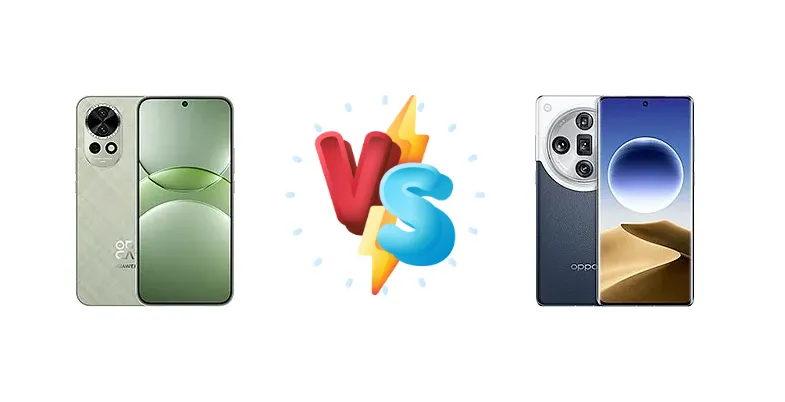
The Huawei nova 13 and Oppo Find X7 Ultra represent distinct approaches to the flagship smartphone market. The nova 13 aims to deliver a premium experience at a more accessible price point, while the Find X7 Ultra throws everything including the kitchen sink at the competition. This comparison dissects their key differences to help you determine which device best suits your needs.
🏆 Quick Verdict
For the average user prioritizing sustained performance and a top-tier display, the Oppo Find X7 Ultra is the clear winner. Its Snapdragon 8 Gen 3 chipset and 12:47h active use battery life provide a superior experience. However, the Huawei nova 13 offers compelling value for those seeking fast charging and a stylish design on a tighter budget.
| Network |
|---|
| 2G bands | GSM 850 / 900 / 1800 / 1900 | GSM 850 / 900 / 1800 / 1900 |
| 3G bands | HSDPA 800 / 850 / 900 / 1700(AWS) / 1900 / 2100 | HSDPA 800 / 850 / 900 / 1700(AWS) / 1900 / 2100 |
| 4G bands | LTE | 1, 2, 3, 4, 5, 7, 8, 12, 17, 18, 19, 20, 26, 28, 34, 38, 39, 40, 41, 66 |
| 5G bands | SA/NSA | 1, 2, 3, 5, 7, 8, 20, 28, 38, 40, 41, 66, 77, 78, 79 SA/NSA |
| Speed | HSPA, LTE, 5G | HSPA, LTE, 5G |
| Technology | GSM / CDMA / HSPA / CDMA2000 / LTE / 5G | GSM / CDMA / HSPA / CDMA2000 / LTE / 5G |
| Launch |
|---|
| Announced | 2024, October 22 | 2024, January 08 |
| Status | Available. Released 2024, October 25 | Available. Released 2024, January 12 |
| Body |
|---|
| Build | - | Glass front (Gorilla Glass Victus 2), glass back (Gorilla Glass) or eco leather back, aluminum frame |
| Dimensions | 161.4 x 75.3 x 7 mm (6.35 x 2.96 x 0.28 in) | 164.3 x 76.2 x 9.5 mm (6.47 x 3.00 x 0.37 in) |
| SIM | Nano-SIM + Nano-SIM | Nano-SIM + Nano-SIM |
| Weight | 195 g (6.88 oz) | 221 g (7.80 oz) |
| Display |
|---|
| Protection | Aluminosilicate glass | Corning Gorilla Glass Victus 2 |
| Resolution | 1084 x 2412 pixels, 20:9 ratio (~395 ppi density) | 1440 x 3168 pixels (~510 ppi density) |
| Size | 6.7 inches, 108.3 cm2 (~89.1% screen-to-body ratio) | 6.82 inches, 113.0 cm2 (~90.3% screen-to-body ratio) |
| Type | OLED, 1B colors, HDR, 120Hz | LTPO AMOLED, 1B colors, 120Hz, Dolby Vision, HDR10+, 1600 nits (typ), 2600 nits (HBM), 4500 nits (peak) |
| Platform |
|---|
| CPU | - | Octa-core (1x3.3 GHz Cortex-X4 & 3x3.2 GHz Cortex-A720 & 2x3.0 GHz Cortex-A720 & 2x2.3 GHz Cortex-A520) |
| Chipset | - | Qualcomm SM8650-AB Snapdragon 8 Gen 3 (4 nm) |
| GPU | - | Adreno 750 |
| OS | HarmonyOS 4.2 | Android 14, up to 4 major Android upgrades, ColorOS 14 |
| Memory |
|---|
| Card slot | No | No |
| Internal | 256GB 12GB RAM, 512GB 12GB RAM, 1TB 12GB RAM | 256GB 12GB RAM, 256GB 16GB RAM, 512GB 16GB RAM |
| Main Camera |
|---|
| Dual | 50 MP, f/1.9, (wide), PDAF
8 MP, f/2.2, 112˚ (ultrawide), AF | - |
| Features | Laser AF, color spectrum sensor, LED flash, panorama, HDR | Laser AF, color spectrum sensor, Hasselblad Color Calibration, LED flash, HDR, panorama |
| Quad | - | 50 MP, f/1.8, 23mm (wide), 1.0"-type, 1.6µm, dual pixel PDAF, OIS
50 MP, f/2.6, 65mm (periscope telephoto), 1/1.56", 1.0µm, 2.8x optical zoom, multi-directional PDAF (25cm - ∞), OIS
50 MP, f/4.3, 135mm (periscope telephoto), 1/2.51", 0.7µm, 6x optical zoom, dual pixel PDAF (35cm - ∞), OIS
50 MP, f/2.0, 14mm, 123˚ (ultrawide), 1/1.95", 1.0µm, PDAF |
| Video | 4K, 1080p, gyro-EIS | 4K@30/60fps, 1080p@30/60/240fps; gyro-EIS; HDR, 10‑bit video, Dolby Vision |
| Selfie camera |
|---|
| Features | HDR, panorama | Panorama |
| Single | 60 MP, f/2.4, 17mm, 100˚ (ultrawide) | 32 MP, f/2.4, 21mm (wide), 1/2.74", 0.8µm, PDAF |
| Video | 4K@30fps, 1080p@30fps, gyro-EIS | 4K@30/60fps, 1080p@30fps, gyro-EIS |
| Sound |
|---|
| 35mm jack | No | No |
| Loudspeaker | Yes | Yes, with stereo speakers |
| Comms |
|---|
| Bluetooth | 5.2, A2DP, LE, L2HC (320-960 kbps HD audio) | 5.4, A2DP, LE, aptX HD, LHDC |
| Infrared port | Yes | Yes |
| NFC | Yes | Yes |
| Positioning | GPS, GALILEO, GLONASS, BDS, QZSS | GPS (L1+L5), BDS (B1I+B1c+B2a), GALILEO (E1+E5a), QZSS (L1+L5), GLONASS |
| Radio | No | No |
| USB | USB Type-C 2.0, OTG | USB Type-C 3.2, OTG |
| WLAN | Wi-Fi 802.11 a/b/g/n/ac/6, dual-band, Wi-Fi Direct | Wi-Fi 802.11 a/b/g/n/ac/6e/7, dual-band, Wi-Fi Direct |
| Features |
|---|
| Sensors | Fingerprint (under display, optical), accelerometer, gyro, compass | Fingerprint (under display, optical), accelerometer, gyro, proximity, compass |
| Battery |
|---|
| Charging | 100W wired, 3-50% in 10 min
5W reverse wired | 100W wired, PD, 50% in 10 min, 100% in 26 min
50W wireless
10W reverse wireless |
| Type | 5000 mAh | 5000 mAh |
| Misc |
|---|
| Colors | Black, White, Purple, Green | Black, Dark Blue, Light Brown |
| Models | BLK-AL80, BLK-LX9 | PHY110, PHY120 |
| Price | About 350 EUR | $ 546.64 |
Huawei nova 13
- 100W Wired Charging: Extremely fast top-ups.
- Stylish Design: Likely a focus for the nova series.
- Potentially Lower Price: Offers value for budget-conscious buyers.
- Unknown Chipset: Likely less powerful than the Snapdragon 8 Gen 3.
- Missing Display Specs: Suggests a less advanced display.
Oppo Find X7 Ultra
- Snapdragon 8 Gen 3: Top-tier performance and efficiency.
- Bright Display: 1165 nits for excellent outdoor visibility.
- Long Battery Life: 12:47h of active use.
- 50W Wireless Charging: Convenient charging option.
- Higher Price: A premium flagship comes with a premium cost.
- Potential for Throttling: High performance can lead to heat buildup.
Display Comparison
The Oppo Find X7 Ultra boasts a significantly brighter display, reaching a measured peak of 1165 nits. This translates to superior visibility in direct sunlight compared to the Huawei nova 13 (brightness data unavailable, but likely lower given its market positioning). While both phones likely utilize AMOLED panels, the Find X7 Ultra’s higher brightness and potential for LTPO technology (implied by its flagship status) suggest a more dynamic and power-efficient viewing experience. The absence of detailed display specs for the nova 13 suggests Oppo prioritizes this aspect more heavily.
Camera Comparison
While both phones are expected to feature multi-camera systems, the Oppo Find X7 Ultra is likely to excel in image quality due to its flagship positioning. Details on the nova 13’s camera are missing, but the Find X7 Ultra’s potential for larger sensors, wider apertures, and advanced image processing algorithms (powered by the Snapdragon 8 Gen 3’s ISP) will result in superior low-light performance and dynamic range. The Find X7 Ultra’s focus on camera technology is a key differentiator.
Performance
The Oppo Find X7 Ultra’s Qualcomm Snapdragon 8 Gen 3 (4nm) chipset is a powerhouse, featuring a unique octa-core configuration with a prime Cortex-X4 core clocked at 3.3 GHz. This architecture, combined with the 4nm fabrication process, delivers exceptional performance and thermal efficiency. The Huawei nova 13’s chipset is not specified, but given its price point, it will likely utilize a mid-range processor, resulting in noticeable performance differences in demanding tasks like gaming and video editing. The Snapdragon 8 Gen 3’s Adreno GPU will also provide a substantial advantage in graphics-intensive applications.
Battery Life
The Oppo Find X7 Ultra demonstrates impressive battery endurance, achieving 12 hours and 47 minutes of active use. While the Huawei nova 13’s battery capacity is unknown, the Find X7 Ultra’s longer runtime suggests a more efficient chipset and optimized power management. Both phones support 100W wired charging, achieving 50% charge in approximately 10 minutes. However, the Find X7 Ultra adds 50W wireless charging and 10W reverse wireless charging, offering greater versatility. The Find X7 Ultra’s 0-100% wired charge time is 26 minutes, while the nova 13’s is not specified, but likely similar for the initial 50%.
Buying Guide
Buy the Huawei nova 13 if you need a stylish phone with incredibly fast 100W wired charging and are comfortable with potential software limitations. It’s ideal for users who prioritize quick top-ups and a sleek aesthetic. Buy the Oppo Find X7 Ultra if you prefer uncompromising performance, a brighter and more capable display, and extended battery life, even if it comes at a higher price. This is the phone for power users, mobile gamers, and photography enthusiasts.
Frequently Asked Questions
❓ Does the Oppo Find X7 Ultra get noticeably hot during extended gaming sessions?
The Snapdragon 8 Gen 3 is thermally efficient, but demanding games will inevitably generate heat. The Find X7 Ultra likely incorporates advanced cooling solutions to mitigate throttling, but some warmth is expected during prolonged use. Reviewers will need to test sustained performance to determine the extent of any throttling.
❓ Is the 100W charging on the Huawei nova 13 compatible with all USB-PD chargers?
While the nova 13 supports 100W wired charging, full speed may require a compatible charger that specifically supports Huawei’s SuperCharge protocol. Standard USB-PD chargers may charge at a slower rate. It's best to use the included charger or a Huawei-certified alternative.
❓ How does the camera processing differ between the Huawei nova 13 and the Oppo Find X7 Ultra?
Oppo typically aims for a more natural and balanced image processing style, while Huawei historically favored more vibrant and saturated colors. The Find X7 Ultra’s Snapdragon 8 Gen 3 ISP will likely offer more advanced computational photography features, resulting in better dynamic range and detail preservation.
❓ What kind of software experience can I expect on the Huawei nova 13, given the ongoing restrictions?
Huawei’s software experience has evolved due to restrictions on Google Mobile Services. The nova 13 will run on Huawei’s EMUI or HarmonyOS, which includes Huawei’s AppGallery as an alternative app store. While many popular apps are available, some Google services may be missing or require workarounds.