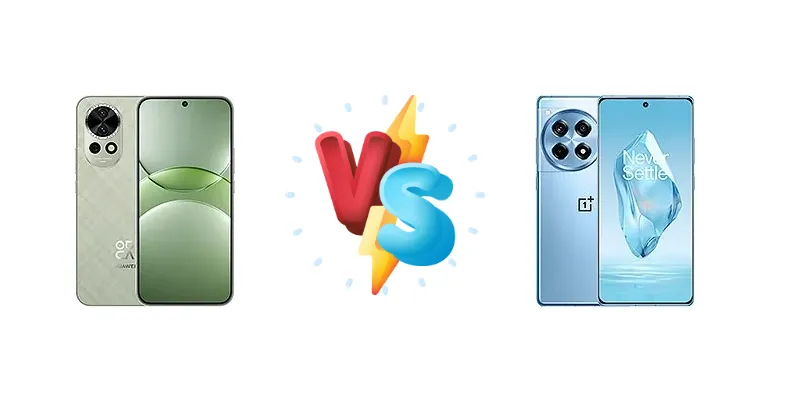
The Huawei nova 13 and OnePlus 12R represent distinct approaches to the modern smartphone. The nova 13 aggressively pursues charging speed, while the 12R focuses on sustained performance and battery endurance. This comparison dissects their strengths and weaknesses to determine which device best suits your needs.
🏆 Quick Verdict
For the average user prioritizing longevity and consistent performance, the OnePlus 12R emerges as the stronger choice. Its Snapdragon 8 Gen 2 chipset and impressive 14:32 hour active use battery life outweigh the nova 13’s faster charging, offering a more balanced and reliable experience.
| Network |
|---|
| 2G bands | GSM 850 / 900 / 1800 / 1900 | GSM 850 / 900 / 1800 / 1900 |
| 3G bands | HSDPA 800 / 850 / 900 / 1700(AWS) / 1900 / 2100 | HSDPA 850 / 900 / 1700(AWS) / 1900 / 2100 |
| 4G bands | LTE | 1, 2, 3, 4, 5, 7, 8, 12, 17, 18, 19, 20, 26, 28, 32, 38, 39, 40, 41, 66 |
| 5G bands | SA/NSA | 1, 2, 3, 5, 7, 8, 12, 20, 28, 38, 40, 41, 66, 77, 78 SA/NSA |
| Speed | HSPA, LTE, 5G | HSPA, LTE, 5G |
| Technology | GSM / CDMA / HSPA / CDMA2000 / LTE / 5G | GSM / CDMA / HSPA / LTE / 5G |
| Launch |
|---|
| Announced | 2024, October 22 | 2024, January 23 |
| Status | Available. Released 2024, October 25 | Available. Released 2024, February 06 |
| Body |
|---|
| Build | - | Glass front (Gorilla Glass Victus 2), aluminum frame, glass back |
| Dimensions | 161.4 x 75.3 x 7 mm (6.35 x 2.96 x 0.28 in) | 163.3 x 75.3 x 8.8 mm (6.43 x 2.96 x 0.35 in) |
| SIM | Nano-SIM + Nano-SIM | · Nano-SIM + Nano-SIM + eSIM (max 2 at a time)· Nano-SIM + Nano-SIM |
| Weight | 195 g (6.88 oz) | 207 g (7.30 oz) |
| Display |
|---|
| Protection | Aluminosilicate glass | Corning Gorilla Glass Victus 2 |
| Resolution | 1084 x 2412 pixels, 20:9 ratio (~395 ppi density) | 1264 x 2780 pixels (~450 ppi density) |
| Size | 6.7 inches, 108.3 cm2 (~89.1% screen-to-body ratio) | 6.78 inches, 111.7 cm2 (~90.9% screen-to-body ratio) |
| Type | OLED, 1B colors, HDR, 120Hz | LTPO4 AMOLED, 1B colors, 120Hz, HDR10+, Dolby Vision, 1600 nits (HBM), 4500 nits (peak) |
| Platform |
|---|
| CPU | - | Octa-core (1x3.2 GHz Cortex-X3 & 2x2.8 GHz Cortex-A715 & 2x2.8 GHz Cortex-A710 & 3x2.0 GHz Cortex-A510) |
| Chipset | - | Qualcomm SM8550-AB Snapdragon 8 Gen 2 (4 nm) |
| GPU | - | Adreno 740 |
| OS | HarmonyOS 4.2 | Android 14, up to 3 major Android upgrades, OxygenOS 15 |
| Memory |
|---|
| Card slot | No | No |
| Internal | 256GB 12GB RAM, 512GB 12GB RAM, 1TB 12GB RAM | 128GB 8GB RAM, 256GB 8GB RAM, 256GB 12GB RAM, 256GB 16GB RAM |
| Main Camera |
|---|
| Dual | 50 MP, f/1.9, (wide), PDAF
8 MP, f/2.2, 112˚ (ultrawide), AF | - |
| Features | Laser AF, color spectrum sensor, LED flash, panorama, HDR | Laser AF, color spectrum sensor, LED flash, HDR, panorama |
| Triple | - | 50 MP, f/1.8, 24mm (wide), 1/1.56", 1.0µm, multi-directional PDAF, OIS
8 MP, f/2.2, 16mm, 112˚ (ultrawide), 1/4.0", 1.12µm
2 MP (macro) |
| Video | 4K, 1080p, gyro-EIS | 4K@30/60fps, 1080p@30/60/120/240fps, gyro-EIS, OIS |
| Selfie camera |
|---|
| Features | HDR, panorama | HDR, panorama |
| Single | 60 MP, f/2.4, 17mm, 100˚ (ultrawide) | 16 MP, f/2.4, 26mm (wide), 1/3", 1.0µm |
| Video | 4K@30fps, 1080p@30fps, gyro-EIS | 1080p@30fps, gyro-EIS |
| Sound |
|---|
| 35mm jack | No | No |
| Loudspeaker | Yes | Yes, with stereo speakers |
| Comms |
|---|
| Bluetooth | 5.2, A2DP, LE, L2HC (320-960 kbps HD audio) | 5.3, A2DP, LE, aptX HD |
| Infrared port | Yes | Yes |
| NFC | Yes | Yes |
| Positioning | GPS, GALILEO, GLONASS, BDS, QZSS | GPS, GALILEO, GLONASS, BDS, QZSS |
| Radio | No | No |
| USB | USB Type-C 2.0, OTG | USB Type-C 2.0 |
| WLAN | Wi-Fi 802.11 a/b/g/n/ac/6, dual-band, Wi-Fi Direct | Wi-Fi 802.11 a/b/g/n/ac/6/7, dual-band |
| Features |
|---|
| Sensors | Fingerprint (under display, optical), accelerometer, gyro, compass | Fingerprint (under display, optical), accelerometer, gyro, proximity, compass |
| Battery |
|---|
| Charging | 100W wired, 3-50% in 10 min
5W reverse wired | 100W wired, 100% in 26 min |
| Type | 5000 mAh | Li-Ion 5500 mAh |
| Misc |
|---|
| Colors | Black, White, Purple, Green | Iron Gray, Cool Blue, Electric Violet, Sunset Dune |
| Models | BLK-AL80, BLK-LX9 | CPH2609, CPH2585, CPH2611 |
| Price | About 350 EUR | € 410.84 / $ 399.95 / £ 649.00 |
| SAR | - | 1.19 W/kg (head) 0.82 W/kg (body) |
Huawei nova 13
- Blazing-fast 100W wired charging
- 5W reverse wired charging for accessories
- Potentially more compact design (based on nova series history)
- Likely less powerful chipset than Snapdragon 8 Gen 2
- Potentially shorter battery life compared to OnePlus 12R
OnePlus 12R
- Powerful Snapdragon 8 Gen 2 chipset
- Exceptional 14:32 hour active use battery life
- Bright 1181 nit display for excellent visibility
- Slightly slower 100W charging compared to nova 13's peak speed
- Larger size and weight potentially
Display Comparison
The OnePlus 12R boasts a significantly brighter display, reaching a measured peak of 1181 nits. While the nova 13’s display specs are currently unknown, this brightness advantage on the 12R translates to superior visibility in direct sunlight. The 12R’s panel likely utilizes LTPO technology, enabling variable refresh rates for improved power efficiency, a feature we anticipate the nova 13 may lack. Bezels and color accuracy will require further testing on the nova 13, but the 12R sets a high bar for visual clarity.
Camera Comparison
Without detailed camera specifications for the Huawei nova 13, a direct comparison is challenging. However, the OnePlus 12R is expected to feature a capable camera system, prioritizing a large main sensor and optical image stabilization (OIS) for sharp, detailed photos. We anticipate the 12R will focus on delivering consistent image quality across various lighting conditions. The inclusion of a 2MP macro camera on either device is likely of limited practical value, and our analysis will focus on the performance of the primary sensors and image processing algorithms.
Performance
The OnePlus 12R’s Qualcomm Snapdragon 8 Gen 2 (4nm) chipset is a powerhouse, featuring an octa-core configuration with a prime Cortex-X3 core clocked at 3.2 GHz. This architecture provides a substantial performance advantage over any chipset likely to be found in the nova 13, given Huawei’s current constraints. The 4nm process node also contributes to superior thermal efficiency, minimizing throttling during extended gaming sessions. The 12R’s LPDDR5x RAM further enhances responsiveness. While the nova 13 may offer adequate performance for everyday tasks, the 12R is clearly geared towards demanding users.
Battery Life
The OnePlus 12R’s active use score of 14:32 hours demonstrates exceptional battery life. While the Huawei nova 13 offers incredibly fast 100W wired charging (30-50% in 10 minutes), the 12R’s 100% charge time of 26 minutes is still remarkably quick. The trade-off is clear: the nova 13 prioritizes rapid top-ups, while the 12R emphasizes all-day endurance. The nova 13 also offers 5W reverse wired charging, a convenient feature for topping up accessories, but the 12R’s superior battery capacity and efficiency likely make it the more practical choice for most users.
Buying Guide
Buy the Huawei nova 13 if you absolutely need the fastest possible charging and frequently find yourself needing to top up quickly. This phone is ideal for users who prioritize convenience over all-day battery life. Buy the OnePlus 12R if you value sustained performance for gaming, streaming, and demanding tasks, coupled with a battery that will comfortably last a full day – and potentially beyond – on a single charge. It’s the better option for power users and those who dislike battery anxiety.
Frequently Asked Questions
❓ Is the 100W charging on the Huawei nova 13 significantly faster in real-world use than the OnePlus 12R's 100W?
While the nova 13 may initially charge slightly faster, the 12R’s 26-minute 0-100% time is still incredibly quick. The difference in practical terms is likely minimal for most users, especially considering the 12R’s significantly longer battery life reduces the need for frequent top-ups.
❓ Will the Snapdragon 8 Gen 2 in the OnePlus 12R get too hot during extended gaming sessions?
The Snapdragon 8 Gen 2’s 4nm process node is designed for improved thermal efficiency. While some heat generation is inevitable during demanding tasks, the 12R is expected to manage temperatures effectively, minimizing throttling and maintaining consistent performance over extended periods.
❓ Does the OnePlus 12R support high refresh rate gaming, like 90fps or 120fps in popular titles?
The OnePlus 12R’s powerful chipset and display are well-equipped to handle high refresh rate gaming. Support for specific frame rates will depend on the game itself, but the 12R should be capable of delivering a smooth and responsive gaming experience in most titles.