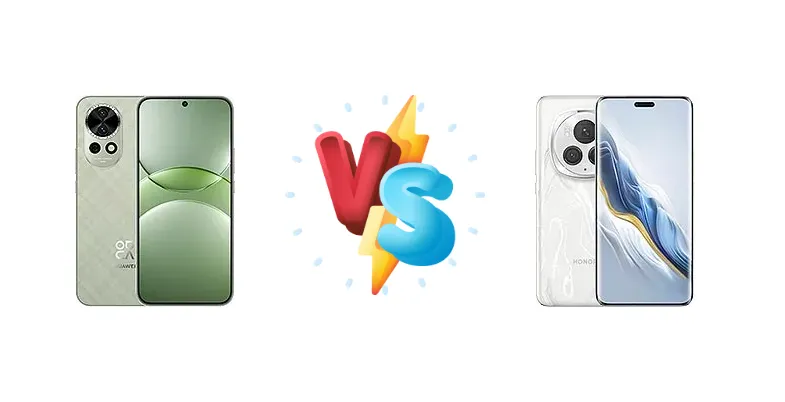
The Huawei nova 13 and Honor Magic6 Pro represent distinct approaches to the modern smartphone experience. The nova 13 aggressively prioritizes charging speed, aiming for quick top-ups, while the Magic6 Pro focuses on maximizing battery endurance and delivering a flagship-level experience with the latest Qualcomm silicon. This comparison dissects their key differences to determine which device best suits your needs.
🏆 Quick Verdict
For users prioritizing absolute charging speed and a more accessible price point, the Huawei nova 13 is the clear winner. However, the Honor Magic6 Pro’s exceptional 14:06 hour active use battery life, coupled with the powerful Snapdragon 8 Gen 3, makes it the superior choice for power users and those demanding sustained performance.
| Network |
|---|
| 2G bands | GSM 850 / 900 / 1800 / 1900 | GSM 850 / 900 / 1800 / 1900 |
| 3G bands | HSDPA 800 / 850 / 900 / 1700(AWS) / 1900 / 2100 | HSDPA 800 / 850 / 900 / 1700(AWS) / 1900 / 2100 |
| 4G bands | LTE | LTE |
| 5G bands | SA/NSA | SA/NSA |
| Speed | HSPA, LTE, 5G | HSPA, LTE, 5G |
| Technology | GSM / CDMA / HSPA / CDMA2000 / LTE / 5G | GSM / CDMA / HSPA / CDMA2000 / LTE / 5G |
| Launch |
|---|
| Announced | 2024, October 22 | 2024, January 11 |
| Status | Available. Released 2024, October 25 | Available. Released 2024, January 18 |
| Body |
|---|
| Build | - | Glass front (NanoCrystal Shield), glass back or silicone polymer back (eco leather) |
| Dimensions | 161.4 x 75.3 x 7 mm (6.35 x 2.96 x 0.28 in) | 162.5 x 75.8 x 8.9 mm (6.40 x 2.98 x 0.35 in) |
| SIM | Nano-SIM + Nano-SIM | · Nano-SIM + eSIM· Nano-SIM + Nano-SIM |
| Weight | 195 g (6.88 oz) | 225 g or 229 g (7.94 oz) |
| Display |
|---|
| Protection | Aluminosilicate glass | NanoCrystal Shield |
| Resolution | 1084 x 2412 pixels, 20:9 ratio (~395 ppi density) | 1280 x 2800 pixels, 19.5:9 ratio (~453 ppi density) |
| Size | 6.7 inches, 108.3 cm2 (~89.1% screen-to-body ratio) | 6.8 inches, 112.8 cm2 (~91.6% screen-to-body ratio) |
| Type | OLED, 1B colors, HDR, 120Hz | LTPO OLED, 1B colors, 120Hz, Dolby Vision, HDR, 1600 nits (HBM), 5000 nits (peak) |
| Platform |
|---|
| CPU | - | Octa-core (1x3.3 GHz Cortex-X4 & 3x3.2 GHz Cortex-A720 & 2x3.0 GHz Cortex-A720 & 2x2.3 GHz Cortex-A520) |
| Chipset | - | Qualcomm SM8650-AB Snapdragon 8 Gen 3 (4 nm) |
| GPU | - | Adreno 750 |
| OS | HarmonyOS 4.2 | Android 14, up to 4 major Android upgrades, MagicOS 8 |
| Memory |
|---|
| Card slot | No | No |
| Internal | 256GB 12GB RAM, 512GB 12GB RAM, 1TB 12GB RAM | 256GB 12GB RAM, 256GB 16GB RAM, 512GB 12GB RAM, 512GB 16GB RAM, 1TB 16GB RAM |
| Main Camera |
|---|
| Dual | 50 MP, f/1.9, (wide), PDAF
8 MP, f/2.2, 112˚ (ultrawide), AF | - |
| Features | Laser AF, color spectrum sensor, LED flash, panorama, HDR | Laser AF, color spectrum sensor, LED flash, HDR, panorama |
| Triple | - | 50 MP, f/1.4-2.0, 23mm (wide), 1/1.3", 1.2µm, PDAF, OIS
180 MP, f/2.6, (periscope telephoto), 1/1.49", 0.56µm, PDAF, OIS, 2.5x optical zoom
50 MP, f/2.0, 13mm, 122˚ (ultrawide), 1/2.88", 0.61µm, AF |
| Video | 4K, 1080p, gyro-EIS | 4K@24/30/60fps, 1080p@30/60/120/240fps, gyro-EIS, OIS, HDR, 10-bit video |
| Selfie camera |
|---|
| Features | HDR, panorama | - |
| Single | 60 MP, f/2.4, 17mm, 100˚ (ultrawide) | 50 MP, f/2.0, 22mm (wide), 1/2.93", 0.6µm, AF
TOF 3D, (depth/biometrics sensor) |
| Video | 4K@30fps, 1080p@30fps, gyro-EIS | 4K@30fps, 1080p@30/60fps, gyro-EIS |
| Sound |
|---|
| 35mm jack | No | No |
| Loudspeaker | Yes | Yes, with stereo speakers |
| Comms |
|---|
| Bluetooth | 5.2, A2DP, LE, L2HC (320-960 kbps HD audio) | 5.3, A2DP, LE, aptX HD |
| Infrared port | Yes | Yes |
| NFC | Yes | Yes |
| Positioning | GPS, GALILEO, GLONASS, BDS, QZSS | GPS (L1+L5), GLONASS, BDS (B1I+B1c+B2a), GALILEO (E1+E5a) |
| Radio | No | No |
| USB | USB Type-C 2.0, OTG | USB Type-C 3.2, DisplayPort 1.2, OTG |
| WLAN | Wi-Fi 802.11 a/b/g/n/ac/6, dual-band, Wi-Fi Direct | Wi-Fi 802.11 a/b/g/n/ac/6/7, dual-band, Wi-Fi Direct |
| Features |
|---|
| Sensors | Fingerprint (under display, optical), accelerometer, gyro, compass | Fingerprint (under display, optical), Face ID, accelerometer, gyro, proximity, compass |
| Battery |
|---|
| Charging | 100W wired, 3-50% in 10 min
5W reverse wired | 80W wired
66W wireless
Reverse wireless
5W reverse wired |
| Type | 5000 mAh | Si/C Li-Ion 5600 mAh |
| Misc |
|---|
| Colors | Black, White, Purple, Green | Black, Green, Blue, Purple, White |
| Models | BLK-AL80, BLK-LX9 | BVL-AN16, BVL-N49 |
| Price | About 350 EUR | € 455.54 / $ 899.00 / £ 598.99 |
Huawei nova 13
- Ultra-fast 100W wired charging
- Potentially more affordable price point
- 5W reverse wired charging
- Chipset performance likely lags behind Snapdragon 8 Gen 3
- Battery life likely shorter than Magic6 Pro
Honor Magic6 Pro
- Exceptional 14:06 hour active use battery life
- Powerful Snapdragon 8 Gen 3 processor
- Bright 1578 nit display
- Slower 80W wired charging compared to nova 13
- Higher price point expected
Display Comparison
The Honor Magic6 Pro boasts a significantly brighter display, reaching a measured peak of 1578 nits. This translates to superior visibility in direct sunlight, a crucial advantage for outdoor users. While the nova 13’s display specifications are currently unavailable, the Magic6 Pro’s brightness level suggests a premium viewing experience. The Magic6 Pro’s panel likely utilizes LTPO technology for adaptive refresh rates, further enhancing battery efficiency, a feature not confirmed for the nova 13.
Camera Comparison
Detailed camera specifications for the Huawei nova 13 are currently unavailable. However, the Honor Magic6 Pro is expected to feature a high-end camera system, leveraging the processing power of the Snapdragon 8 Gen 3 for advanced image processing. The focus should be on the main sensor’s size and aperture, as these directly impact low-light performance. Without specific details on the nova 13’s camera, it’s difficult to make a direct comparison, but the Magic6 Pro’s chipset suggests a more sophisticated imaging experience.
Performance
The Honor Magic6 Pro is powered by the Qualcomm SM8650-AB Snapdragon 8 Gen 3 (4nm), a cutting-edge chipset featuring a unique octa-core configuration (1x3.3 GHz Cortex-X4, 3x3.2 GHz Cortex-A720, 2x3.0 GHz Cortex-A720, 2x2.3 GHz Cortex-A520). This architecture prioritizes both peak performance and efficiency. The nova 13’s chipset is unspecified, but given its positioning, it likely utilizes a mid-range or slightly older generation processor. The 4nm process node of the Snapdragon 8 Gen 3 in the Magic6 Pro offers superior thermal efficiency compared to older nodes, minimizing throttling during extended gaming sessions and demanding applications.
Battery Life
The Honor Magic6 Pro excels in battery life, achieving an impressive 14:06 hours of active use. While the nova 13 offers a rapid 100W wired charging solution (30-50% in 10 minutes), the Magic6 Pro counters with 80W wired, 66W wireless, and reverse wireless charging capabilities. The nova 13’s 100W charging is faster, but the Magic6 Pro’s larger battery capacity and efficient chipset provide significantly longer runtimes between charges. The inclusion of 5W reverse wired charging on both devices allows for topping up accessories.
Buying Guide
Buy the Huawei nova 13 if you frequently find yourself needing to quickly replenish your battery throughout the day and value a faster charging experience above all else. Buy the Honor Magic6 Pro if you demand all-day battery life, top-tier performance for demanding tasks like gaming, and a brighter, more vibrant display experience. The Magic6 Pro is geared towards users who want a no-compromise flagship.
Frequently Asked Questions
❓ How does the 80W charging on the Honor Magic6 Pro compare to the 100W charging on the Huawei nova 13 in real-world usage?
While the nova 13 charges faster initially, the Magic6 Pro’s larger battery and efficient power management mean you’ll likely spend less time overall plugged into a charger. The 100W is great for quick top-ups, but the Magic6 Pro’s endurance reduces the need for frequent charging.
❓ Is the Snapdragon 8 Gen 3 in the Honor Magic6 Pro overkill for everyday tasks like browsing and social media?
No, the Snapdragon 8 Gen 3 provides a future-proof experience and ensures smooth performance even with demanding applications. While everyday tasks won’t fully utilize its capabilities, it guarantees a lag-free experience and handles multitasking with ease. It also benefits gaming and video editing.
❓ Does the Honor Magic6 Pro support high refresh rate gaming, and will the Snapdragon 8 Gen 3 maintain stable frame rates?
The Snapdragon 8 Gen 3 is designed to handle high refresh rate gaming. While specific game support and settings will vary, the chipset’s Adreno GPU is capable of delivering consistently high frame rates in popular titles. The advanced thermal management system further minimizes throttling, ensuring sustained performance.