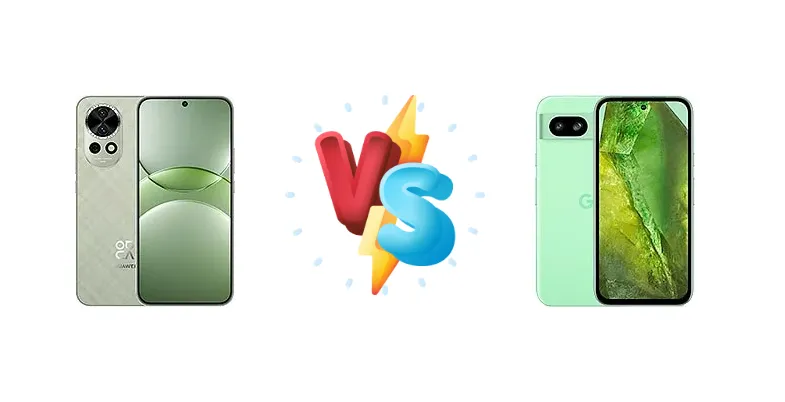
The Huawei nova 13 and Google Pixel 8a represent distinct philosophies in the mid-range smartphone market. The nova 13 prioritizes charging speed, boasting a remarkable 100W wired charging capability, while the Pixel 8a focuses on sustained performance and all-day battery life, backed by Google’s Tensor G3 chipset and a measured 40:06h endurance rating. This comparison dissects these core differences to determine which device best suits your needs.
🏆 Quick Verdict
For users prioritizing minimal downtime and rapid top-ups, the Huawei nova 13 is the clear winner thanks to its 100W charging, capable of adding 50% charge in just 10 minutes. However, the Google Pixel 8a excels in overall battery endurance, offering a significantly longer usage time between charges and a more refined software experience.
| Network |
|---|
| 2G bands | GSM 850 / 900 / 1800 / 1900 | GSM 850 / 900 / 1800 / 1900 |
| 3G bands | HSDPA 800 / 850 / 900 / 1700(AWS) / 1900 / 2100 | HSDPA 800 / 850 / 900 / 1700(AWS) / 1900 / 2100 |
| 4G bands | LTE | 1, 2, 3, 4, 5, 7, 8, 12, 17, 18, 19, 20, 26, 28, 32, 38, 40, 41, 42, 66 - G6GPR (International) |
| 5G bands | SA/NSA | 1, 2, 3, 5, 7, 8, 12, 20, 26, 28, 38, 40, 41, 66, 75, 76, 77, 78 SA/NSA/Sub6 - G6GPR (International) |
| Speed | HSPA, LTE, 5G | HSPA, LTE, 5G |
| Technology | GSM / CDMA / HSPA / CDMA2000 / LTE / 5G | GSM / HSPA / LTE / 5G |
| Launch |
|---|
| Announced | 2024, October 22 | 2024, May 07 |
| Status | Available. Released 2024, October 25 | Available. Released 2024, May 14 |
| Body |
|---|
| Build | - | Glass front (Gorilla Glass 3), aluminum frame, plastic back |
| Dimensions | 161.4 x 75.3 x 7 mm (6.35 x 2.96 x 0.28 in) | 152.1 x 72.7 x 8.9 mm (5.99 x 2.86 x 0.35 in) |
| SIM | Nano-SIM + Nano-SIM | Nano-SIM + eSIM |
| Weight | 195 g (6.88 oz) | 188 g (6.63 oz) |
| Display |
|---|
| Protection | Aluminosilicate glass | Corning Gorilla Glass 3, Mohs level 5 |
| Resolution | 1084 x 2412 pixels, 20:9 ratio (~395 ppi density) | 1080 x 2400 pixels, 20:9 ratio (~430 ppi density) |
| Size | 6.7 inches, 108.3 cm2 (~89.1% screen-to-body ratio) | 6.1 inches, 90.3 cm2 (~81.6% screen-to-body ratio) |
| Type | OLED, 1B colors, HDR, 120Hz | OLED, HDR, 120Hz, 2000 nits (peak) |
| Platform |
|---|
| CPU | - | Nona-core (1x3.0 GHz Cortex-X3 & 4x2.45 GHz Cortex-A715 & 4x2.15 GHz Cortex-A510) |
| Chipset | - | Google Tensor G3 (4 nm) |
| GPU | - | Immortalis-G715s MC10 |
| OS | HarmonyOS 4.2 | Android 14, upgradable to Android 16, up to 7 major Android upgrades |
| Memory |
|---|
| Card slot | No | No |
| Internal | 256GB 12GB RAM, 512GB 12GB RAM, 1TB 12GB RAM | 128GB 8GB RAM, 256GB 8GB RAM |
| Main Camera |
|---|
| Dual | 50 MP, f/1.9, (wide), PDAF
8 MP, f/2.2, 112˚ (ultrawide), AF | 64 MP (16 MP eff.), f/1.9, 26mm (wide), 1/1.73", 0.8µm, dual pixel PDAF, OIS
13 MP, f/2.2, 120˚ (ultrawide), 1.12µm |
| Features | Laser AF, color spectrum sensor, LED flash, panorama, HDR | Dual-LED flash, Pixel Shift, Ultra HDR, panorama, Best Take |
| Video | 4K, 1080p, gyro-EIS | 4K@30/60fps, 1080p@30/60/120/240fps, OIS |
| Selfie camera |
|---|
| Features | HDR, panorama | HDR, panorama |
| Single | 60 MP, f/2.4, 17mm, 100˚ (ultrawide) | 13 MP, f/2.2, 20mm (ultrawide), 1.12µm |
| Video | 4K@30fps, 1080p@30fps, gyro-EIS | 4K@30fps, 1080p@30/60fps |
| Sound |
|---|
| 35mm jack | No | No |
| Loudspeaker | Yes | Yes, with stereo speakers |
| Comms |
|---|
| Bluetooth | 5.2, A2DP, LE, L2HC (320-960 kbps HD audio) | 5.3, A2DP, LE |
| Infrared port | Yes | - |
| NFC | Yes | Yes |
| Positioning | GPS, GALILEO, GLONASS, BDS, QZSS | GPS, GLONASS, GALILEO, BDS, QZSS, NavIC |
| Radio | No | No |
| USB | USB Type-C 2.0, OTG | USB Type-C 3.2 |
| WLAN | Wi-Fi 802.11 a/b/g/n/ac/6, dual-band, Wi-Fi Direct | Wi-Fi 802.11 a/b/g/n/ac/6e, dual/tri-band (market/region dependent) |
| Features |
|---|
| Sensors | Fingerprint (under display, optical), accelerometer, gyro, compass | Fingerprint (under display, optical), accelerometer, gyro, proximity, compass, barometer |
| Battery |
|---|
| Charging | 100W wired, 3-50% in 10 min
5W reverse wired | 18W wired, PD3.0
7.5W wireless
Bypass charging |
| Type | 5000 mAh | Li-Po 4492 mAh |
| Misc |
|---|
| Colors | Black, White, Purple, Green | Obsidian, Porcelain, Bay, Aloe |
| Models | BLK-AL80, BLK-LX9 | GKV4X, G6GPR, G8HHN, G576D |
| Price | About 350 EUR | $ 229.98 / C$ 417.99 / £ 279.00 / € 299.99 / ₹ 33,300 |
| EU LABEL |
|---|
| Battery | - | 40:06h endurance, 1000 cycles |
| Energy | - | Class B |
| Free fall | - | Class A (270 falls) |
| Repairability | - | Class B |
Huawei nova 13
- Blazing-fast 100W wired charging
- 5W reverse wired charging for accessories
- Potentially competitive price point
- Battery life likely shorter than Pixel 8a
- Chipset details currently unknown
Google Pixel 8a
- Exceptional 40:06h battery endurance
- Google Tensor G3 with AI capabilities
- Excellent camera performance with computational photography
- Slower 18W wired charging
- No reverse wireless charging
Display Comparison
The Pixel 8a boasts a display capable of reaching 1508 nits peak brightness, a figure measured directly, ensuring excellent visibility even in direct sunlight. While the nova 13’s display specifications are currently unavailable, Huawei typically employs OLED panels. The Pixel 8a’s brightness advantage is significant, impacting outdoor usability. The Pixel 8a’s display technology likely incorporates features like smooth refresh rates and potentially LTPO for adaptive power saving, features not yet confirmed for the nova 13.
Camera Comparison
The Pixel 8a’s camera system benefits from Google’s renowned computational photography, leveraging the Tensor G3’s processing power. While sensor details are not provided for the nova 13, the Pixel 8a’s image processing excels in dynamic range and low-light performance. The absence of detailed camera specs for the nova 13 suggests a focus on general-purpose photography rather than specialized features. The Pixel 8a’s software algorithms are a key differentiator, consistently delivering high-quality images with minimal user effort.
Performance
The Google Pixel 8a is powered by the Google Tensor G3 (4nm), a nona-core processor featuring a Cortex-X3 prime core for peak performance, alongside A715 and A510 cores for efficiency. This 4nm fabrication process contributes to improved thermal management compared to older nodes. The nova 13’s chipset is unspecified, but given its positioning, it likely utilizes a mid-range Qualcomm Snapdragon or MediaTek Dimensity chip. The Tensor G3’s integrated AI capabilities provide advantages in areas like image processing and voice recognition, differentiating it from a purely performance-focused chipset.
Battery Life
The Pixel 8a’s endurance rating of 40:06h and active use score of 11:25h demonstrate exceptional battery life, supported by 83h of endurance based on older testing. This contrasts sharply with the nova 13’s focus on rapid charging. The nova 13’s 100W wired charging can add 50% charge in just 10 minutes, a significant advantage for users who need a quick boost. However, the Pixel 8a’s larger battery capacity and efficient Tensor G3 chipset provide a longer overall usage time. The Pixel 8a also supports 7.5W wireless charging and bypass charging, features absent in the nova 13’s specifications.
Buying Guide
Buy the Huawei nova 13 if you frequently find yourself needing to quickly replenish your battery and value the convenience of extremely fast charging. This phone is ideal for power users who are constantly on the go. Buy the Google Pixel 8a if you prioritize all-day battery life, a clean Android experience, and Google’s computational photography prowess. It’s the better choice for users who want a reliable, long-lasting phone without constantly reaching for a charger.
Frequently Asked Questions
❓ How does the 100W charging on the nova 13 affect battery health compared to the Pixel 8a's 18W charging?
While 100W charging is significantly faster, it generates more heat. Huawei likely employs battery management technologies to mitigate potential long-term degradation. However, the Pixel 8a’s slower charging rate generally results in less heat and potentially slower battery aging over the phone’s lifespan. The Pixel 8a also boasts 1000 charge cycles, suggesting a focus on longevity.
❓ Does the Google Tensor G3 in the Pixel 8a offer a noticeable gaming performance advantage over the likely Snapdragon/Dimensity chip in the nova 13?
The Tensor G3 is optimized for AI tasks and machine learning, which enhances features like image processing and voice assistant responsiveness. While it’s a capable performer, it’s not necessarily focused on raw GPU power. The nova 13’s chipset, depending on the specific model, may offer comparable or even superior graphics performance for demanding games, but this is speculative without knowing the exact chip.
❓ What is 'bypass charging' on the Pixel 8a and why is it useful?
Bypass charging allows the Pixel 8a to draw power directly from the charger instead of the battery when it's plugged in, reducing heat and minimizing battery wear during extended use while charging. This is particularly beneficial for users who use their phone heavily while it's connected to a power source.