
Huawei nova 13 Pro vs Xiaomi 14 Pro: A Deep Dive into Charging, Performance, and Value
| Phones Images | |||||
|---|---|---|---|---|---|
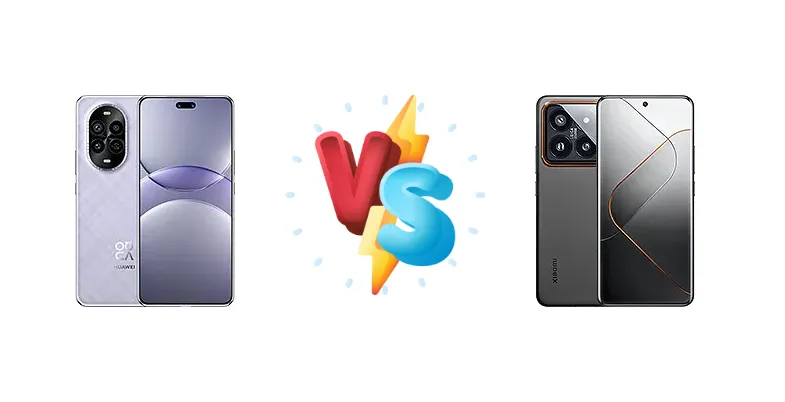
|
🏆 Quick Verdict
For the average user prioritizing speed and convenience, the Xiaomi 14 Pro is the superior choice. Its Snapdragon 8 Gen 3 chipset delivers significantly higher performance, and while the nova 13 Pro charges faster to 50%, the 14 Pro’s 120W charging and wireless capabilities offer greater overall flexibility.
| PHONES | ||
|---|---|---|
| Phone Names | Huawei nova 13 Pro | Xiaomi 14 Pro |
| Network | ||
|---|---|---|
| 2G bands | GSM 850 / 900 / 1800 / 1900 | GSM 850 / 900 / 1800 / 1900 |
| 3G bands | HSDPA 800 / 850 / 900 / 1700(AWS) / 1900 / 2100 | HSDPA 800 / 850 / 900 / 1700(AWS) / 1900 / 2100 |
| 4G bands | LTE | 1, 3, 4, 5, 7, 8, 18, 19, 26, 28, 34, 38, 39, 40, 41, 42, 48, 66 |
| 5G bands | SA/NSA | 1, 3, 5, 7, 8, 28, 38, 40, 41, 48, 66, 77, 78, 79 SA/NSA |
| Speed | HSPA, LTE, 5G | HSPA, LTE, 5G |
| Technology | GSM / CDMA / HSPA / CDMA2000 / LTE / 5G | GSM / CDMA / HSPA / CDMA2000 / LTE / 5G |
| Launch | ||
|---|---|---|
| Announced | 2024, October 22 | 2023, October 26 |
| Status | Available. Released 2024, October 25 | Available. Released 2023, November 01 |
| Body | ||
|---|---|---|
| Build | - | Glass front, aluminum frame or titanium frame, glass back |
| Dimensions | 163.4 x 74.9 x 7.8 mm (6.43 x 2.95 x 0.31 in) | 161.4 x 75.3 x 8.5 mm |
| SIM | Nano-SIM + Nano-SIM | Nano-SIM + Nano-SIM |
| Weight | 209 g (7.37 oz) | 223 g or 230 g (7.87 oz) |
| Display | ||
|---|---|---|
| Protection | Aluminosilicate glass | Shatterproof glass |
| Resolution | 1224 x 2776 pixels (~449 ppi density) | 1440 x 3200 pixels, 20:9 ratio (~522 ppi density) |
| Size | 6.76 inches, 108.8 cm2 (~88.9% screen-to-body ratio) | 6.73 inches, 108.9 cm2 (~89.6% screen-to-body ratio) |
| Type | LTPO OLED, 1B colors, HDR, 120Hz | LTPO AMOLED, 68B colors, 120Hz, Dolby Vision, HDR10+, 3000 nits (peak) |
| Platform | ||
|---|---|---|
| CPU | - | Octa-core (1x3.3 GHz Cortex-X4 & 3x3.2 GHz Cortex-A720 & 2x3.0 GHz Cortex-A720 & 2x2.3 GHz Cortex-A520) |
| Chipset | - | Qualcomm SM8650-AB Snapdragon 8 Gen 3 (4 nm) |
| GPU | - | Adreno 750 |
| OS | HarmonyOS 4.2 | Android 14, HyperOS |
| Memory | ||
|---|---|---|
| Card slot | No | No |
| Internal | 256GB 12GB RAM, 512GB 12GB RAM, 1TB 12GB RAM | 256GB 12GB RAM, 512GB 16GB RAM, 1TB 16GB RAM |
| Main Camera | ||
|---|---|---|
| Features | Laser AF, color spectrum sensor, LED flash, panorama, HDR | Laser AF, color spectrum sensor, Leica lens, Dual-LED dual-tone flash, HDR, panorama |
| Triple | 50 MP, f/1.4-4.0, 23mm (wide), PDAF, OIS 12 MP, f/2.4, 69mm (telephoto), PDAF, OIS 8 MP, f/2.2, 16mm, 112˚ (ultrawide), AF | 50 MP, f/1.4-f/4.0, 23mm (wide), 1/1.31", 1.2µm, dual pixel PDAF, OIS 50 MP, f/2.0, 75mm (telephoto), PDAF (10cm - ∞), OIS, 3.2x optical zoom 50 MP, f/2.2, 14mm, 115˚ (ultrawide), AF |
| Video | 4K, 1080p, gyro-EIS | 8K@24fps (HDR), 4K@24/30/60fps (HDR10+, 10-bit Dolby Vision HDR, 10-bit LOG), 1080p@30/60/120/240/960fps, 720p@1920fps, gyro-EIS |
| Selfie camera | ||
|---|---|---|
| Dual | 8 MP, f/2.2, 52mm (telephoto), AF, 2x optical zoom 60 MP, f/2.4, 17mm, 100˚ (ultrawide), AF | - |
| Features | HDR, panorama | HDR, panorama |
| Single | - | 32 MP, f/2.0, 22mm (wide), 0.7µm |
| Video | 4K@30fps, 1080p@30fps, gyro-EIS | 4K@30/60fps, 1080p@30/60fps, gyro-EIS |
| Sound | ||
|---|---|---|
| 35mm jack | No | No |
| Loudspeaker | Yes, with stereo speakers | Yes, with stereo speakers |
| Comms | ||
|---|---|---|
| Bluetooth | 5.2, A2DP, LE, L2HC (320-960 kbps HD audio) | 5.4, A2DP, LE, aptX HD, aptX Adaptive |
| Infrared port | Yes | Yes |
| NFC | Yes | Yes |
| Positioning | GPS (L1+L5), GLONASS (L1), BDS (B1I+B1c+B2a+B2b), GALILEO (E1+E5a+E5b), QZSS (L1+L5), NavIC | GPS (L1+L5), GLONASS (G1), BDS (B1I+B1c+B2a), GALILEO (E1+E5a), QZSS (L1+L5), NavIC (L5) |
| Radio | No | No |
| USB | USB Type-C 2.0, OTG | USB Type-C 3.2 Gen 2, OTG |
| WLAN | Wi-Fi 802.11 a/b/g/n/ac/6, dual-band, Wi-Fi Direct | Wi-Fi 802.11 a/b/g/n/ac/6e/7, dual-band, Wi-Fi Direct |
| Features | ||
|---|---|---|
| Sensors | Fingerprint (under display, optical), accelerometer, gyro, compass | Fingerprint (under display, optical), accelerometer, proximity, gyro, compass, barometer |
| Battery | ||
|---|---|---|
| Charging | 100W wired, 3-50% in 9 min 5W reverse wired | 120W wired, PD3.0, QC4, 100% in 18 min 50W wireless, 100% in 40 min 10W reverse wireless |
| Type | 5000 mAh | Li-Po 4880 mAh |
| Misc | ||
|---|---|---|
| Colors | Black, White, Purple, Green | Black, Silver, Titanium, Green |
| Models | MIS-AL00 | 23116PN5BC |
| Price | € 497.00 | About 650 EUR |
Huawei nova 13 Pro
- Extremely fast initial charging (0-50% in 9 minutes)
- Potentially more affordable price
- 5W reverse wired charging
- Likely less powerful chipset
- No wireless charging
- Limited information available on display and camera
Xiaomi 14 Pro
- Snapdragon 8 Gen 3 provides top-tier performance
- 120W wired charging and 50W wireless charging
- Advanced ISP for superior image processing
- Longer full charge time than initial nova 13 Pro burst
- Potentially higher price
- Thermal throttling potential under sustained load (needs testing)
Display Comparison
Display specifications are currently unavailable for the Huawei nova 13 Pro. However, given its market positioning, it likely features an OLED panel. The Xiaomi 14 Pro, while details are missing, is expected to feature a high-resolution display with LTPO technology for adaptive refresh rates, maximizing battery efficiency. The 14 Pro’s expected higher peak brightness will provide better visibility in direct sunlight, a key advantage for outdoor users.
Camera Comparison
Camera details for the nova 13 Pro are currently unavailable. The Xiaomi 14 Pro is expected to feature a sophisticated camera system, though specific sensor sizes and apertures are unknown. The Snapdragon 8 Gen 3’s ISP (Image Signal Processor) will play a crucial role in image processing, offering advanced features like improved low-light performance and faster autofocus. Without knowing the nova 13 Pro’s camera specs, it’s difficult to make a direct comparison, but the 14 Pro’s chipset advantage suggests superior image quality.
Performance
The Xiaomi 14 Pro’s Qualcomm SM8650-AB Snapdragon 8 Gen 3 (4nm) is the clear performance leader. Its octa-core configuration, with a prime Cortex-X4 core clocked at 3.3 GHz, promises substantial gains over any chipset likely found in the nova 13 Pro. The 4nm process node also contributes to improved thermal efficiency, potentially mitigating throttling during extended gaming sessions. While the nova 13 Pro may be adequate for everyday tasks, the 14 Pro is geared towards power users and mobile gamers.
Battery Life
The Xiaomi 14 Pro’s 120W wired charging, capable of a full charge in 18 minutes, significantly surpasses the Huawei nova 13 Pro’s 100W charging (3-50% in 9 minutes). While the nova 13 Pro excels in initial charging speed, the 14 Pro offers a complete charge faster. Furthermore, the 14 Pro adds 50W wireless charging (100% in 40 minutes) and 10W reverse wireless charging, features absent in the nova 13 Pro. This provides greater flexibility for users who prefer wireless convenience or need to top up other devices.
Buying Guide
Buy the Huawei nova 13 Pro if you prioritize extremely fast initial charging bursts (0-50% in under 10 minutes) and a potentially more affordable price point. Buy the Xiaomi 14 Pro if you demand top-tier performance for gaming and demanding applications, value wireless charging, and appreciate the broader ecosystem benefits of a flagship device.