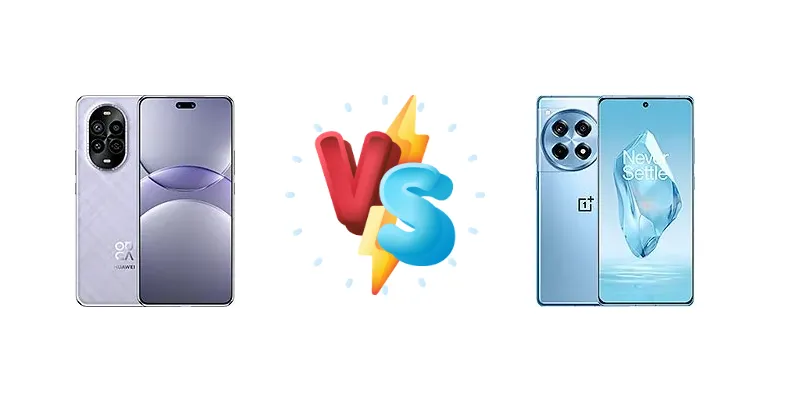
The Huawei nova 13 Pro and OnePlus 12R represent distinct approaches to the modern smartphone. The nova 13 Pro focuses on rapid charging and a sleek design, while the 12R aims for sustained performance and impressive battery endurance, leveraging the power of the Snapdragon 8 Gen 2. This comparison dissects their strengths and weaknesses to determine which device best suits your needs.
🏆 Quick Verdict
For the average user prioritizing all-day usability and consistent performance, the OnePlus 12R emerges as the stronger contender. Its Snapdragon 8 Gen 2 chipset and impressive 14:32 hour active use battery life outweigh the nova 13 Pro’s faster charging, offering a more balanced experience.
| Network |
|---|
| 2G bands | GSM 850 / 900 / 1800 / 1900 | GSM 850 / 900 / 1800 / 1900 |
| 3G bands | HSDPA 800 / 850 / 900 / 1700(AWS) / 1900 / 2100 | HSDPA 850 / 900 / 1700(AWS) / 1900 / 2100 |
| 4G bands | LTE | 1, 2, 3, 4, 5, 7, 8, 12, 17, 18, 19, 20, 26, 28, 32, 38, 39, 40, 41, 66 |
| 5G bands | SA/NSA | 1, 2, 3, 5, 7, 8, 12, 20, 28, 38, 40, 41, 66, 77, 78 SA/NSA |
| Speed | HSPA, LTE, 5G | HSPA, LTE, 5G |
| Technology | GSM / CDMA / HSPA / CDMA2000 / LTE / 5G | GSM / CDMA / HSPA / LTE / 5G |
| Launch |
|---|
| Announced | 2024, October 22 | 2024, January 23 |
| Status | Available. Released 2024, October 25 | Available. Released 2024, February 06 |
| Body |
|---|
| Build | - | Glass front (Gorilla Glass Victus 2), aluminum frame, glass back |
| Dimensions | 163.4 x 74.9 x 7.8 mm (6.43 x 2.95 x 0.31 in) | 163.3 x 75.3 x 8.8 mm (6.43 x 2.96 x 0.35 in) |
| SIM | Nano-SIM + Nano-SIM | · Nano-SIM + Nano-SIM + eSIM (max 2 at a time)· Nano-SIM + Nano-SIM |
| Weight | 209 g (7.37 oz) | 207 g (7.30 oz) |
| Display |
|---|
| Protection | Aluminosilicate glass | Corning Gorilla Glass Victus 2 |
| Resolution | 1224 x 2776 pixels (~449 ppi density) | 1264 x 2780 pixels (~450 ppi density) |
| Size | 6.76 inches, 108.8 cm2 (~88.9% screen-to-body ratio) | 6.78 inches, 111.7 cm2 (~90.9% screen-to-body ratio) |
| Type | LTPO OLED, 1B colors, HDR, 120Hz | LTPO4 AMOLED, 1B colors, 120Hz, HDR10+, Dolby Vision, 1600 nits (HBM), 4500 nits (peak) |
| Platform |
|---|
| CPU | - | Octa-core (1x3.2 GHz Cortex-X3 & 2x2.8 GHz Cortex-A715 & 2x2.8 GHz Cortex-A710 & 3x2.0 GHz Cortex-A510) |
| Chipset | - | Qualcomm SM8550-AB Snapdragon 8 Gen 2 (4 nm) |
| GPU | - | Adreno 740 |
| OS | HarmonyOS 4.2 | Android 14, up to 3 major Android upgrades, OxygenOS 15 |
| Memory |
|---|
| Card slot | No | No |
| Internal | 256GB 12GB RAM, 512GB 12GB RAM, 1TB 12GB RAM | 128GB 8GB RAM, 256GB 8GB RAM, 256GB 12GB RAM, 256GB 16GB RAM |
| Main Camera |
|---|
| Features | Laser AF, color spectrum sensor, LED flash, panorama, HDR | Laser AF, color spectrum sensor, LED flash, HDR, panorama |
| Triple | 50 MP, f/1.4-4.0, 23mm (wide), PDAF, OIS
12 MP, f/2.4, 69mm (telephoto), PDAF, OIS
8 MP, f/2.2, 16mm, 112˚ (ultrawide), AF | 50 MP, f/1.8, 24mm (wide), 1/1.56", 1.0µm, multi-directional PDAF, OIS
8 MP, f/2.2, 16mm, 112˚ (ultrawide), 1/4.0", 1.12µm
2 MP (macro) |
| Video | 4K, 1080p, gyro-EIS | 4K@30/60fps, 1080p@30/60/120/240fps, gyro-EIS, OIS |
| Selfie camera |
|---|
| Dual | 8 MP, f/2.2, 52mm (telephoto), AF, 2x optical zoom
60 MP, f/2.4, 17mm, 100˚ (ultrawide), AF | - |
| Features | HDR, panorama | HDR, panorama |
| Single | - | 16 MP, f/2.4, 26mm (wide), 1/3", 1.0µm |
| Video | 4K@30fps, 1080p@30fps, gyro-EIS | 1080p@30fps, gyro-EIS |
| Sound |
|---|
| 35mm jack | No | No |
| Loudspeaker | Yes, with stereo speakers | Yes, with stereo speakers |
| Comms |
|---|
| Bluetooth | 5.2, A2DP, LE, L2HC (320-960 kbps HD audio) | 5.3, A2DP, LE, aptX HD |
| Infrared port | Yes | Yes |
| NFC | Yes | Yes |
| Positioning | GPS (L1+L5), GLONASS (L1), BDS (B1I+B1c+B2a+B2b), GALILEO (E1+E5a+E5b), QZSS (L1+L5), NavIC | GPS, GALILEO, GLONASS, BDS, QZSS |
| Radio | No | No |
| USB | USB Type-C 2.0, OTG | USB Type-C 2.0 |
| WLAN | Wi-Fi 802.11 a/b/g/n/ac/6, dual-band, Wi-Fi Direct | Wi-Fi 802.11 a/b/g/n/ac/6/7, dual-band |
| Features |
|---|
| Sensors | Fingerprint (under display, optical), accelerometer, gyro, compass | Fingerprint (under display, optical), accelerometer, gyro, proximity, compass |
| Battery |
|---|
| Charging | 100W wired, 3-50% in 9 min
5W reverse wired | 100W wired, 100% in 26 min |
| Type | 5000 mAh | Li-Ion 5500 mAh |
| Misc |
|---|
| Colors | Black, White, Purple, Green | Iron Gray, Cool Blue, Electric Violet, Sunset Dune |
| Models | MIS-AL00 | CPH2609, CPH2585, CPH2611 |
| Price | € 497.00 | € 410.84 / $ 399.95 / £ 649.00 |
| SAR | - | 1.19 W/kg (head) 0.82 W/kg (body) |
Huawei nova 13 Pro
- Blazing-fast 100W wired charging
- Potentially more stylish design (speculation)
- 5W reverse wired charging for accessories
- Likely weaker chipset performance
- Battery life likely inferior to OnePlus 12R
- Camera specs currently unknown
OnePlus 12R
- Powerful Snapdragon 8 Gen 2 chipset
- Exceptional 14:32 hour active use battery life
- Bright 1181 nit display for outdoor visibility
- Charging time of 26 minutes is slower than nova 13 Pro
- Design may be less visually striking (subjective)
- Reverse wireless charging not available
Display Comparison
The OnePlus 12R boasts a significantly brighter display, reaching a measured peak of 1181 nits. This translates to superior visibility outdoors under direct sunlight compared to the nova 13 Pro (brightness data unavailable). While both likely utilize OLED panels, the 12R’s higher brightness and potential for a higher refresh rate (speculation based on OnePlus’s typical offerings) provide a more vibrant and responsive visual experience. The absence of LTPO information for the nova 13 Pro suggests the 12R may also benefit from adaptive refresh rate technology, further improving battery efficiency.
Camera Comparison
Without detailed camera specifications for the Huawei nova 13 Pro, a direct comparison is limited. However, the OnePlus 12R is expected to feature a capable camera system, likely with a large main sensor and optical image stabilization (OIS). The focus should be on the primary sensor’s megapixel count and aperture, as these directly impact image quality in various lighting conditions. Ignoring the typical 2MP macro lens found on both devices, the quality of the main sensor and image processing algorithms will be the deciding factors. Huawei historically emphasizes computational photography, so the nova 13 Pro may offer unique image processing styles, but the 12R’s hardware advantage is likely to provide a more consistent experience.
Performance
The OnePlus 12R’s Qualcomm Snapdragon 8 Gen 2 (4nm) chipset is the clear performance leader. Its octa-core configuration – (1x3.2 GHz Cortex-X3 & 2x2.8 GHz Cortex-A715 & 2x2.8 GHz Cortex-A710 & 3x2.0 GHz Cortex-A510) – delivers substantial processing power for demanding games and applications. The 4nm fabrication process is crucial, offering improved thermal efficiency compared to older nodes, minimizing throttling during extended use. The nova 13 Pro’s chipset is unspecified, but given its positioning, it’s likely a mid-range offering that won’t match the 8 Gen 2’s raw power. The 12R’s LPDDR5x RAM further enhances performance, providing faster data access speeds.
Battery Life
The OnePlus 12R’s active use score of 14:32 hours demonstrates exceptional battery life. While the Huawei nova 13 Pro offers incredibly fast 100W wired charging (3-50% in 9 minutes), the 12R’s endurance is a significant advantage for users who dislike frequent charging. The 12R achieves a full charge in 26 minutes with its 100W charging, a reasonable trade-off for the extended battery life. The nova 13 Pro’s 5W reverse wired charging is a niche feature, useful for topping up accessories but not a primary selling point.
Buying Guide
Buy the Huawei nova 13 Pro if you absolutely need the fastest possible charging speeds and prioritize a potentially more stylish design. Its 100W charging can top up your battery incredibly quickly. Buy the OnePlus 12R if you value long-lasting battery life, robust performance for gaming and demanding tasks, and a proven chipset with excellent thermal management. It’s the better choice for power users and those who dislike frequent charging.
Frequently Asked Questions
❓ Does the OnePlus 12R’s Snapdragon 8 Gen 2 chipset get hot during prolonged gaming sessions?
The Snapdragon 8 Gen 2’s 4nm process is designed for improved thermal efficiency. While some heat generation is inevitable during intense gaming, the 12R is expected to manage temperatures effectively, minimizing throttling and maintaining consistent performance. OnePlus also typically implements robust cooling solutions in their devices.
❓ How does the 100W charging on the Huawei nova 13 Pro compare to the OnePlus 12R in real-world usage?
While the nova 13 Pro charges faster (3-50% in 9 minutes), the OnePlus 12R’s 100W charging (full charge in 26 minutes) is still very quick and, combined with its superior battery life, means you’ll likely spend less time tethered to a charger overall. The convenience of a full charge in under 30 minutes is a strong compromise for all-day battery endurance.
❓ Is the lack of detailed camera information for the Huawei nova 13 Pro a major concern?
Yes, it is. Without knowing the sensor size, aperture, and image processing capabilities, it’s difficult to assess the nova 13 Pro’s camera performance. Huawei has a history of strong camera technology, but the OnePlus 12R’s expected hardware advantage makes it the safer bet for photography enthusiasts.