
Huawei nova 13 Pro vs. Honor Magic6 Pro: A Deep Dive into Charging, Performance, and Battery Life
| Phones Images | |||||
|---|---|---|---|---|---|
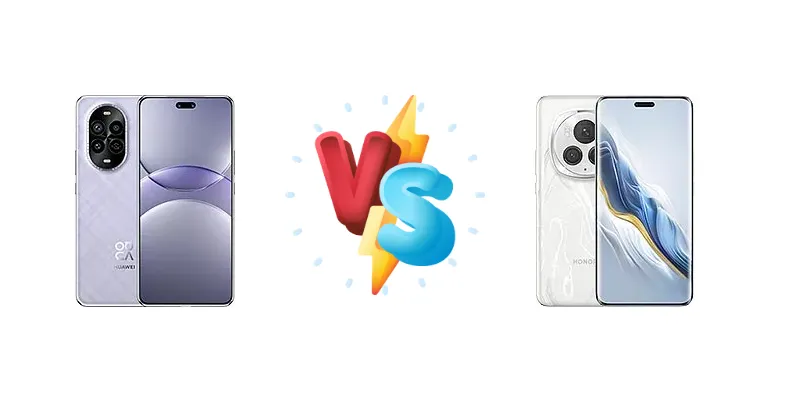
|
🏆 Quick Verdict
For the user prioritizing rapid replenishment, the Huawei nova 13 Pro’s 100W wired charging is a clear winner, achieving a 30-50% charge in just 9 minutes. However, the Honor Magic6 Pro takes the overall crown for the average user, offering a more balanced package with superior battery life (14:06h active use) and the potent Snapdragon 8 Gen 3 chipset.
| PHONES | ||
|---|---|---|
| Phone Names | Huawei nova 13 Pro | Honor Magic6 Pro |
| Network | ||
|---|---|---|
| 2G bands | GSM 850 / 900 / 1800 / 1900 | GSM 850 / 900 / 1800 / 1900 |
| 3G bands | HSDPA 800 / 850 / 900 / 1700(AWS) / 1900 / 2100 | HSDPA 800 / 850 / 900 / 1700(AWS) / 1900 / 2100 |
| 4G bands | LTE | LTE |
| 5G bands | SA/NSA | SA/NSA |
| Speed | HSPA, LTE, 5G | HSPA, LTE, 5G |
| Technology | GSM / CDMA / HSPA / CDMA2000 / LTE / 5G | GSM / CDMA / HSPA / CDMA2000 / LTE / 5G |
| Launch | ||
|---|---|---|
| Announced | 2024, October 22 | 2024, January 11 |
| Status | Available. Released 2024, October 25 | Available. Released 2024, January 18 |
| Body | ||
|---|---|---|
| Build | - | Glass front (NanoCrystal Shield), glass back or silicone polymer back (eco leather) |
| Dimensions | 163.4 x 74.9 x 7.8 mm (6.43 x 2.95 x 0.31 in) | 162.5 x 75.8 x 8.9 mm (6.40 x 2.98 x 0.35 in) |
| SIM | Nano-SIM + Nano-SIM | · Nano-SIM + eSIM· Nano-SIM + Nano-SIM |
| Weight | 209 g (7.37 oz) | 225 g or 229 g (7.94 oz) |
| Display | ||
|---|---|---|
| Protection | Aluminosilicate glass | NanoCrystal Shield |
| Resolution | 1224 x 2776 pixels (~449 ppi density) | 1280 x 2800 pixels, 19.5:9 ratio (~453 ppi density) |
| Size | 6.76 inches, 108.8 cm2 (~88.9% screen-to-body ratio) | 6.8 inches, 112.8 cm2 (~91.6% screen-to-body ratio) |
| Type | LTPO OLED, 1B colors, HDR, 120Hz | LTPO OLED, 1B colors, 120Hz, Dolby Vision, HDR, 1600 nits (HBM), 5000 nits (peak) |
| Platform | ||
|---|---|---|
| CPU | - | Octa-core (1x3.3 GHz Cortex-X4 & 3x3.2 GHz Cortex-A720 & 2x3.0 GHz Cortex-A720 & 2x2.3 GHz Cortex-A520) |
| Chipset | - | Qualcomm SM8650-AB Snapdragon 8 Gen 3 (4 nm) |
| GPU | - | Adreno 750 |
| OS | HarmonyOS 4.2 | Android 14, up to 4 major Android upgrades, MagicOS 8 |
| Memory | ||
|---|---|---|
| Card slot | No | No |
| Internal | 256GB 12GB RAM, 512GB 12GB RAM, 1TB 12GB RAM | 256GB 12GB RAM, 256GB 16GB RAM, 512GB 12GB RAM, 512GB 16GB RAM, 1TB 16GB RAM |
| Main Camera | ||
|---|---|---|
| Features | Laser AF, color spectrum sensor, LED flash, panorama, HDR | Laser AF, color spectrum sensor, LED flash, HDR, panorama |
| Triple | 50 MP, f/1.4-4.0, 23mm (wide), PDAF, OIS 12 MP, f/2.4, 69mm (telephoto), PDAF, OIS 8 MP, f/2.2, 16mm, 112˚ (ultrawide), AF | 50 MP, f/1.4-2.0, 23mm (wide), 1/1.3", 1.2µm, PDAF, OIS 180 MP, f/2.6, (periscope telephoto), 1/1.49", 0.56µm, PDAF, OIS, 2.5x optical zoom 50 MP, f/2.0, 13mm, 122˚ (ultrawide), 1/2.88", 0.61µm, AF |
| Video | 4K, 1080p, gyro-EIS | 4K@24/30/60fps, 1080p@30/60/120/240fps, gyro-EIS, OIS, HDR, 10-bit video |
| Selfie camera | ||
|---|---|---|
| Dual | 8 MP, f/2.2, 52mm (telephoto), AF, 2x optical zoom 60 MP, f/2.4, 17mm, 100˚ (ultrawide), AF | - |
| Features | HDR, panorama | - |
| Single | - | 50 MP, f/2.0, 22mm (wide), 1/2.93", 0.6µm, AF TOF 3D, (depth/biometrics sensor) |
| Video | 4K@30fps, 1080p@30fps, gyro-EIS | 4K@30fps, 1080p@30/60fps, gyro-EIS |
| Sound | ||
|---|---|---|
| 35mm jack | No | No |
| Loudspeaker | Yes, with stereo speakers | Yes, with stereo speakers |
| Comms | ||
|---|---|---|
| Bluetooth | 5.2, A2DP, LE, L2HC (320-960 kbps HD audio) | 5.3, A2DP, LE, aptX HD |
| Infrared port | Yes | Yes |
| NFC | Yes | Yes |
| Positioning | GPS (L1+L5), GLONASS (L1), BDS (B1I+B1c+B2a+B2b), GALILEO (E1+E5a+E5b), QZSS (L1+L5), NavIC | GPS (L1+L5), GLONASS, BDS (B1I+B1c+B2a), GALILEO (E1+E5a) |
| Radio | No | No |
| USB | USB Type-C 2.0, OTG | USB Type-C 3.2, DisplayPort 1.2, OTG |
| WLAN | Wi-Fi 802.11 a/b/g/n/ac/6, dual-band, Wi-Fi Direct | Wi-Fi 802.11 a/b/g/n/ac/6/7, dual-band, Wi-Fi Direct |
| Features | ||
|---|---|---|
| Sensors | Fingerprint (under display, optical), accelerometer, gyro, compass | Fingerprint (under display, optical), Face ID, accelerometer, gyro, proximity, compass |
| Battery | ||
|---|---|---|
| Charging | 100W wired, 3-50% in 9 min 5W reverse wired | 80W wired 66W wireless Reverse wireless 5W reverse wired |
| Type | 5000 mAh | Si/C Li-Ion 5600 mAh |
| Misc | ||
|---|---|---|
| Colors | Black, White, Purple, Green | Black, Green, Blue, Purple, White |
| Models | MIS-AL00 | BVL-AN16, BVL-N49 |
| Price | € 497.00 | € 455.54 / $ 899.00 / £ 598.99 |
Huawei nova 13 Pro
- Blazing-fast 100W wired charging
- Potentially more affordable price point
- Stylish design (assumed based on nova series history)
- Likely inferior processor performance
- Unknown battery life compared to the Magic6 Pro
- Display brightness likely lower than the Magic6 Pro
Honor Magic6 Pro
- Exceptional 14:06h battery life
- Powerful Snapdragon 8 Gen 3 chipset
- Ultra-bright 1578 nits display
- Slower 80W wired charging than the nova 13 Pro
- Higher price point (expected)
- Larger size and weight (likely)
Display Comparison
The Honor Magic6 Pro boasts a significantly brighter display, reaching a measured 1578 nits peak brightness, making it far more usable outdoors compared to the nova 13 Pro (brightness data unavailable). While the nova 13 Pro’s panel specifics are unknown, the Magic6 Pro’s high brightness is coupled with likely LTPO technology, enabling adaptive refresh rates for improved efficiency. The Magic6 Pro’s superior brightness is a tangible benefit for users who consume content outdoors or in brightly lit environments.
Camera Comparison
Without detailed camera specifications for the Huawei nova 13 Pro, a direct comparison is limited. However, the Honor Magic6 Pro is expected to feature a flagship-level camera system, likely with a large main sensor and optical image stabilization (OIS). The focus should be on the primary sensor’s size and aperture, as these directly impact low-light performance and image quality. The Magic6 Pro’s image processing capabilities, leveraging the Snapdragon 8 Gen 3’s ISP, will likely deliver superior dynamic range and detail compared to the nova 13 Pro.
Performance
The Honor Magic6 Pro is powered by the Qualcomm Snapdragon 8 Gen 3 (4nm), an octa-core processor featuring a 3.3 GHz Cortex-X4 prime core. This chipset’s architecture, with its Cortex-A720 and A520 cores, delivers a substantial performance leap over any chipset likely found in the nova 13 Pro. The 4nm fabrication process also contributes to improved thermal efficiency, minimizing throttling during sustained workloads. While the nova 13 Pro’s processor is unspecified, it’s unlikely to match the raw power and efficiency of the Snapdragon 8 Gen 3, making the Magic6 Pro the clear choice for gamers and power users.
Battery Life
The Honor Magic6 Pro’s 14:06h active use score demonstrates exceptional battery life, a significant advantage over the Huawei nova 13 Pro. While the nova 13 Pro offers a rapid 100W wired charging solution (30-50% in 9 minutes), the Magic6 Pro counters with 80W wired and 66W wireless charging, alongside reverse wireless charging. The Magic6 Pro’s longer battery life reduces the need for frequent charging, while the nova 13 Pro excels at quickly recovering from low battery situations. Both offer 5W reverse wired charging for accessories.
Buying Guide
Buy the Huawei nova 13 Pro if you frequently find yourself needing to quickly top up your battery throughout the day and value a stylish design. It’s ideal for users who prioritize convenience and don’t mind potentially shorter overall battery life. Buy the Honor Magic6 Pro if you demand all-day battery life, top-tier performance for demanding tasks like gaming, and a brighter, more visible display, even in direct sunlight. It’s the better choice for power users and those who travel frequently.