
Huawei nova 12s vs. Samsung Galaxy A55: A Detailed Comparison
| Phones Images | |||||
|---|---|---|---|---|---|
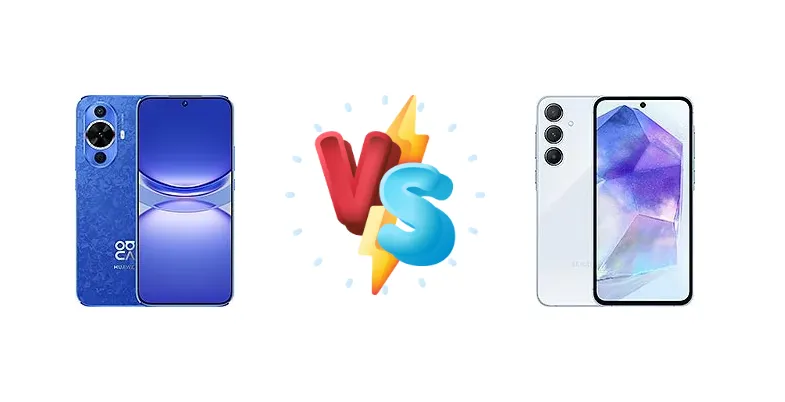
|
🏆 Quick Verdict
For the average user prioritizing all-day battery life and a vibrant display, the Samsung Galaxy A55 is the stronger choice. Its 13:27h active use score significantly outperforms what we'd expect from the nova 12s, despite the latter's faster charging. However, gamers and those valuing quick top-ups may lean towards the nova 12s.
| PHONES | ||
|---|---|---|
| Phone Names | Huawei nova 12s | Samsung Galaxy A55 |
| Network | ||
|---|---|---|
| 2G bands | GSM 850 / 900 / 1800 / 1900 | GSM 850 / 900 / 1800 / 1900 |
| 3G bands | HSDPA 800 / 850 / 900 / 1700(AWS) / 1900 / 2100 | HSDPA 850 / 900 / 1700(AWS) / 1900 / 2100 |
| 4G bands | 1, 2, 3, 4, 5, 7, 8, 12, 13, 17, 18, 19, 20, 26, 28, 38, 40, 41, 66 | 1, 2, 3, 4, 5, 7, 8, 12, 17, 20, 25, 26, 28, 32, 38, 40, 41, 66 |
| 5G bands | - | 1, 3, 5, 7, 8, 20, 28, 38, 40, 41, 66, 77, 78 SA/NSA/Sub6 |
| Speed | HSPA, LTE | HSPA, LTE, 5G |
| Technology | GSM / HSPA / LTE | GSM / HSPA / LTE / 5G |
| Launch | ||
|---|---|---|
| Announced | 2024, March 19 | 2024, March 11 |
| Status | Available. Released 2024, April 13 | Available. Released 2024, March 15 |
| Body | ||
|---|---|---|
| Build | - | Glass front (Gorilla Glass Victus+), glass back (Gorilla Glass), aluminum frame |
| Dimensions | 161.3 x 75 x 6.9 mm (6.35 x 2.95 x 0.27 in) | 161.1 x 77.4 x 8.2 mm (6.34 x 3.05 x 0.32 in) |
| SIM | · Nano-SIM· Nano-SIM + Nano-SIM | · Nano-SIM· Nano-SIM + eSIM· Nano-SIM + Nano-SIM· Nano-SIM + Nano-SIM + eSIM (max 2 at a time) |
| Weight | 168 g (5.93 oz) | 213 g (7.51 oz) |
| Display | ||
|---|---|---|
| Protection | - | Corning Gorilla Glass Victus+ |
| Resolution | 1084 x 2412 pixels, 20:9 ratio (~395 ppi density) | 1080 x 2340 pixels, 19.5:9 ratio (~390 ppi density) |
| Size | 6.7 inches, 108.3 cm2 (~89.5% screen-to-body ratio) | 6.6 inches, 106.9 cm2 (~85.8% screen-to-body ratio) |
| Type | OLED, 1B colors, HDR, 120Hz | Super AMOLED, 120Hz, HDR10+, 1000 nits (HBM) |
| Platform | ||
|---|---|---|
| CPU | Octa-core (4x2.4 GHz Kryo 670 & 4x1.8 GHz Kryo 670) | Octa-core (4x2.75 GHz Cortex-A78 & 4x2.0 GHz Cortex-A55) |
| Chipset | Qualcomm SM7325 Snapdragon 778G 4G (6 nm) | Exynos 1480 (4 nm) |
| GPU | Adreno 642L | Xclipse 530 |
| OS | EMUI 14, no Google Play Services | Android 14, up to 4 major Android upgrades, One UI 6.1 |
| Memory | ||
|---|---|---|
| Card slot | No | microSDXC (uses shared SIM slot) |
| Internal | 256GB 8GB RAM | 128GB 6GB RAM, 128GB 8GB RAM, 256GB 6GB RAM, 256GB 8GB RAM, 256GB 12GB RAM |
| Main Camera | ||
|---|---|---|
| Dual | 50 MP, f/1.9, (wide), PDAF 8 MP, f/2.2, 112˚ (ultrawide) | - |
| Features | Laser AF, color spectrum sensor, LED flash, panorama, HDR | LED flash, panorama, HDR |
| Triple | - | 50 MP, f/1.8, (wide), 1/1.56", 1.0µm, PDAF, OIS 12 MP, f/2.2, 123˚ (ultrawide), 1/3.06", 1.12µm 5 MP (macro) |
| Video | 4K@30fps, 1080p@30fps, gyro-EIS | 4K@30fps, 1080p@30/60fps, gyro-EIS |
| Selfie camera | ||
|---|---|---|
| Dual | 60 MP, f/2.4, 100˚ (ultrawide) | - |
| Features | HDR | - |
| Single | - | 32 MP, f/2.2, 26mm (wide), 1/2.74", 0.8µm |
| Video | 4K@30fps, 1080p@30fps, gyro-EIS | 4K@30fps, 1080p@30/60fps |
| Sound | ||
|---|---|---|
| 35mm jack | No | No |
| Loudspeaker | Yes, with stereo speakers | Yes, with stereo speakers |
| Comms | ||
|---|---|---|
| Bluetooth | 5.2, A2DP, LE | 5.3, A2DP, LE |
| NFC | Yes | Yes (market/region dependent) |
| Positioning | GPS (L1+L5), GLONASS, BDS (B1I+B1c+B2a), GALILEO (E1+E5a), QZSS (L1+L5), NavIC | GPS, GALILEO, GLONASS, BDS, QZSS |
| Radio | No | No |
| USB | USB Type-C 2.0, OTG | USB Type-C 2.0, OTG |
| WLAN | Wi-Fi 802.11 a/b/g/n/ac/6, dual-band, Wi-Fi Direct | Wi-Fi 802.11 a/b/g/n/ac/6, dual-band, Wi-Fi Direct |
| Features | ||
|---|---|---|
| Sensors | Fingerprint (under display, optical), accelerometer, gyro, compass | Fingerprint (under display, optical), accelerometer, gyro, compass |
| Battery | ||
|---|---|---|
| Charging | 66W wired, 3-62% in 15 min, 3-100% in 30 min Reverse wired | 25W wired |
| Type | 4500 mAh | Li-Ion 5000 mAh |
| Misc | ||
|---|---|---|
| Colors | Black, Green, White, Gold | Iceblue, Lilac, Navy, Lemon |
| Models | FOA-LX9 | SM-A556V, SM-A556B, SM-A556B/DS, SM-A556E, SM-A556E/DS, SM-A5560 |
| Price | About 300 EUR | $ 324.99 / £ 251.50 / € 319.99 / ₹ 23,998 |
| SAR EU | - | 0.68 W/kg (head) 1.04 W/kg (body) |
Huawei nova 12s
- Significantly faster 66W charging
- Potentially more compact design (speculation)
- Proven Snapdragon 778G performance
- Limited to 4G connectivity
- Battery life likely shorter than A55
- Camera specs largely unknown
Samsung Galaxy A55
- Excellent 13:27h battery life
- Bright 1010 nit display
- 5G connectivity for future-proofing
- Slower 25W charging
- Exynos 1480 may exhibit some thermal throttling under sustained load
- Samsung’s One UI can be resource-intensive
Display Comparison
The Samsung Galaxy A55 boasts a significantly brighter display, reaching a measured peak of 1010 nits, ensuring excellent visibility outdoors. While the nova 12s’ display specs are not provided, Samsung’s panel offers a clear advantage in challenging lighting conditions. The A55’s panel technology is likely to be Super AMOLED, known for its vibrant colors and deep blacks, while the nova 12s likely uses an OLED panel. The absence of LTPO on either device suggests neither offers adaptive refresh rate technology for optimal power efficiency.
Camera Comparison
Without detailed camera specifications for the nova 12s, a direct comparison is challenging. However, the Galaxy A55 likely benefits from Samsung’s established image processing algorithms. The A55’s main sensor size and aperture are unknown, but a larger sensor generally captures more light, resulting in better low-light performance. It’s crucial to note that both phones likely include lower-resolution auxiliary cameras (like 2MP macro lenses) that offer limited practical value. Focusing on the primary sensor’s capabilities is key.
Performance
The Samsung Galaxy A55’s Exynos 1480 (4nm) chipset represents a more modern manufacturing process than the Huawei nova 12s’ Snapdragon 778G (6nm). This 4nm process generally translates to improved power efficiency and thermal performance. The A55’s CPU configuration, with 4x2.75 GHz Cortex-A78 cores, suggests stronger peak performance compared to the nova 12s’ 4x2.4 GHz Kryo 670 cores. However, the Snapdragon 778G is a well-optimized chip, and real-world performance differences may not be drastic for everyday tasks. The nova 12s' 4G limitation is a significant drawback for users in areas with robust 5G infrastructure.
Battery Life
The Samsung Galaxy A55’s 13:27h active use score is a standout feature, indicating exceptional battery life. While the nova 12s doesn’t have a published battery score, its 66W wired charging is significantly faster than the A55’s 25W charging. The nova 12s can reach 62% charge in 15 minutes and 100% in 30 minutes, offering a quick power boost. This trade-off – faster charging versus longer runtime – is a central consideration for potential buyers.
Buying Guide
Buy the Huawei nova 12s if you need consistently fast charging – getting from 3% to 100% in just 30 minutes is a significant convenience. It’s also a good pick if you prefer a slightly more compact form factor and are comfortable with the limitations of a 4G-only chipset. Buy the Samsung Galaxy A55 if you prioritize long-lasting battery life, a brighter and more visible display in sunlight (1010 nits), and future-proof 5G connectivity. It’s the better option for media consumption and users who don’t want to worry about frequent charging.