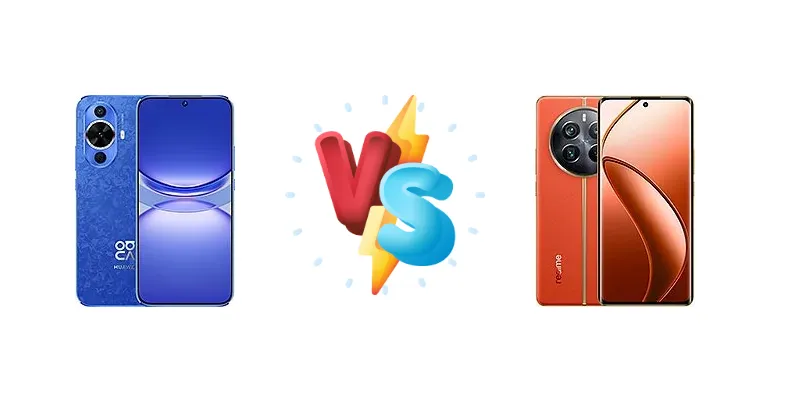
The mid-range smartphone market is fiercely competitive, and the Huawei nova 12s and Realme 12 Pro+ represent compelling options for users seeking premium features without the flagship price tag. This comparison dives deep into their specifications, focusing on the core differences in chipset architecture, battery performance, and charging capabilities to determine which device offers the best overall experience.
🏆 Quick Verdict
For the average user prioritizing sustained performance and all-day battery life, the Realme 12 Pro+ emerges as the stronger contender. Its Snapdragon 7s Gen 2, built on a more efficient 4nm process, provides a noticeable advantage over the 6nm Snapdragon 778G in the nova 12s, despite similar clock speeds.
| Network |
|---|
| 2G bands | GSM 850 / 900 / 1800 / 1900 | GSM 850 / 900 / 1800 / 1900 |
| 3G bands | HSDPA 800 / 850 / 900 / 1700(AWS) / 1900 / 2100 | HSDPA 850 / 900 / 2100 |
| 4G bands | 1, 2, 3, 4, 5, 7, 8, 12, 13, 17, 18, 19, 20, 26, 28, 38, 40, 41, 66 | 1, 3, 5, 8, 28, 40, 41 |
| 5G bands | - | 1, 3, 5, 8, 28, 40, 41, 77, 78 SA/NSA |
| Speed | HSPA, LTE | HSPA, LTE, 5G |
| Technology | GSM / HSPA / LTE | GSM / HSPA / LTE / 5G |
| Launch |
|---|
| Announced | 2024, March 19 | 2024, January 29 |
| Status | Available. Released 2024, April 13 | Available. Released 2024, January 29 |
| Body |
|---|
| Dimensions | 161.3 x 75 x 6.9 mm (6.35 x 2.95 x 0.27 in) | 161.5 x 74 x 8.8 mm (6.36 x 2.91 x 0.35 in) |
| SIM | · Nano-SIM· Nano-SIM + Nano-SIM | Nano-SIM + Nano-SIM |
| Weight | 168 g (5.93 oz) | 196 g (6.91 oz) |
| Display |
|---|
| Resolution | 1084 x 2412 pixels, 20:9 ratio (~395 ppi density) | 1080 x 2412 pixels, 20:9 ratio (~394 ppi density) |
| Size | 6.7 inches, 108.3 cm2 (~89.5% screen-to-body ratio) | 6.7 inches, 108.0 cm2 (~90.4% screen-to-body ratio) |
| Type | OLED, 1B colors, HDR, 120Hz | AMOLED, 1B colors, 120Hz, 800 nits (HBM), 950 nits (peak) |
| Platform |
|---|
| CPU | Octa-core (4x2.4 GHz Kryo 670 & 4x1.8 GHz Kryo 670) | Octa-core (4x2.40 GHz Cortex-A78 & 4x1.95 GHz Cortex-A55) |
| Chipset | Qualcomm SM7325 Snapdragon 778G 4G (6 nm) | Qualcomm SM7435-AB Snapdragon 7s Gen 2 (4 nm) |
| GPU | Adreno 642L | Adreno 710 |
| OS | EMUI 14, no Google Play Services | Android 14, Realme UI 5.0 |
| Memory |
|---|
| Card slot | No | No |
| Internal | 256GB 8GB RAM | 128GB 8GB RAM, 256GB 8GB RAM, 256GB 12GB RAM, 512GB 12GB RAM |
| Main Camera |
|---|
| Dual | 50 MP, f/1.9, (wide), PDAF
8 MP, f/2.2, 112˚ (ultrawide) | - |
| Features | Laser AF, color spectrum sensor, LED flash, panorama, HDR | LED flash, HDR, panorama |
| Triple | - | 50 MP, f/1.8, 24mm (wide), 1/1.56", 1.0µm, multi-directional PDAF, OIS
64 MP, f/2.8, 71mm, (periscope telephoto), 1/2.0", 0.7µm, PDAF, OIS, 3x optical zoom
8 MP, f/2.2, 16mm, 112˚ (ultrawide), 1/4.0", 1.12µm |
| Video | 4K@30fps, 1080p@30fps, gyro-EIS | 4K@30fps, 1080p@30/60/120fps, gyro-EIS |
| Selfie camera |
|---|
| Dual | 60 MP, f/2.4, 100˚ (ultrawide) | - |
| Features | HDR | - |
| Single | - | 32 MP, f/2.4, 22mm (wide) |
| Video | 4K@30fps, 1080p@30fps, gyro-EIS | 1080p@30fps |
| Sound |
|---|
| 35mm jack | No | No |
| Loudspeaker | Yes, with stereo speakers | Yes, with stereo speakers |
| Comms |
|---|
| Bluetooth | 5.2, A2DP, LE | 5.2, A2DP, LE |
| NFC | Yes | Yes (market/region dependent) |
| Positioning | GPS (L1+L5), GLONASS, BDS (B1I+B1c+B2a), GALILEO (E1+E5a), QZSS (L1+L5), NavIC | GPS, GLONASS, GALILEO, BDS, QZSS |
| Radio | No | No |
| USB | USB Type-C 2.0, OTG | USB Type-C 2.0 |
| WLAN | Wi-Fi 802.11 a/b/g/n/ac/6, dual-band, Wi-Fi Direct | Wi-Fi 802.11 a/b/g/n/ac/6, dual-band |
| Features |
|---|
| Sensors | Fingerprint (under display, optical), accelerometer, gyro, compass | Fingerprint (under display, optical), accelerometer, gyro, proximity, compass |
| Battery |
|---|
| Charging | 66W wired, 3-62% in 15 min, 3-100% in 30 min
Reverse wired | 67W wired, 50% in 19 min |
| Type | 4500 mAh | 5000 mAh |
| Misc |
|---|
| Colors | Black, Green, White, Gold | Submarine Blue, Navigator Beige, Explorer Red |
| Models | FOA-LX9 | RMX3840, RMX3841 |
| Price | About 300 EUR | $ 465.00 / £ 299.00 / € 344.26 / ₹ 28,400 |
Huawei nova 12s
- Faster initial charging speed (0-62% in 15 mins)
- Potentially more affordable price point
- Sleek and stylish design (based on Huawei's aesthetic)
- Older 6nm Snapdragon 778G chipset
- 4G connectivity only
- Battery life likely shorter than Realme 12 Pro+
Realme 12 Pro+
- More efficient 4nm Snapdragon 7s Gen 2 chipset
- Longer battery life (13:24h active use)
- Brighter display (802 nits)
- Slightly slower charging to 50% (19 mins)
- Potentially higher price
- Image processing style may not appeal to all users
Display Comparison
The Realme 12 Pro+ boasts a significantly brighter display, reaching a measured peak of 802 nits, compared to an unspecified brightness for the nova 12s. This higher brightness translates to better visibility outdoors under direct sunlight. While both likely utilize OLED panels, Realme’s higher peak brightness is a clear advantage. Details regarding refresh rate and PWM dimming are missing for both, but are crucial for discerning visual smoothness and eye comfort, particularly for prolonged use.
Camera Comparison
Without detailed camera specifications for either device, a direct comparison is limited. However, the Realme 12 Pro+ is known for its 50MP main camera with OIS, suggesting a focus on image stabilization and low-light performance. The nova 12s’ camera capabilities are less publicized. The presence or absence of optical image stabilization (OIS) on the Huawei is a critical factor, as it significantly improves image quality in challenging conditions. We can assume both phones will include standard wide and ultrawide lenses, but sensor size and aperture values will dictate image quality.
Performance
The core difference lies in the chipsets. The Realme 12 Pro+ utilizes the Snapdragon 7s Gen 2 (SM7435-AB), fabricated on a 4nm process, while the Huawei nova 12s features the older Snapdragon 778G (SM7325) built on a 6nm node. Although both CPUs feature a 2.4 GHz peak clock speed, the 4nm process of the 7s Gen 2 offers superior transistor density and thermal efficiency. This means the Realme 12 Pro+ is likely to sustain peak performance for longer periods without significant throttling. The CPU architecture also differs; the Realme uses Cortex-A78 cores, generally more performant than the Kryo 670 cores in the Huawei.
Battery Life
The Realme 12 Pro+ demonstrates superior battery endurance with an active use score of 13:24h, indicating a well-optimized power management system. While the nova 12s’ battery capacity is unknown, its 66W wired charging is competitive with the Realme’s 67W. However, the Realme 12 Pro+ takes 19 minutes to reach 50% charge, while the nova 12s achieves 62% in 15 minutes, suggesting a faster initial charging rate for the Huawei, but potentially slower overall 0-100% times (30 minutes claimed for the Huawei). The 4nm chipset in the Realme likely contributes to its longer battery life.
Buying Guide
Buy the Huawei nova 12s if you prioritize fast charging and a sleek design, and are comfortable with the limitations of a 4G-only chipset. Buy the Realme 12 Pro+ if you value longer battery life, a brighter display, and the benefits of a newer, more efficient processor, even if it means slightly slower charging speeds.
Frequently Asked Questions
❓ Does the Snapdragon 778G in the Huawei nova 12s struggle with demanding games like Genshin Impact?
The Snapdragon 778G is a capable chipset, but it may exhibit some throttling during extended gaming sessions with high graphical settings. While playable, users may need to lower settings to maintain consistent frame rates and prevent overheating. The 7s Gen 2 in the Realme 12 Pro+ will offer a smoother experience in these scenarios due to its more efficient architecture.
❓ Is the 66W charging on the Huawei nova 12s significantly slower than the 67W on the Realme 12 Pro+ in real-world use?
While the wattage difference is minimal, the Huawei nova 12s charges faster initially (62% in 15 minutes), but the Realme 12 Pro+ likely maintains a more consistent charging rate throughout the entire cycle. The overall 0-100% time for the Huawei is claimed to be 30 minutes, while the Realme's charging speed is less defined, suggesting a comparable overall experience.
❓ Given the nova 12s is 4G only, will I experience significantly slower data speeds compared to the 5G capabilities of other phones in this price range?
Yes, the lack of 5G connectivity on the Huawei nova 12s is a significant limitation for users in areas with 5G coverage. Data speeds will be capped at 4G LTE, which is considerably slower than 5G, impacting activities like streaming, downloading, and online gaming. This is a key consideration if 5G is important to your usage.