
Huawei nova 12s vs Nothing Phone (2a) Plus: A Detailed Comparison of Mid-Range Contenders
| Phones Images | |||||
|---|---|---|---|---|---|
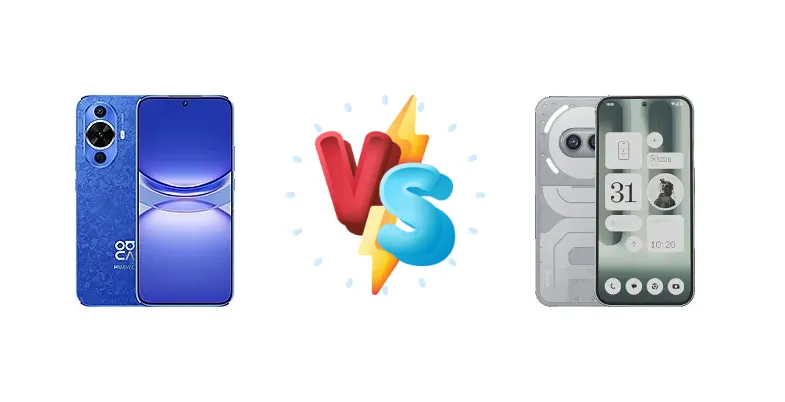
|
🏆 Quick Verdict
For the average user prioritizing sustained performance and faster charging, the Huawei nova 12s emerges as the stronger choice. While the Nothing Phone (2a) Plus boasts impressive battery life and a brighter display, the Snapdragon 778G's proven track record and 66W charging provide a more consistently responsive experience.
| PHONES | ||
|---|---|---|
| Phone Names | Huawei nova 12s | Nothing Phone (2a) Plus |
| Network | ||
|---|---|---|
| 2G bands | GSM 850 / 900 / 1800 / 1900 | GSM 850 / 900 / 1800 / 1900 |
| 3G bands | HSDPA 800 / 850 / 900 / 1700(AWS) / 1900 / 2100 | HSDPA 800 / 850 / 900 / 1700(AWS) / 1900 / 2100 |
| 4G bands | 1, 2, 3, 4, 5, 7, 8, 12, 13, 17, 18, 19, 20, 26, 28, 38, 40, 41, 66 | 1, 3, 4, 5, 7, 8, 18, 19, 20, 26, 28, 38, 39, 40, 41, 42, 66 |
| 5G bands | - | 1, 3, 5, 7, 8, 20, 28, 38, 40, 41, 66, 77, 78 SA/NSA |
| Speed | HSPA, LTE | HSPA, LTE, 5G |
| Technology | GSM / HSPA / LTE | GSM / HSPA / LTE / 5G |
| Launch | ||
|---|---|---|
| Announced | 2024, March 19 | 2024, July 31 |
| Status | Available. Released 2024, April 13 | Available. Released 2024, August 03 |
| Body | ||
|---|---|---|
| Build | - | Glass front (Gorilla Glass 5), plastic frame, plastic back |
| Dimensions | 161.3 x 75 x 6.9 mm (6.35 x 2.95 x 0.27 in) | 161.7 x 76.3 x 8.5 mm (6.37 x 3.00 x 0.33 in) |
| SIM | · Nano-SIM· Nano-SIM + Nano-SIM | Nano-SIM + Nano-SIM |
| Weight | 168 g (5.93 oz) | 190 g (6.70 oz) |
| Display | ||
|---|---|---|
| Protection | - | Corning Gorilla Glass 5 |
| Resolution | 1084 x 2412 pixels, 20:9 ratio (~395 ppi density) | 1080 x 2412 pixels, 20:9 ratio (~395 ppi density) |
| Size | 6.7 inches, 108.3 cm2 (~89.5% screen-to-body ratio) | 6.7 inches, 107.5 cm2 (~87.1% screen-to-body ratio) |
| Type | OLED, 1B colors, HDR, 120Hz | AMOLED, 1B colors, 120Hz, 2160Hz PWM, HDR10+, 700 nits (typ), 1100 nits (HBM), 1300 nits (peak) |
| Platform | ||
|---|---|---|
| CPU | Octa-core (4x2.4 GHz Kryo 670 & 4x1.8 GHz Kryo 670) | Octa-core (2x3.0 GHz Cortex-A715 & 6x 2.0 GHz Cortex-A510) |
| Chipset | Qualcomm SM7325 Snapdragon 778G 4G (6 nm) | Mediatek Dimensity 7350 Pro (4 nm) |
| GPU | Adreno 642L | Mali-G610 MC4 |
| OS | EMUI 14, no Google Play Services | Android 14, up to 3 major Android upgrades, Nothing OS 3.0 |
| Memory | ||
|---|---|---|
| Card slot | No | No |
| Internal | 256GB 8GB RAM | 256GB 8GB RAM, 256GB 12GB RAM |
| Main Camera | ||
|---|---|---|
| Dual | 50 MP, f/1.9, (wide), PDAF 8 MP, f/2.2, 112˚ (ultrawide) | 50 MP, f/1.9, 24mm (wide), 1/1.57", 1.0µm, PDAF, OIS 50 MP, f/2.2, 114˚ (ultrawide), 1/2.76", 0.64µm |
| Features | Laser AF, color spectrum sensor, LED flash, panorama, HDR | LED flash, panorama, HDR |
| Video | 4K@30fps, 1080p@30fps, gyro-EIS | 4K@30fps, 1080p@60/120fps, gyro-EIS |
| Selfie camera | ||
|---|---|---|
| Dual | 60 MP, f/2.4, 100˚ (ultrawide) | - |
| Features | HDR | HDR |
| Single | - | 50 MP, f/2.2, (wide), 1/2.76" |
| Video | 4K@30fps, 1080p@30fps, gyro-EIS | 4K@30fps |
| Sound | ||
|---|---|---|
| 35mm jack | No | No |
| Loudspeaker | Yes, with stereo speakers | Yes, with stereo speakers |
| Comms | ||
|---|---|---|
| Bluetooth | 5.2, A2DP, LE | 5.3, A2DP, LE |
| NFC | Yes | Yes, 360˚ |
| Positioning | GPS (L1+L5), GLONASS, BDS (B1I+B1c+B2a), GALILEO (E1+E5a), QZSS (L1+L5), NavIC | GPS, GALILEO, GLONASS, BDS, QZSS |
| Radio | No | No |
| USB | USB Type-C 2.0, OTG | USB Type-C 2.0, OTG |
| WLAN | Wi-Fi 802.11 a/b/g/n/ac/6, dual-band, Wi-Fi Direct | Wi-Fi 802.11 a/b/g/n/ac/6, dual-band, Wi-Fi Direct |
| Features | ||
|---|---|---|
| Sensors | Fingerprint (under display, optical), accelerometer, gyro, compass | Fingerprint (under display, optical), accelerometer, gyro, proximity, compass |
| Battery | ||
|---|---|---|
| Charging | 66W wired, 3-62% in 15 min, 3-100% in 30 min Reverse wired | 50W wired, 50% in 21 min, 100% in 56 min |
| Type | 4500 mAh | 5000 mAh |
| Misc | ||
|---|---|---|
| Colors | Black, Green, White, Gold | Black, Grey |
| Models | FOA-LX9 | A142P |
| Price | About 300 EUR | € 269.90 / ₹ 22,599 |
Huawei nova 12s
- Faster 66W wired charging
- Proven Snapdragon 778G performance
- Potentially more affordable price point
- Likely lacks 5G connectivity
- Limited battery life information
Nothing Phone (2a) Plus
- Excellent battery life (16:34h active use)
- Brighter 1097 nit display
- More modern Dimensity 7350 Pro chipset
- Slower 50W charging
- Potentially higher price
Display Comparison
The Nothing Phone (2a) Plus takes the lead in display brightness, achieving a measured peak of 1097 nits, making it more visible outdoors. While the nova 12s’ display specifications aren’t provided, it’s likely lower. The Nothing Phone (2a) Plus’s brightness advantage is crucial for users who frequently use their phones in direct sunlight. However, without knowing the panel technology (OLED vs LCD) or refresh rate of the nova 12s, a complete assessment is difficult. The Nothing Phone (2a) Plus’s display is likely to offer better contrast and color accuracy if it utilizes an OLED panel.
Camera Comparison
Without detailed camera specifications for the Huawei nova 12s, a direct comparison is limited. However, the focus should be on the main sensor size and image processing capabilities. The Nothing Phone (2a) Plus likely benefits from MediaTek’s Imagiq ISP, offering advanced image processing features. The absence of information regarding OIS on either device makes it difficult to assess low-light performance. It’s reasonable to assume both phones will include standard features like HDR and portrait modes, but the quality of these features will depend heavily on the underlying hardware and software tuning.
Performance
The Nothing Phone (2a) Plus, powered by the MediaTek Dimensity 7350 Pro (4nm), holds a clear architectural advantage over the Huawei nova 12s’ Qualcomm Snapdragon 778G (6nm). The Dimensity 7350 Pro’s newer Cortex-A715 cores, clocked at 3.0 GHz, offer significantly improved single-core performance compared to the Snapdragon 778G’s Kryo 670 cores at 2.4 GHz. The 4nm process node of the Dimensity chip also translates to better power efficiency and potentially less thermal throttling during extended gaming sessions. However, the Snapdragon 778G is a well-optimized chip, and the real-world performance difference may not be drastic for typical usage.
Battery Life
The Nothing Phone (2a) Plus demonstrates a significant advantage in battery endurance, achieving an active use score of 16 hours and 34 minutes. This suggests a larger battery capacity and/or more efficient power management. The Huawei nova 12s compensates with significantly faster charging: 66W wired, capable of charging from 3-62% in 15 minutes and fully charging in 30 minutes. The Nothing Phone (2a) Plus’s 50W charging takes 21 minutes to reach 50% and 56 minutes for a full charge. This difference in charging speed is substantial, offering a more convenient experience for users who frequently need to top up their battery quickly.
Buying Guide
Buy the Huawei nova 12s if you need a phone with consistently reliable performance for everyday tasks and gaming, and value the convenience of significantly faster charging speeds. Buy the Nothing Phone (2a) Plus if you prioritize all-day battery life, a vibrant display for media consumption, and a unique, minimalist software experience, and are willing to trade off some charging speed.