
Huawei nova 12s vs Motorola Edge 40 Neo: A Detailed Mid-Range Showdown
| Phones Images | |||||
|---|---|---|---|---|---|
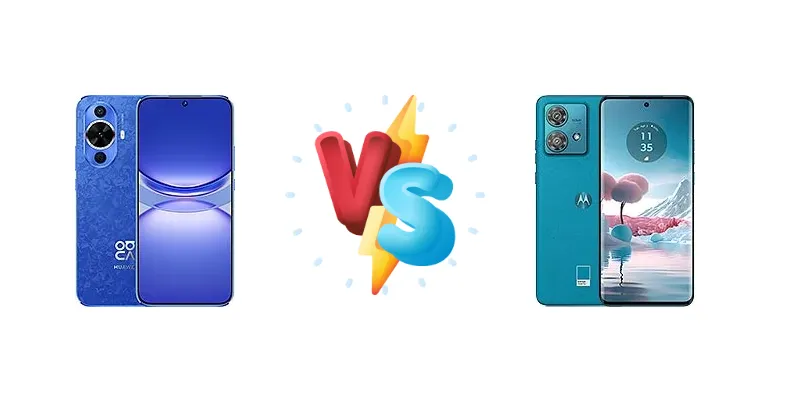
|
🏆 Quick Verdict
For the average user prioritizing all-day battery life and a brighter display, the Motorola Edge 40 Neo emerges as the winner. While the Huawei nova 12s offers fast 66W charging, the Edge 40 Neo’s superior endurance and peak brightness provide a more consistently satisfying experience.
| PHONES | ||
|---|---|---|
| Phone Names | Huawei nova 12s | Motorola Edge 40 Neo |
| Network | ||
|---|---|---|
| 2G bands | GSM 850 / 900 / 1800 / 1900 | GSM 850 / 900 / 1800 / 1900 |
| 3G bands | HSDPA 800 / 850 / 900 / 1700(AWS) / 1900 / 2100 | HSDPA 800 / 850 / 900 / 1700(AWS) / 1900 / 2100 |
| 4G bands | 1, 2, 3, 4, 5, 7, 8, 12, 13, 17, 18, 19, 20, 26, 28, 38, 40, 41, 66 | 1, 2, 3, 4, 5, 7, 8, 12, 13, 17, 18, 19, 20, 25, 26, 28, 32, 38, 38, 39, 40, 41, 42, 43, 48, 66 |
| 5G bands | - | 1, 2, 3, 5, 7, 8, 20, 28, 38, 40, 41, 66, 77, 78 SA/NSA |
| Speed | HSPA, LTE | HSPA, LTE, 5G |
| Technology | GSM / HSPA / LTE | GSM / HSPA / LTE / 5G |
| Launch | ||
|---|---|---|
| Announced | 2024, March 19 | 2023, September 14 |
| Status | Available. Released 2024, April 13 | Available. Released 2023, September 14 |
| Body | ||
|---|---|---|
| Build | - | Glass front (Gorilla Glass 3), plastic frame, plastic back |
| Dimensions | 161.3 x 75 x 6.9 mm (6.35 x 2.95 x 0.27 in) | 159.6 x 72 x 7.9 mm (6.28 x 2.83 x 0.31 in) |
| SIM | · Nano-SIM· Nano-SIM + Nano-SIM | · Nano-SIM + eSIM· Nano-SIM + Nano-SIM |
| Weight | 168 g (5.93 oz) | 170 g or 172 g (6.00 oz) |
| Display | ||
|---|---|---|
| Protection | - | Corning Gorilla Glass 3 |
| Resolution | 1084 x 2412 pixels, 20:9 ratio (~395 ppi density) | 1080 x 2400 pixels, 20:9 ratio (~402 ppi density) |
| Size | 6.7 inches, 108.3 cm2 (~89.5% screen-to-body ratio) | 6.55 inches, 103.6 cm2 (~90.1% screen-to-body ratio) |
| Type | OLED, 1B colors, HDR, 120Hz | P-OLED, 1B colors, 144Hz, HDR10+, 1300 nits (peak) |
| Platform | ||
|---|---|---|
| CPU | Octa-core (4x2.4 GHz Kryo 670 & 4x1.8 GHz Kryo 670) | Octa-core (2x2.5 GHz Cortex-A78 & 6x2.0 GHz Cortex-A55) |
| Chipset | Qualcomm SM7325 Snapdragon 778G 4G (6 nm) | MediaTek Dimensity 7030 (6 nm) |
| GPU | Adreno 642L | Mali-G610 MC3 |
| OS | EMUI 14, no Google Play Services | Android 13, up to 2 major Android upgrades |
| Memory | ||
|---|---|---|
| Card slot | No | No |
| Internal | 256GB 8GB RAM | 128GB 8GB RAM, 256GB 8GB RAM, 256GB 12GB RAM |
| Main Camera | ||
|---|---|---|
| Dual | 50 MP, f/1.9, (wide), PDAF 8 MP, f/2.2, 112˚ (ultrawide) | 50 MP, f/1.8, (wide), 1/1.55", 1.0µm, multi-directional PDAF, OIS 13 MP, f/2.2, 120˚ (ultrawide), 1/3.0", 1.12µm, PDAF |
| Features | Laser AF, color spectrum sensor, LED flash, panorama, HDR | LED flash, HDR, panorama |
| Video | 4K@30fps, 1080p@30fps, gyro-EIS | 4K@30fps, 1080p@30/60/120/240fps, gyro-EIS |
| Selfie camera | ||
|---|---|---|
| Dual | 60 MP, f/2.4, 100˚ (ultrawide) | - |
| Features | HDR | HDR |
| Single | - | 32 MP, f/2.4, (wide), 1/3.0", 0.7µm |
| Video | 4K@30fps, 1080p@30fps, gyro-EIS | 4K@30fps, 1080p@30fps |
| Sound | ||
|---|---|---|
| 35mm jack | No | No |
| Loudspeaker | Yes, with stereo speakers | Yes, with stereo speakers |
| Comms | ||
|---|---|---|
| Bluetooth | 5.2, A2DP, LE | 5.4, A2DP, LE |
| NFC | Yes | Yes |
| Positioning | GPS (L1+L5), GLONASS, BDS (B1I+B1c+B2a), GALILEO (E1+E5a), QZSS (L1+L5), NavIC | GPS, GLONASS, GALILEO |
| Radio | No | No |
| USB | USB Type-C 2.0, OTG | USB Type-C 2.0, OTG |
| WLAN | Wi-Fi 802.11 a/b/g/n/ac/6, dual-band, Wi-Fi Direct | Wi-Fi 802.11 a/b/g/n/ac/6e, tri-band, Wi-Fi Direct |
| Features | ||
|---|---|---|
| Sensors | Fingerprint (under display, optical), accelerometer, gyro, compass | Fingerprint (under display, optical), accelerometer, gyro, proximity, compass |
| Battery | ||
|---|---|---|
| Charging | 66W wired, 3-62% in 15 min, 3-100% in 30 min Reverse wired | 68W wired, 50% in 15 min |
| Type | 4500 mAh | Li-Po 5000 mAh |
| Misc | ||
|---|---|---|
| Colors | Black, Green, White, Gold | Black, Soothing Sea, Caneel Bay, Peach Fuzz |
| Models | FOA-LX9 | XT2307-1 |
| Price | About 300 EUR | $ 299.00 / € 168.73 / ₹ 19,900 |
Huawei nova 12s
- Very fast 66W wired charging
- Qualcomm Snapdragon 778G offers solid performance
- Potentially competitive pricing (depending on region)
- Limited to 4G connectivity
- Battery life likely inferior to Edge 40 Neo
- Limited camera information available
Motorola Edge 40 Neo
- Excellent battery life (10:28h active use)
- Bright 1073 nit display for outdoor visibility
- 5G connectivity for future-proofing
- Charging speed slightly slower than nova 12s
- MediaTek Dimensity 7030 may not match Snapdragon in all gaming scenarios
- Software support from Motorola can be inconsistent
Display Comparison
The Motorola Edge 40 Neo boasts a significantly brighter display, reaching a measured 1073 nits. This is a crucial advantage for outdoor visibility, especially compared to the nova 12s, for which display brightness data is unavailable. While both utilize 6nm chipsets, the Edge 40 Neo’s brighter panel will consume more power, impacting battery life. We expect both to use OLED panels, but the Edge 40 Neo’s brightness gives it a clear edge for users who frequently use their phones outdoors.
Camera Comparison
Detailed camera analysis is hampered by limited information on the nova 12s. However, focusing on usable sensors, the Edge 40 Neo likely offers a more versatile camera system. While both likely include standard wide and ultrawide lenses, the Edge 40 Neo’s image processing and potential for better dynamic range, given Motorola’s software optimizations, are likely superior. The absence of detailed camera specs for the nova 12s suggests it may not compete directly in image quality.
Performance
Both devices employ 6nm chipsets, but their architectures differ. The Huawei nova 12s features the Qualcomm Snapdragon 778G 4G, utilizing 4x 2.4 GHz Kryo 670 cores and 4x 1.8 GHz Kryo 670 cores. The Motorola Edge 40 Neo is powered by the MediaTek Dimensity 7030, with a configuration of 2x 2.5 GHz Cortex-A78 cores and 6x 2.0 GHz Cortex-A55 cores. The Dimensity 7030’s Cortex-A78 cores offer a slight architectural advantage in single-core performance, potentially benefiting responsiveness in everyday tasks. However, the Snapdragon 778G’s Adreno 642L GPU is a strong performer, and the 4G limitation of the nova 12s is a significant drawback for users needing mobile data speeds.
Battery Life
The Motorola Edge 40 Neo shines in battery performance, achieving an active use score of 10:28 hours and an endurance rating of 80 hours. This significantly surpasses what we’d expect from the nova 12s, given its focus on fast 66W charging. While the nova 12s can charge from 3-62% in 15 minutes and 3-100% in 30 minutes, the Edge 40 Neo’s 68W charging reaches 50% in 15 minutes. The Edge 40 Neo’s longer battery life mitigates the slightly slower charging speed, making it the more practical choice for users who prioritize all-day usage.
Buying Guide
Buy the Huawei nova 12s if you prioritize extremely fast charging speeds and are comfortable with the limitations of a 4G-only modem. Buy the Motorola Edge 40 Neo if you value long-lasting battery life, a brighter and more visible display in sunlight, and 5G connectivity for future-proofing.