
Huawei nova 12s vs. Google Pixel 7a: A Deep Dive into Mid-Range Champions
| Phones Images | |||||
|---|---|---|---|---|---|
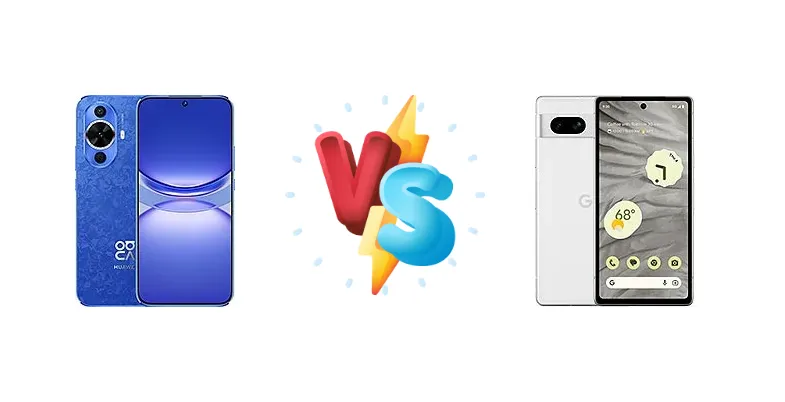
|
🏆 Quick Verdict
For the average user prioritizing camera versatility and software experience, the Google Pixel 7a emerges as the stronger choice. Its Tensor G2 chip delivers superior image processing and AI capabilities, despite the nova 12s’ faster charging. However, users heavily invested in the Huawei ecosystem or seeking the fastest possible charging speeds may find the nova 12s more appealing.
| PHONES | ||
|---|---|---|
| Phone Names | Huawei nova 12s | Google Pixel 7a |
| Network | ||
|---|---|---|
| 2G bands | GSM 850 / 900 / 1800 / 1900 | GSM 850 / 900 / 1800 / 1900 |
| 3G bands | HSDPA 800 / 850 / 900 / 1700(AWS) / 1900 / 2100 | HSDPA 800 / 850 / 900 / 1700(AWS) / 1900 / 2100 |
| 4G bands | 1, 2, 3, 4, 5, 7, 8, 12, 13, 17, 18, 19, 20, 26, 28, 38, 40, 41, 66 | 1, 2, 3, 4, 5, 7, 8, 12, 13, 14, 17, 20, 25, 26, 28, 29, 30, 38, 40, 41, 48, 66, 71 - GWKK3, G0DZQ |
| 5G bands | - | 1, 2, 3, 5, 7, 8, 12, 14, 20, 25, 28, 30, 38, 41, 48, 66, 71, 77, 78 SA/NSA/Sub6 - GWKK3 |
| Speed | HSPA, LTE | HSPA, LTE, 5G |
| Technology | GSM / HSPA / LTE | GSM / HSPA / LTE / 5G |
| - | 1, 2, 3, 5, 7, 8, 12, 20, 25, 28, 38, 40, 41, 66, 75, 76, 77, 78, 79 SA/NSA/Sub6 - GHL1X, G82U8 | |
| Launch | ||
|---|---|---|
| Announced | 2024, March 19 | 2023, May 10 |
| Status | Available. Released 2024, April 13 | Available. Released 2023, May 10 |
| Body | ||
|---|---|---|
| Build | - | Glass front (Gorilla Glass 3), aluminum frame, plastic back |
| Dimensions | 161.3 x 75 x 6.9 mm (6.35 x 2.95 x 0.27 in) | 152 x 72.9 x 9 mm (5.98 x 2.87 x 0.35 in) |
| SIM | · Nano-SIM· Nano-SIM + Nano-SIM | Nano-SIM + eSIM |
| Weight | 168 g (5.93 oz) | 193.5 g (6.84 oz) |
| - | IP67 dust/water resistant (up to 1m for 30 min) | |
| Display | ||
|---|---|---|
| Protection | - | Corning Gorilla Glass 3 |
| Resolution | 1084 x 2412 pixels, 20:9 ratio (~395 ppi density) | 1080 x 2400 pixels, 20:9 ratio (~429 ppi density) |
| Size | 6.7 inches, 108.3 cm2 (~89.5% screen-to-body ratio) | 6.1 inches, 90.7 cm2 (~81.8% screen-to-body ratio) |
| Type | OLED, 1B colors, HDR, 120Hz | OLED, HDR, 90Hz |
| - | Always-on display | |
| Platform | ||
|---|---|---|
| CPU | Octa-core (4x2.4 GHz Kryo 670 & 4x1.8 GHz Kryo 670) | Octa-core (2x2.85 GHz Cortex-X1 & 2x2.35 GHz Cortex-A78 & 4x1.80 GHz Cortex-A55) |
| Chipset | Qualcomm SM7325 Snapdragon 778G 4G (6 nm) | Google Tensor G2 (5 nm) |
| GPU | Adreno 642L | Mali-G710 MP7 |
| OS | EMUI 14, no Google Play Services | Android 13, upgradable to Android 15, up to 5 major Android upgrades |
| Memory | ||
|---|---|---|
| Card slot | No | No |
| Internal | 256GB 8GB RAM | 128GB 8GB RAM |
| - | UFS 3.1 | |
| Main Camera | ||
|---|---|---|
| Dual | 50 MP, f/1.9, (wide), PDAF 8 MP, f/2.2, 112˚ (ultrawide) | 64 MP, f/1.9, 26mm (wide), 1/1.73", 0.8µm, dual pixel PDAF, OIS 13 MP, f/2.2, 120˚ (ultrawide), 1.12µm |
| Features | Laser AF, color spectrum sensor, LED flash, panorama, HDR | Dual-LED flash, Pixel Shift, Auto-HDR, panorama |
| Video | 4K@30fps, 1080p@30fps, gyro-EIS | 4K@30/60fps, 1080p@30/60/120/240fps, OIS |
| Selfie camera | ||
|---|---|---|
| Dual | 60 MP, f/2.4, 100˚ (ultrawide) | - |
| Features | HDR | HDR, panorama |
| Single | - | 13 MP, f/2.2, 20mm (ultrawide), 1.12µm |
| Video | 4K@30fps, 1080p@30fps, gyro-EIS | 4K@30fps, 1080p@30fps |
| Sound | ||
|---|---|---|
| 3.5mm jack | - | No |
| 35mm jack | No | No |
| Loudspeaker | Yes, with stereo speakers | Yes, with stereo speakers |
| Comms | ||
|---|---|---|
| Bluetooth | 5.2, A2DP, LE | 5.3, A2DP, LE |
| NFC | Yes | Yes |
| Positioning | GPS (L1+L5), GLONASS, BDS (B1I+B1c+B2a), GALILEO (E1+E5a), QZSS (L1+L5), NavIC | GPS, GLONASS, GALILEO, BDS, QZSS, NavIC |
| Radio | No | No |
| USB | USB Type-C 2.0, OTG | USB Type-C 3.2 |
| WLAN | Wi-Fi 802.11 a/b/g/n/ac/6, dual-band, Wi-Fi Direct | Wi-Fi 802.11 a/b/g/n/ac/6e, tri-band |
| Features | ||
|---|---|---|
| Sensors | Fingerprint (under display, optical), accelerometer, gyro, compass | Fingerprint (under display, optical), accelerometer, gyro, proximity, compass, barometer |
| Battery | ||
|---|---|---|
| Charging | 66W wired, 3-62% in 15 min, 3-100% in 30 min Reverse wired | 18W wired, PD3.0 7.5W wireless |
| Type | 4500 mAh | Li-Po 4385 mAh |
| Misc | ||
|---|---|---|
| Colors | Black, Green, White, Gold | Charcoal, Snow, Sea, Coral |
| Models | FOA-LX9 | GWKK3, GHL1X, G0DZQ, G82U8 |
| Price | About 300 EUR | € 179.90 / $ 150.00 / £ 170.00 / ₹ 25,980 |
Huawei nova 12s
- 66W SuperCharge delivers incredibly fast charging speeds.
- Reverse wired charging adds versatility.
- Streamlined Android experience (though without Google Mobile Services).
- Snapdragon 778G is less powerful than the Tensor G2.
- Camera performance likely lags behind the Pixel 7a.
- Lacks Google Mobile Services, impacting app availability.
Google Pixel 7a
- Google Tensor G2 offers superior AI and image processing.
- Excellent camera quality with features like Magic Eraser.
- Guaranteed software updates directly from Google.
- 18W charging is significantly slower than the nova 12s.
- Battery life, while good, isn't exceptional.
- No reverse wireless charging.
Display Comparison
The Pixel 7a boasts a brighter display, reaching a measured peak of 1070 nits, which translates to better visibility under direct sunlight compared to the nova 12s (brightness data unavailable). While the nova 12s’ panel specifications are not provided, the Pixel 7a’s OLED panel delivers vibrant colors and deep blacks. The absence of LTPO technology on either device suggests both will rely on adaptive refresh rate switching to conserve battery, rather than dynamically scaling to extremely low refresh rates for static content.
Camera Comparison
The Pixel 7a excels in computational photography thanks to the Tensor G2’s image signal processor (ISP). While specific sensor details for the nova 12s are missing, the Pixel 7a’s camera system is renowned for its dynamic range, accurate colors, and impressive low-light performance. Google’s software algorithms, like Night Sight and Super Res Zoom, significantly enhance image quality. The nova 12s likely relies more on hardware capabilities, but without detailed sensor information, it’s difficult to assess its performance relative to the Pixel 7a’s AI-driven approach. We can assume the Pixel 7a's video capabilities are also superior due to the Tensor G2's dedicated processing power.
Performance
The core difference lies in the chipsets. The Google Pixel 7a’s Tensor G2, fabricated on a 5nm process, features a tri-cluster configuration with Cortex-X1 performance cores clocked at 2.85 GHz, designed for demanding tasks and AI processing. Conversely, the Huawei nova 12s utilizes the Qualcomm Snapdragon 778G 4G (6nm), which prioritizes efficiency and a balanced performance profile. The Tensor G2’s architecture allows for more complex AI calculations, impacting features like voice recognition and image processing. While the Snapdragon 778G is a capable performer, the Tensor G2 offers a noticeable advantage in computationally intensive tasks. The Pixel 7a also benefits from potentially faster RAM speeds (LPDDR5x is likely) compared to the nova 12s, further enhancing responsiveness.
Battery Life
The Pixel 7a has an endurance rating of 76 hours, indicating solid battery life. The nova 12s compensates for a potentially smaller battery capacity with its significantly faster 66W wired charging, capable of reaching 30% to 62% in just 15 minutes and a full charge in 30 minutes. The Pixel 7a’s 18W charging, while supporting PD3.0, is considerably slower. The nova 12s also offers reverse wired charging, a feature absent on the Pixel 7a, allowing it to top up other devices. This makes the nova 12s the clear winner for users who prioritize minimizing downtime.
Buying Guide
Buy the Huawei nova 12s if you need exceptionally fast 66W charging and prefer a more traditional Android experience without Google Mobile Services. This phone is ideal for users who frequently top up their battery and value a streamlined interface. Buy the Google Pixel 7a if you prioritize camera quality, AI-powered features like Magic Eraser, and a guaranteed three years of Android updates directly from Google. It’s the better option for photography enthusiasts and those deeply integrated into the Google ecosystem.