
Huawei nova 12i vs Xiaomi Redmi Note 13 Pro 4G: A Detailed Comparison
| Phones Images | |||||
|---|---|---|---|---|---|
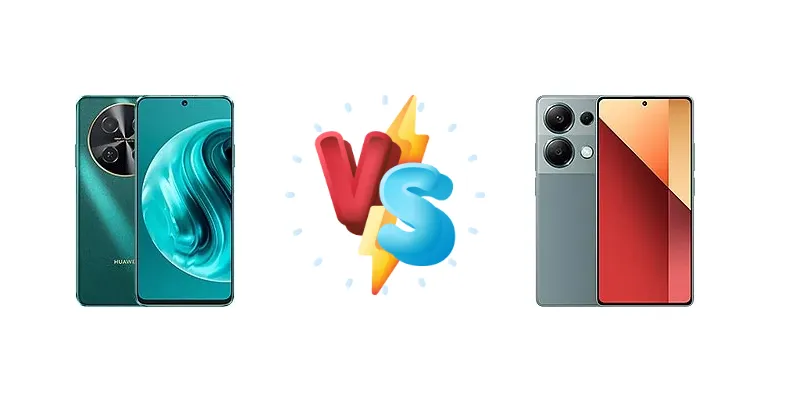
|
🏆 Quick Verdict
For the average user prioritizing fast charging and a brighter display, the Xiaomi Redmi Note 13 Pro 4G emerges as the stronger contender. Its 67W charging significantly outperforms the nova 12i’s 40W, and the 1047 nit peak brightness provides a superior viewing experience, despite the Snapdragon 680 offering a slightly more efficient architecture.
| PHONES | ||
|---|---|---|
| Phone Names | Huawei nova 12i | Xiaomi Redmi Note 13 Pro 4G |
| Network | ||
|---|---|---|
| 2G bands | GSM 850 / 900 / 1800 / 1900 | GSM 850 / 900 / 1800 / 1900 |
| 3G bands | HSDPA 850 / 900 / 1700(AWS) / 1900 / 2100 | HSDPA 850 / 900 / 1700(AWS) / 1900 / 2100 |
| 4G bands | 1, 2, 3, 4, 5, 7, 8, 18, 19, 20, 26, 28, 34, 38, 39, 40, 41 | 1, 2, 3, 4, 5, 7, 8, 12, 13, 17, 18, 19, 20, 26, 28, 38, 40, 41, 66 |
| Speed | HSPA, LTE | HSPA, LTE |
| Technology | GSM / HSPA / LTE | GSM / HSPA / LTE |
| Launch | ||
|---|---|---|
| Announced | 2024, March 19 | 2024, January 15 |
| Status | Available. Released 2024, April 16 | Available. Released 2024, January 15 |
| Body | ||
|---|---|---|
| Build | - | Glass front (Gorilla Glass 5), plastic frame, plastic back |
| Dimensions | 163.3 x 74.7 x 8.4 mm (6.43 x 2.94 x 0.33 in) | 161.1 x 75 x 8 mm (6.34 x 2.95 x 0.31 in) |
| SIM | · Nano-SIM· Nano-SIM + Nano-SIM | Nano-SIM + Nano-SIM |
| Weight | 199 g (7.02 oz) | 188 g (6.63 oz) |
| Display | ||
|---|---|---|
| Protection | - | Corning Gorilla Glass 5 |
| Resolution | 1080 x 2388 pixels (~391 ppi density) | 1080 x 2400 pixels, 20:9 ratio (~395 ppi density) |
| Size | 6.7 inches, 108.7 cm2 (~89.1% screen-to-body ratio) | 6.67 inches, 107.4 cm2 (~88.9% screen-to-body ratio) |
| Type | IPS LCD, 90Hz | AMOLED, 1B colors, 120Hz, 500 nits (typ), 1000 nits (HBM), 1300 nits (peak) |
| Platform | ||
|---|---|---|
| CPU | Octa-core (4x2.4 GHz Cortex-A73 & 4x1.9 GHz Cortex-A53) | Octa-core (2x2.2 GHz Cortex-A76 & 6x2.0 GHz Cortex-A55) |
| Chipset | Qualcomm Snapdragon 680 4G (6 nm) | Mediatek Helio G99 Ultra |
| GPU | Adreno 610 | Mali-G57 MC2 |
| OS | EMUI 14, no Google Play Services | Android 13, up to 3 major Android upgrades, HyperOS |
| Memory | ||
|---|---|---|
| Card slot | No | microSDXC (uses shared SIM slot) |
| Internal | 128GB 8GB RAM, 256GB 8GB RAM | 128GB 8GB RAM, 256GB 8GB RAM, 256GB 12GB RAM, 512GB 8GB RAM, 512GB 12GB RAM |
| Main Camera | ||
|---|---|---|
| Dual | 108 MP, f/1.9, 26mm (wide), PDAF Auxiliary lens | - |
| Features | LED flash, HDR, panorama | LED flash, HDR, panorama |
| Triple | - | 200 MP, f/1.7, 23mm (wide), 1/1.4", 0.56µm, multi-directional PDAF, OIS 8 MP, f/2.2, 15mm, 120˚ (ultrawide), 1/4.4", 1.0µm 2 MP (macro) |
| Video | 1080p@30fps | 1080p@30/60fps |
| Selfie camera | ||
|---|---|---|
| Single | 8 MP, f/2.0, (wide) | 16 MP, f/2.4, (wide), 1/3.0", 1.0µm |
| Video | 1080p@30fps | 1080p@30/60fps |
| Sound | ||
|---|---|---|
| 35mm jack | No | Yes |
| Loudspeaker | Yes | Yes, with dual speakers |
| Comms | ||
|---|---|---|
| Bluetooth | 5.0, A2DP, LE | 5.2, A2DP, LE |
| Infrared port | - | Yes |
| NFC | Yes | Yes (market/region dependent) |
| Positioning | GPS, GLONASS, GALILEO, BDS, QZSS | GPS, GLONASS, GALILEO, BDS |
| Radio | No | FM radio |
| USB | USB Type-C 2.0 | USB Type-C 2.0, OTG |
| WLAN | Wi-Fi 802.11 a/b/g/n/ac, dual-band | Wi-Fi 802.11 a/b/g/n/ac, dual-band |
| Features | ||
|---|---|---|
| Sensors | Fingerprint (side-mounted), accelerometer, compass | Fingerprint (under display, optical), accelerometer, gyro, compass |
| Battery | ||
|---|---|---|
| Charging | 40W wired, 3-62% in 30 min | 67W wired, 50% in 16 min, 100% in 46 min |
| Type | Li-Po 5000 mAh | 5000 mAh |
| Misc | ||
|---|---|---|
| Colors | Green, Black, White | Midnight Black, Lavender Purple, Forest Green |
| Models | CTR-AL20, CTR-L81 | 23117RA68G, 2312FPCA6G |
| Price | About 110 EUR | € 92.00 / $ 269.99 / £ 299.99 |
| SAR | - | 1.09 W/kg (head) 1.09 W/kg (body) |
| SAR EU | - | 0.99 W/kg (head) 0.99 W/kg (body) |
Huawei nova 12i
- Potentially better power efficiency due to 6nm Snapdragon 680.
- Proven Qualcomm chipset with established software support.
- Sleek design (assumed based on Huawei's design language).
- Slower 40W charging compared to the Redmi.
- Likely less bright display impacting outdoor visibility.
Xiaomi Redmi Note 13 Pro 4G
- Significantly faster 67W charging.
- Brighter 1047 nit display for excellent outdoor visibility.
- Longer active use battery life (11:36h).
- Helio G99 Ultra may not be as power efficient as the Snapdragon 680.
- Mediatek chipsets sometimes face software optimization challenges.
Display Comparison
The Xiaomi Redmi Note 13 Pro 4G boasts a significantly brighter display, reaching a measured peak of 1047 nits. This is a substantial advantage over what we’d expect from the nova 12i, making it far more usable outdoors under direct sunlight. While the nova 12i’s panel specifics are unknown, the Redmi’s brightness level suggests a superior viewing experience. The Redmi Note 13 Pro 4G’s brightness also implies a more powerful backlight, potentially impacting battery consumption, but the overall active use score of 11:36h suggests efficient power management.
Camera Comparison
Detailed camera analysis is limited by the provided data. However, the Redmi Note 13 Pro 4G’s camera system is likely to be more versatile, given the current market trends for this price point. While both phones likely feature multi-camera setups, the Redmi’s focus on 'Photo/Video' suggests a more robust feature set and potentially larger sensor sizes. The absence of sensor size information for either device makes a definitive comparison impossible, but the Redmi’s marketing emphasizes camera capabilities, hinting at a stronger offering.
Performance
The Redmi Note 13 Pro 4G utilizes the Mediatek Helio G99 Ultra, featuring a dual-core configuration with 2x2.2 GHz Cortex-A76 cores and 6x2.0 GHz Cortex-A55 cores. The nova 12i, on the other hand, is powered by the Qualcomm Snapdragon 680 4G, employing an octa-core setup with 4x2.4 GHz Cortex-A73 and 4x1.9 GHz Cortex-A53 cores. While the Snapdragon 680’s 6nm process node offers better theoretical power efficiency, the Helio G99 Ultra’s Cortex-A76 cores provide a performance edge in CPU-intensive tasks. The real-world impact will likely be noticeable in app loading times and multitasking, favoring the Redmi Note 13 Pro 4G.
Battery Life
The Redmi Note 13 Pro 4G shines in the battery and charging department. Its active use score of 11:36h demonstrates excellent real-world endurance. Crucially, the 67W wired charging capability is a game-changer, achieving 50% charge in just 16 minutes and a full charge in 46 minutes. The Huawei nova 12i’s 40W charging, while respectable, pales in comparison, taking approximately 30 minutes to reach 62%. This difference in charging speed significantly impacts user convenience, making the Redmi Note 13 Pro 4G the clear winner for those who value quick top-ups.
Buying Guide
Buy the Huawei nova 12i if you prioritize a proven, if slightly older, chipset architecture known for efficiency and are less concerned with blazing-fast charging. It’s a solid choice for everyday tasks and moderate usage. Buy the Xiaomi Redmi Note 13 Pro 4G if you value a brighter, more vibrant display, significantly faster charging speeds, and a longer active use battery life, even if it means sacrificing some theoretical chipset efficiency.