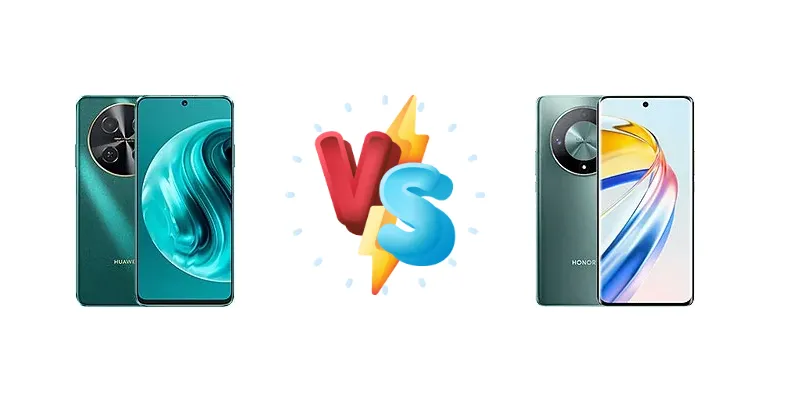
The Huawei nova 12i and Honor X9b represent compelling options in the crowded mid-range smartphone market. While both aim for affordability, they diverge significantly in their core processing power, leveraging different generations of Qualcomm's Snapdragon series. This comparison dissects those differences, focusing on how the chipset choice impacts everyday performance and long-term usability.
🏆 Quick Verdict
For most users, the Honor X9b is the superior choice. Its Snapdragon 6 Gen 1, built on a more efficient 4nm process, delivers noticeably better performance and thermal management compared to the Huawei nova 12i’s Snapdragon 680. While the nova 12i offers a slightly faster charging speed, the X9b’s overall efficiency and processing capabilities provide a more future-proof experience.
| Network |
|---|
| 2G bands | GSM 850 / 900 / 1800 / 1900 | GSM 850 / 900 / 1800 / 1900 |
| 3G bands | HSDPA 850 / 900 / 1700(AWS) / 1900 / 2100 | HSDPA 850 / 900 / 1900 / 2100 |
| 4G bands | 1, 2, 3, 4, 5, 7, 8, 18, 19, 20, 26, 28, 34, 38, 39, 40, 41 | 1, 2, 3, 4, 5, 7, 8, 20, 28, 32, 38, 40, 41 |
| 5G bands | - | 1, 3, 7, 8, 20, 28, 38, 40, 41, 77, 78 SA/NSA |
| Speed | HSPA, LTE | HSPA, LTE, 5G |
| Technology | GSM / HSPA / LTE | GSM / HSPA / LTE / 5G |
| Launch |
|---|
| Announced | 2024, March 19 | 2023, October 18 |
| Status | Available. Released 2024, April 16 | Available. Released 2023, October |
| Body |
|---|
| Dimensions | 163.3 x 74.7 x 8.4 mm (6.43 x 2.94 x 0.33 in) | 163.6 x 75.5 x 8 mm (6.44 x 2.97 x 0.31 in) |
| SIM | · Nano-SIM· Nano-SIM + Nano-SIM | Nano-SIM + Nano-SIM |
| Weight | 199 g (7.02 oz) | 185 g (6.53 oz) |
| Display |
|---|
| Resolution | 1080 x 2388 pixels (~391 ppi density) | 1220 x 2652 pixels, 19.5:9 ratio (~431 ppi density) |
| Size | 6.7 inches, 108.7 cm2 (~89.1% screen-to-body ratio) | 6.78 inches, 112.6 cm2 (~91.2% screen-to-body ratio) |
| Type | IPS LCD, 90Hz | AMOLED, 1B colors, 120Hz, 1200 nits (peak) |
| Platform |
|---|
| CPU | Octa-core (4x2.4 GHz Cortex-A73 & 4x1.9 GHz Cortex-A53) | Octa-core (4x2.2 GHz Cortex-A78 & 4x1.8 GHz Cortex-A55) |
| Chipset | Qualcomm Snapdragon 680 4G (6 nm) | Qualcomm SM6450 Snapdragon 6 Gen 1 (4 nm) |
| GPU | Adreno 610 | Adreno 710 |
| OS | EMUI 14, no Google Play Services | Android 13, Magic OS 7.2 |
| Memory |
|---|
| Card slot | No | No |
| Internal | 128GB 8GB RAM, 256GB 8GB RAM | 256GB 8GB RAM, 256GB 12GB RAM, 512GB 8GB RAM, 512GB 12GB RAM |
| Main Camera |
|---|
| Dual | 108 MP, f/1.9, 26mm (wide), PDAF
Auxiliary lens | - |
| Features | LED flash, HDR, panorama | LED flash, panorama, HDR |
| Triple | - | 108 MP, f/1.8, (wide), 1/1.67", PDAF
5 MP, f/2.2, (ultrawide)
2 MP (macro) |
| Video | 1080p@30fps | 4K@30fps, 1080p@30fps |
| Selfie camera |
|---|
| Single | 8 MP, f/2.0, (wide) | 16 MP, f/2.5, (wide) |
| Video | 1080p@30fps | 1080p@30fps |
| Sound |
|---|
| 35mm jack | No | No |
| Loudspeaker | Yes | Yes |
| Comms |
|---|
| Bluetooth | 5.0, A2DP, LE | 5.1, A2DP, LE |
| Infrared port | - | Yes |
| NFC | Yes | Yes (market/region dependent) |
| Positioning | GPS, GLONASS, GALILEO, BDS, QZSS | GPS, GLONASS, GALILEO, BDS |
| Radio | No | No |
| USB | USB Type-C 2.0 | USB Type-C 2.0, OTG |
| WLAN | Wi-Fi 802.11 a/b/g/n/ac, dual-band | Wi-Fi 802.11 a/b/g/n/ac, dual-band, Wi-Fi Direct |
| Features |
|---|
| Sensors | Fingerprint (side-mounted), accelerometer, compass | Fingerprint (under display, optical), accelerometer, gyro, proximity, compass |
| Battery |
|---|
| Charging | 40W wired, 3-62% in 30 min | 35W wired
Reverse wired |
| Type | Li-Po 5000 mAh | Li-Po 5800 mAh |
| Misc |
|---|
| Colors | Green, Black, White | Sunrise Orange, Midnight Black, Emerald Green |
| Models | CTR-AL20, CTR-L81 | ALI-NX1 |
| Price | About 110 EUR | About 970 EUR |
Huawei nova 12i
- Faster 40W wired charging
- Potentially lower price point
- Simple and straightforward user experience
- Less powerful Snapdragon 680 chipset
- 6nm process less efficient than 4nm
- Older CPU architecture
Honor X9b
- More efficient Snapdragon 6 Gen 1 chipset
- 4nm process for better thermal management
- Reverse wired charging capability
- Superior CPU architecture (Cortex-A78)
- Slightly slower 35W wired charging
- Potentially higher price point
- May not be available in all markets
Display Comparison
Neither device's display specifications are provided, so a direct comparison is limited. However, given the price points, we can assume both utilize LCD panels. The absence of details like refresh rate or resolution suggests neither prioritizes a premium display experience. Users should expect standard viewing angles and color reproduction typical of this segment. The focus here is clearly on internal performance, not visual fidelity.
Camera Comparison
Without specific camera sensor details, a detailed comparison is challenging. However, the chipset’s image signal processor (ISP) plays a crucial role. The Snapdragon 6 Gen 1 in the X9b benefits from a newer ISP, likely offering improved image processing capabilities, including better noise reduction and dynamic range. While both phones likely feature similar megapixel counts in their main sensors, the X9b’s ISP will likely produce more refined images, particularly in challenging lighting conditions. The absence of information regarding OIS (Optical Image Stabilization) suggests neither phone prioritizes advanced camera features.
Performance
The core difference lies in the chipsets. The Honor X9b’s Snapdragon 6 Gen 1 (4nm) represents a significant leap over the Huawei nova 12i’s Snapdragon 680 (6nm). The 4nm process inherently offers better power efficiency, translating to less heat generation and potentially reduced throttling during sustained workloads. Furthermore, the X9b utilizes Cortex-A78 cores in its CPU configuration, which are architecturally superior to the Cortex-A73 cores found in the nova 12i, providing a performance boost in CPU-intensive tasks. The X9b’s CPU clock speeds (4x2.2 GHz) are also slightly lower than the nova 12i’s (4x2.4 GHz), but the architectural improvements and process node more than compensate for this difference. This means smoother app launches, faster multitasking, and a more responsive user experience on the X9b.
Battery Life
The Huawei nova 12i boasts 40W wired charging, claiming a 3-62% charge in 30 minutes. The Honor X9b offers 35W wired charging with reverse wired charging capability. While the nova 12i charges slightly faster initially, the Snapdragon 6 Gen 1’s 4nm efficiency in the X9b likely results in lower overall power consumption, potentially leading to comparable or even better real-world battery life despite a potentially similar battery capacity (not specified). The X9b’s reverse wired charging is a useful feature for topping up accessories like earbuds or smartwatches.
Buying Guide
Buy the Huawei nova 12i if you prioritize a slightly faster charging experience and are primarily focused on basic smartphone tasks like calling, texting, and light social media use. Buy the Honor X9b if you value smoother multitasking, improved gaming performance, and a more efficient processor that will likely hold up better over time, even if it means a slightly slower charging rate.
Frequently Asked Questions
❓ Will the Snapdragon 6 Gen 1 in the Honor X9b handle demanding games like PUBG Mobile smoothly?
The Snapdragon 6 Gen 1 is capable of running PUBG Mobile, but expect to use medium graphics settings for a consistently smooth experience. While not a dedicated gaming chipset, its improved CPU and GPU performance over the Snapdragon 680 will result in fewer frame drops and a more enjoyable gaming session.
❓ Does the Huawei nova 12i’s 40W charging significantly reduce charging time compared to the Honor X9b’s 35W?
While the nova 12i charges slightly faster initially (reaching 62% in 30 minutes), the difference in overall charging time from 0-100% is likely minimal. The X9b’s more efficient chipset means it consumes less power during charging, potentially offsetting the slower wattage. The convenience of reverse wired charging on the X9b is also a factor.
❓ Is the difference in CPU architecture (Cortex-A78 vs Cortex-A73) noticeable in everyday tasks?
Yes, the Cortex-A78 cores in the Honor X9b’s Snapdragon 6 Gen 1 offer a tangible improvement in responsiveness and multitasking. You’ll notice faster app launches, smoother scrolling, and a more fluid overall user experience compared to the Huawei nova 12i.