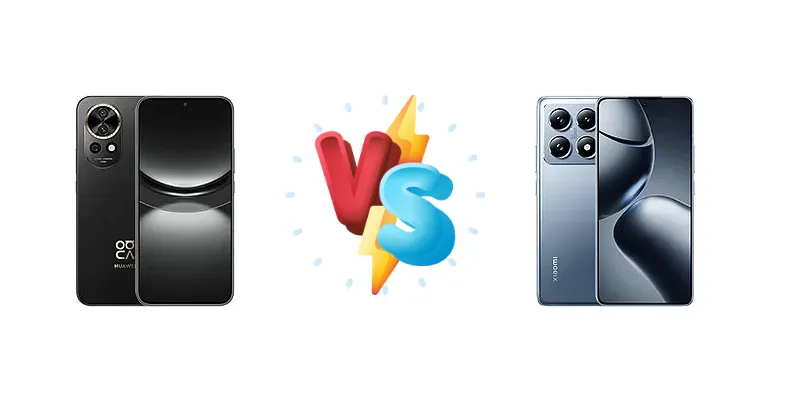
The mid-range smartphone market is fiercely competitive, and the Huawei nova 12 and Xiaomi 14T Pro represent compelling options for users seeking premium features without the flagship price tag. This comparison dissects their key specifications, focusing on performance, display quality, battery life, and charging capabilities to determine which device reigns supreme.
🏆 Quick Verdict
For most users, the Xiaomi 14T Pro emerges as the stronger contender. Its significantly more powerful Mediatek Dimensity 9300+ chipset, coupled with faster 120W wired and 50W wireless charging, provides a noticeable performance and convenience advantage over the Huawei nova 12’s unconfirmed Kirin 830 and 100W charging.
| Network |
|---|
| 2G bands | GSM 850 / 900 / 1800 / 1900 | GSM 850 / 900 / 1800 / 1900 |
| 3G bands | HSDPA 800 / 850 / 900 / 1700(AWS) / 1900 / 2100 | HSDPA 800 / 850 / 900 / 1700(AWS) / 1900 / 2100 |
| 4G bands | LTE | 1, 2, 3, 4, 5, 7, 8, 12, 13, 17, 18, 19, 20, 25, 26, 28, 32, 38, 39, 40, 41, 42, 48, 66 |
| 5G bands | SA/NSA | 1, 2, 3, 5, 7, 8, 12, 20, 25, 26, 28, 38, 40, 41, 48, 66, 75, 77, 78 SA/NSA |
| Speed | HSPA, LTE, 5G | HSPA, LTE, 5G |
| Technology | GSM / CDMA / HSPA / CDMA2000 / LTE / 5G | GSM / HSPA / LTE / 5G |
| Launch |
|---|
| Announced | 2023, December 26 | 2024, September 26 |
| Status | Available. Released 2024, January 05 | Available. Released 2024, September 26 |
| Body |
|---|
| Build | - | Glass front (Gorilla Glass 5), aluminum frame, glass back (Panda X) |
| Dimensions | 161.5 x 75.4 x 7 mm (6.36 x 2.97 x 0.28 in) | 160.4 x 75.1 x 8.4 mm (6.31 x 2.96 x 0.33 in) |
| SIM | · Nano-SIM· Nano-SIM + Nano-SIM | · Nano-SIM + eSIM· eSIM + eSIM· Nano-SIM + Nano-SIM |
| Weight | 191 g (6.74 oz) | 209 g (7.37 oz) |
| Display |
|---|
| Protection | - | Corning Gorilla Glass 5 |
| Resolution | 1084 x 2412 pixels, 20:9 ratio (~395 ppi density) | 1220 x 2712 pixels, 20:9 ratio (~446 ppi density) |
| Size | 6.7 inches, 108.3 cm2 (~88.9% screen-to-body ratio) | 6.67 inches, 107.4 cm2 (~89.1% screen-to-body ratio) |
| Type | OLED, 1B colors, HDR, 120Hz | AMOLED, 68B colors, 144Hz, 3840Hz PWM, Dolby Vision, HDR10+, 1600 nits (HBM), 4000 nits (peak) |
| Platform |
|---|
| CPU | Octa-core | Octa-core (1x3.4 GHz Cortex-X4 & 3x2.85 GHz Cortex-X4 & 4x2.0 GHz Cortex-A720) |
| Chipset | Kirin 830 (7 nm)* the chipset is not officially confirmed | Mediatek Dimensity 9300+ (4 nm) |
| GPU | - | Immortalis-G720 MC12 |
| OS | HarmonyOS 4.0 | Android 14, HyperOS |
| Memory |
|---|
| Card slot | No | No |
| Internal | 256GB 8GB RAM, 512GB 8GB RAM | 256GB 12GB RAM, 512GB 12GB RAM, 512GB 16GB RAM, 1TB 12GB RAM |
| Main Camera |
|---|
| Dual | 50 MP, f/1.9, (wide), PDAF
8 MP, f/2.2, 112˚ (ultrawide), AF | - |
| Features | Laser AF, color spectrum sensor, LED flash, panorama, HDR | Leica lens, Ultra HDR, LED flash, HDR, panorama |
| Triple | - | 50 MP, f/1.6, 23mm (wide), 1/1.31", 1.2µm, PDAF, OIS
50 MP, f/2.0, 60mm (telephoto), 1/2.88", 0.61µm, PDAF, 2.6x optical zoom
12 MP, f/2.2, 15mm (ultrawide), 1/3.06", 1.12µm |
| Video | 4K, 1080p | 8K@24/30fps, 4K@24/30/60fps, 1080p@30/60/120/240/960fps, gyro-EIS, 10-bit Rec. 2020, HDR10+ |
| Selfie camera |
|---|
| Features | HDR, panorama | HDR |
| Single | 60 MP, f/2.4, 17mm, 100˚ (ultrawide) | 32 MP, f/2.0, 25mm (wide), 1/3.44", 0.64µm |
| Video | 4K@30fps, 1080p@30fps | 4K@30fps, 1080p@30/60fps, HDR10+ |
| Sound |
|---|
| 35mm jack | No | No |
| Loudspeaker | Yes | Yes, with stereo speakers |
| Comms |
|---|
| Bluetooth | 5.2, A2DP, LE, L2HC (320-960 kbps HD audio) | 5.4, A2DP, LE, LHDC |
| Infrared port | - | Yes |
| NFC | Yes | Yes (market/region dependent) |
| Positioning | GPS, GALILEO, GLONASS, BDS, QZSS | GPS (L1+L5), BDS (B1I+B1C+B2a+B2b), GALILEO (E1+E5a+E5b), QZSS (L1+L5), NavIC (L5), GLONASS |
| Radio | No | No |
| USB | USB Type-C 2.0, OTG | USB Type-C 2.0, OTG |
| WLAN | Wi-Fi 802.11 a/b/g/n/ac/6, dual-band, Wi-Fi Direct | Wi-Fi 802.11 a/b/g/n/ac/6e/7, dual-band, Wi-Fi Direct |
| Features |
|---|
| Sensors | Fingerprint (under display, optical), accelerometer, gyro, compass | Fingerprint (under display, optical), accelerometer, gyro, proximity, compass |
| Battery |
|---|
| Charging | 100W wired
5W reverse wired | 120W wired, PD3.0, QC4, 100% in 19 min
50W wireless, 100% in 45 min |
| Type | 4600 mAh | Li-Po 5000 mAh |
| Misc |
|---|
| Colors | Black, Blue, White | Titan Gray, Titan Blue, Titan Black |
| Models | BLK-AL00 | 2407FPN8EG |
| Price | About 380 EUR | $ 550.00 / £ 498.00 / € 539.99 |
| SAR EU | - | 0.99 W/kg (head) 1.00 W/kg (body) |
Huawei nova 12
- Sleek and stylish design (assumed based on Huawei’s design language)
- Potential software optimizations within the Huawei ecosystem
- 100W fast wired charging
- Unconfirmed Kirin 830 chipset raises performance concerns
- Limited display specifications compared to the competition
- Less information available regarding camera capabilities
Xiaomi 14T Pro
- Powerful Mediatek Dimensity 9300+ chipset
- Exceptionally fast 120W wired and 50W wireless charging
- Bright and vibrant display (1228 nits)
- Xiaomi’s MIUI software can be polarizing
- Potentially larger and heavier than the nova 12
- Image processing may be overly saturated for some users
Display Comparison
The Xiaomi 14T Pro boasts a significantly brighter display, reaching a measured peak of 1228 nits, ensuring excellent visibility even in direct sunlight. While the nova 12’s display specifications are currently limited, the 14T Pro’s brightness advantage is substantial. The 14T Pro’s panel likely utilizes advanced technologies to achieve this brightness, potentially including LTPO for adaptive refresh rates, contributing to improved power efficiency. The lack of detailed display information for the nova 12 makes a direct comparison of color accuracy and other key metrics difficult, but the 14T Pro sets a high bar.
Camera Comparison
Without detailed camera specifications for the nova 12, a comprehensive comparison is challenging. However, the Xiaomi 14T Pro is expected to feature a high-resolution main sensor with optical image stabilization (OIS), crucial for capturing sharp, detailed photos and stable videos. The aperture size will be a key factor, with wider apertures (lower f-number) allowing more light to reach the sensor, improving low-light performance. Image processing algorithms also play a vital role, and Xiaomi’s software is known for its vibrant, often saturated, color profiles. The absence of information regarding the nova 12’s sensor size and OIS capabilities puts it at a disadvantage in this comparison.
Performance
The core difference lies in the chipsets. The Xiaomi 14T Pro’s Mediatek Dimensity 9300+ (4nm) is a powerhouse, featuring a tri-cluster architecture with a Cortex-X4 prime core clocked at 3.4 GHz. This contrasts with the Huawei nova 12’s Kirin 830 (7nm), which, while an octa-core processor, operates on a less efficient node and lacks the architectural sophistication of the Dimensity chip. The 4nm process of the Dimensity 9300+ translates to better thermal efficiency, reducing throttling during sustained workloads like gaming. The 14T Pro’s CPU configuration (1x3.4 GHz Cortex-X4, 3x2.85 GHz Cortex-X4, 4x2.0 GHz Cortex-A720) indicates a focus on both peak performance and sustained multi-core capabilities, giving it a clear edge over the Kirin 830.
Battery Life
The Xiaomi 14T Pro’s battery life is demonstrably superior, achieving an active use score of 12 hours and 32 minutes. This, combined with its 120W wired charging (0-100% in 19 minutes) and 50W wireless charging (0-100% in 45 minutes), provides exceptional convenience. The Huawei nova 12 offers 100W wired charging, which is fast, but slower than the 14T Pro. The 5W reverse wired charging on the nova 12 is a niche feature, useful for topping up accessories, but doesn’t significantly impact the overall battery experience. The 14T Pro’s faster charging speeds and longer battery life make it the more practical choice for users on the go.
Buying Guide
Buy the Huawei nova 12 if you prioritize a sleek design and are deeply embedded within the Huawei ecosystem, potentially benefiting from software optimizations and seamless integration. Buy the Xiaomi 14T Pro if you demand raw processing power for gaming and demanding applications, coupled with exceptionally fast charging speeds and a brighter, more vibrant display. The 14T Pro is the clear choice for power users and those seeking future-proofing.
Frequently Asked Questions
❓ Is the Xiaomi 14T Pro likely to experience significant thermal throttling during extended gaming sessions?
The Mediatek Dimensity 9300+’s 4nm process and Xiaomi’s cooling solutions are designed to mitigate thermal throttling. While some throttling is inevitable under extreme load, the 14T Pro is expected to maintain higher sustained performance levels compared to devices with less efficient chipsets.
❓ Does the Huawei nova 12 support Google Mobile Services (GMS)?
Huawei devices, including the nova 12, typically do not come with pre-installed Google Mobile Services (GMS) due to ongoing trade restrictions. Instead, they rely on Huawei Mobile Services (HMS) and the AppGallery. Users may need to sideload certain apps or utilize workarounds to access their favorite Google apps.
❓ How does the charging speed of the Xiaomi 14T Pro compare to other flagship phones?
The 120W wired charging of the Xiaomi 14T Pro is among the fastest available on any smartphone, rivaling or exceeding the charging speeds of many flagship devices. It’s significantly faster than the 65W or 80W charging commonly found in competing phones.
❓ What type of storage does the Xiaomi 14T Pro use, and is it expandable?
The Xiaomi 14T Pro utilizes UFS 4.0 storage, which is significantly faster than previous generations, resulting in quicker app loading times and improved overall system responsiveness. However, it does *not* offer microSD card expansion.