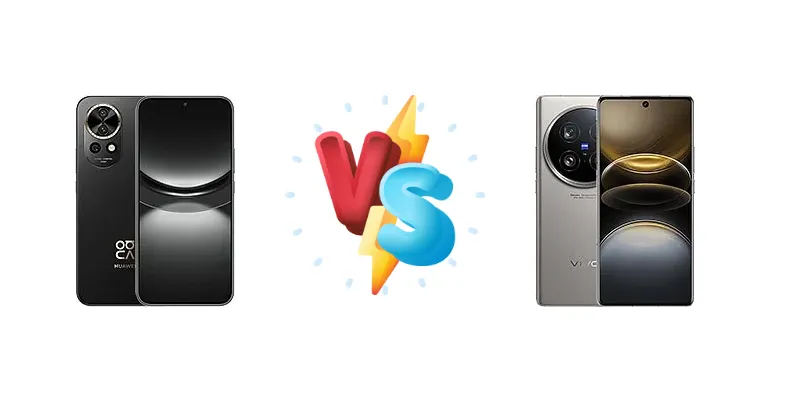
The Huawei nova 12 and vivo X100 Ultra represent distinct approaches to the smartphone market. The nova 12 aims for stylish design and rapid charging at a more accessible price point, while the X100 Ultra throws everything at the wall – a top-tier Snapdragon processor, a massive battery, and cutting-edge charging technologies – to deliver an uncompromising flagship experience. This comparison dissects these differences to help you determine which device best suits your needs.
🏆 Quick Verdict
For the average user prioritizing raw performance and a premium experience, the vivo X100 Ultra is the clear winner. Its Snapdragon 8 Gen 3 chipset and superior battery life justify the higher price. However, the Huawei nova 12 offers a compelling package for those seeking fast charging and a stylish design on a tighter budget.
| Network |
|---|
| 2G bands | GSM 850 / 900 / 1800 / 1900 | GSM 850 / 900 / 1800 / 1900 |
| 3G bands | HSDPA 800 / 850 / 900 / 1700(AWS) / 1900 / 2100 | HSDPA 800 / 850 / 900 / 1700(AWS) / 1900 / 2100 |
| 4G bands | LTE | 1, 2, 3, 4, 5, 7, 8, 12, 17, 18, 19, 20, 25, 26, 28, 34, 38, 39, 40, 41, 42, 66 |
| 5G bands | SA/NSA | 1, 2, 3, 5, 7, 8, 12, 20, 25, 26, 28, 38, 40, 41, 66, 77, 78, 79 SA/NSA |
| Speed | HSPA, LTE, 5G | HSPA, LTE, 5G |
| Technology | GSM / CDMA / HSPA / CDMA2000 / LTE / 5G | GSM / CDMA / HSPA / LTE / 5G |
| Launch |
|---|
| Announced | 2023, December 26 | 2024, May 13 |
| Status | Available. Released 2024, January 05 | Available. Released 2024, May 28 |
| Body |
|---|
| Build | - | Glass front, glass back, aluminum frame |
| Dimensions | 161.5 x 75.4 x 7 mm (6.36 x 2.97 x 0.28 in) | 164.1 x 75.6 x 9.2 mm (6.46 x 2.98 x 0.36 in) |
| SIM | · Nano-SIM· Nano-SIM + Nano-SIM | Nano-SIM + Nano-SIM |
| Weight | 191 g (6.74 oz) | 229 g (8.08 oz) |
| Display |
|---|
| Resolution | 1084 x 2412 pixels, 20:9 ratio (~395 ppi density) | 1440 x 3200 pixels, 20:9 ratio (~517 ppi density) |
| Size | 6.7 inches, 108.3 cm2 (~88.9% screen-to-body ratio) | 6.78 inches, 111.4 cm2 (~89.8% screen-to-body ratio) |
| Type | OLED, 1B colors, HDR, 120Hz | LTPO AMOLED, 1B colors, 120Hz, Dolby Vision, HDR, 3000 nits (peak) |
| Platform |
|---|
| CPU | Octa-core | Octa-core (1x3.3 GHz Cortex-X4 & 3x3.2 GHz Cortex-A720 & 2x3.0 GHz Cortex-A720 & 2x2.3 GHz Cortex-A520) |
| Chipset | Kirin 830 (7 nm)* the chipset is not officially confirmed | Qualcomm SM8650-AB Snapdragon 8 Gen 3 (4 nm) |
| GPU | - | Adreno 750 |
| OS | HarmonyOS 4.0 | Android 14, upgradable to Android 15, OriginOS 5 |
| Memory |
|---|
| Card slot | No | No |
| Internal | 256GB 8GB RAM, 512GB 8GB RAM | 256GB 12GB RAM, 512GB 16GB RAM, 1TB 16GB RAM |
| Main Camera |
|---|
| Dual | 50 MP, f/1.9, (wide), PDAF
8 MP, f/2.2, 112˚ (ultrawide), AF | - |
| Features | Laser AF, color spectrum sensor, LED flash, panorama, HDR | Laser AF, color spectrum sensor, Zeiss optics, Zeiss T* lens coating, LED flash, panorama, HDR, 3D LUT import |
| Triple | - | 50 MP, f/1.8, 23mm (wide), 1/0.98", 1.6µm, dual pixel PDAF, gimbal OIS
200 MP, f/2.7, 85mm (periscope telephoto), 1/1.4", 0.56µm, multi-directional PDAF, OIS, 3.7x optical zoom, macro 3.4:1
50 MP, f/2.2, 14mm, 116˚ (ultrawide), 1/2.0", 0.8µm, AF |
| Video | 4K, 1080p | 8K@30fps, 4K@30/60/120fps, 1080p@30/60/120/240fps, gyro-EIS, Dolby Vision HDR |
| Selfie camera |
|---|
| Features | HDR, panorama | HDR |
| Single | 60 MP, f/2.4, 17mm, 100˚ (ultrawide) | 50 MP, f/2.5, 24mm (wide), 1/2.76", 0.64µm, AF |
| Video | 4K@30fps, 1080p@30fps | 4K@30/60fps, 1080p@30/60fps |
| Sound |
|---|
| 35mm jack | No | No |
| Loudspeaker | Yes | Yes, with stereo speakers |
| Comms |
|---|
| Bluetooth | 5.2, A2DP, LE, L2HC (320-960 kbps HD audio) | 5.4, A2DP, LE, aptX HD, aptX Adaptive, aptX Lossless, LHDC |
| Infrared port | - | Yes |
| NFC | Yes | Yes |
| Positioning | GPS, GALILEO, GLONASS, BDS, QZSS | GPS (L1+L5), BDS (B1I+B1c+B2a), GALILEO (E1+E5a), QZSS (L1+L5), GLONASS |
| Radio | No | No |
| USB | USB Type-C 2.0, OTG | USB Type-C 3.2, OTG, DisplayPort |
| WLAN | Wi-Fi 802.11 a/b/g/n/ac/6, dual-band, Wi-Fi Direct | Wi-Fi 802.11 a/b/g/n/ac/6/7, dual-band |
| Features |
|---|
| Sensors | Fingerprint (under display, optical), accelerometer, gyro, compass | Fingerprint (under display, ultrasonic), accelerometer, gyro, proximity, compass |
| Battery |
|---|
| Charging | 100W wired
5W reverse wired | 80W wired, PD, PPS, QC, UFCS
30W wireless
Reverse wired
Reverse wireless |
| Type | 4600 mAh | Si/C Li-Ion 5500 mAh |
| Misc |
|---|
| Colors | Black, Blue, White | Titanium, White, Grey |
| Models | BLK-AL00 | V2366GA, V2366HA |
| Price | About 380 EUR | About 980 EUR |
Huawei nova 12
- Faster 100W wired charging
- Potentially more affordable price
- Stylish design (based on Huawei's aesthetic)
- Less powerful Kirin 830 chipset
- Likely inferior camera performance
- Unknown battery capacity
vivo X100 Ultra
- Flagship Snapdragon 8 Gen 3 performance
- Excellent battery life (12:55h active use)
- Versatile charging options (80W wired, 30W wireless)
- Higher price point
- May be larger and heavier
- 80W charging is slower than nova 12's 100W
Display Comparison
The vivo X100 Ultra boasts a significantly brighter display, reaching a measured peak of 1801 nits, ensuring excellent visibility even in direct sunlight. While the nova 12’s display specifications are not provided, it’s unlikely to match this level of brightness. The X100 Ultra’s likely use of LTPO technology, common in flagship devices, would also contribute to more efficient power consumption by dynamically adjusting the refresh rate. This is a key advantage for users who consume a lot of video content or game frequently.
Camera Comparison
Without detailed camera specifications for the nova 12, it’s difficult to make a direct comparison. However, the X100 Ultra is expected to feature a high-end camera system, likely with a large main sensor and advanced image processing capabilities. The X100 Ultra’s focus on image quality is evident in its premium positioning. While the nova 12 may offer a capable camera for everyday use, it’s unlikely to compete with the X100 Ultra’s potential for detailed photos and low-light performance. We can assume the X100 Ultra will have superior OIS and lens apertures.
Performance
The performance gap between these two devices is substantial. The vivo X100 Ultra’s Qualcomm Snapdragon 8 Gen 3 (4nm) is a current-generation flagship chipset, featuring a complex core configuration (1x3.3 GHz Cortex-X4, 3x3.2 GHz Cortex-A720, 2x3.0 GHz Cortex-A720, 2x2.3 GHz Cortex-A520) designed for peak performance and efficiency. In contrast, the Huawei nova 12 utilizes the Kirin 830 (7nm), a chipset whose official confirmation is pending, but is expected to be a mid-range offering. The 4nm process node of the Snapdragon 8 Gen 3 translates to better thermal efficiency, reducing throttling during sustained workloads like gaming, a benefit crucial for power users.
Battery Life
The vivo X100 Ultra demonstrates impressive battery life, achieving 12 hours and 55 minutes of active use. This is coupled with versatile charging options: 80W wired (with PD, PPS, QC, and UFCS support), 30W wireless, and both wired and wireless reverse charging. The Huawei nova 12 offers a faster 100W wired charging, but its battery capacity is unknown. While faster charging is convenient, the X100 Ultra’s larger battery and efficient chipset provide a longer overall usage time, making it more suitable for users who are frequently away from a power source.
Buying Guide
Buy the Huawei nova 12 if you need a phone that prioritizes aesthetics, fast 100W charging, and a more affordable price. It’s ideal for social media users and those who value style over ultimate performance. Buy the vivo X100 Ultra if you prefer uncompromising performance for gaming and demanding tasks, exceptional battery life exceeding 12 hours of active use, and a feature-rich flagship experience, even if it comes at a premium cost.
Frequently Asked Questions
❓ Is the Kirin 830 in the Huawei nova 12 powerful enough for demanding games like Genshin Impact?
While the Kirin 830 is a capable mid-range chipset, it's unlikely to deliver the same smooth and consistent performance as the Snapdragon 8 Gen 3 in the vivo X100 Ultra, especially at higher graphics settings. Expect to make compromises on visual fidelity or frame rates in demanding titles.
❓ How does the 80W charging on the vivo X100 Ultra compare to the 100W charging on the Huawei nova 12 in real-world use?
Although the nova 12 has faster peak wattage, the X100 Ultra’s 80W charging, combined with its larger battery and intelligent charging algorithms, will likely result in a comparable or even faster overall charging experience from 0-100%, due to more efficient power delivery and thermal management.
❓ Does the vivo X100 Ultra support all major fast charging protocols?
Yes, the vivo X100 Ultra supports a wide range of fast charging protocols including PD, PPS, QC, and UFCS, ensuring compatibility with a variety of chargers and accessories.
❓ What kind of user would benefit most from the vivo X100 Ultra's advanced thermal management?
Gamers and power users who engage in prolonged, resource-intensive tasks like video editing or 4K video recording will greatly benefit from the X100 Ultra's superior thermal management, which minimizes throttling and maintains consistent performance over extended periods.