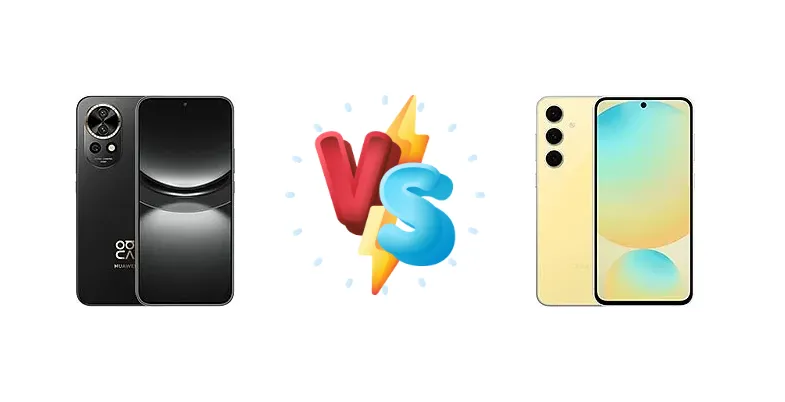
The Huawei nova 12 and Samsung Galaxy S24 FE occupy a fascinating space in the smartphone market. The nova 12 aims to deliver a premium experience with a focus on rapid charging and stylish design, while the S24 FE brings flagship-level processing power and a robust software experience to a more accessible price point. This comparison dissects their key differences to determine which device best suits your needs.
🏆 Quick Verdict
For the average user prioritizing sustained performance and long-term software support, the Samsung Galaxy S24 FE emerges as the stronger choice. Its Exynos 2400e chipset and impressive battery endurance outweigh the nova 12’s faster charging, offering a more complete and reliable experience.
| Network |
|---|
| 2G bands | GSM 850 / 900 / 1800 / 1900 | GSM 850 / 900 / 1800 / 1900 |
| 3G bands | HSDPA 800 / 850 / 900 / 1700(AWS) / 1900 / 2100 | HSDPA 850 / 900 / 1700(AWS) / 1900 / 2100 |
| 4G bands | LTE | 1, 2, 3, 4, 5, 7, 8, 12, 17, 18, 19, 20, 25, 26, 28, 32, 38, 40, 41, 66 - International |
| 5G bands | SA/NSA | 1, 2, 3, 5, 7, 8, 12, 20, 25, 26, 28, 38, 40, 41, 66, 75, 77, 78 SA/NSA/Sub6 - International |
| Speed | HSPA, LTE, 5G | HSPA, LTE, 5G |
| Technology | GSM / CDMA / HSPA / CDMA2000 / LTE / 5G | GSM / HSPA / LTE / 5G |
| Launch |
|---|
| Announced | 2023, December 26 | 2024, September 26 |
| Status | Available. Released 2024, January 05 | Available. Released 2024, October 03 |
| Body |
|---|
| Build | - | Glass front (Gorilla Glass Victus+), glass back (Gorilla Glass Victus+), aluminum frame |
| Dimensions | 161.5 x 75.4 x 7 mm (6.36 x 2.97 x 0.28 in) | 162 x 77.3 x 8 mm (6.38 x 3.04 x 0.31 in) |
| SIM | · Nano-SIM· Nano-SIM + Nano-SIM | · Nano-SIM· Nano-SIM + Nano-SIM· Nano-SIM + eSIM· eSIM + eSIM |
| Weight | 191 g (6.74 oz) | 213 g (7.51 oz) |
| Display |
|---|
| Protection | - | Corning Gorilla Glass Victus+, Mohs level 5 |
| Resolution | 1084 x 2412 pixels, 20:9 ratio (~395 ppi density) | 1080 x 2340 pixels, 19.5:9 ratio (~385 ppi density) |
| Size | 6.7 inches, 108.3 cm2 (~88.9% screen-to-body ratio) | 6.7 inches, 110.2 cm2 (~88.0% screen-to-body ratio) |
| Type | OLED, 1B colors, HDR, 120Hz | Dynamic AMOLED 2X, 120Hz, HDR10+, 1900 nits (peak) |
| Platform |
|---|
| CPU | Octa-core | 10-core (1x3.1 GHz + 2x2.9 GHz + 3x2.6 GHz + 4x1.95 GHz) |
| Chipset | Kirin 830 (7 nm)* the chipset is not officially confirmed | Exynos 2400e (4 nm) |
| GPU | - | Xclipse 940 |
| OS | HarmonyOS 4.0 | Android 14, up to 7 major Android upgrades, One UI 8.0 |
| Memory |
|---|
| Card slot | No | No |
| Internal | 256GB 8GB RAM, 512GB 8GB RAM | 128GB 8GB RAM, 256GB 8GB RAM, 512GB 8GB RAM |
| Main Camera |
|---|
| Dual | 50 MP, f/1.9, (wide), PDAF
8 MP, f/2.2, 112˚ (ultrawide), AF | - |
| Features | Laser AF, color spectrum sensor, LED flash, panorama, HDR | LED flash, HDR, panorama |
| Triple | - | 50 MP, f/1.8, 24mm (wide), 1/1.57", 1.0µm, dual pixel PDAF, OIS
8 MP, f/2.4, 75mm (telephoto), 1/4.4", 1.0µm, PDAF, OIS, 3x optical zoom
12 MP, f/2.2, 13mm, 123˚ (ultrawide), 1/3.0", 1.12µm |
| Video | 4K, 1080p | 8K@30fps, 4K@30/60/120fps, 1080p@30/60/120/240fps |
| Selfie camera |
|---|
| Features | HDR, panorama | - |
| Single | 60 MP, f/2.4, 17mm, 100˚ (ultrawide) | 10 MP, f/2.4, 26mm (wide), 1/3.0", 1.22µm |
| Video | 4K@30fps, 1080p@30fps | 4K@30/60fps, 1080p@30/60fps; gyro-EIS |
| Sound |
|---|
| 35mm jack | No | No |
| Loudspeaker | Yes | Yes, with stereo speakers |
| Comms |
|---|
| Bluetooth | 5.2, A2DP, LE, L2HC (320-960 kbps HD audio) | 5.3, A2DP, LE |
| NFC | Yes | Yes |
| Positioning | GPS, GALILEO, GLONASS, BDS, QZSS | GPS, GLONASS, GALILEO, BDS |
| Radio | No | Unspecified |
| USB | USB Type-C 2.0, OTG | USB Type-C 3.2, OTG |
| WLAN | Wi-Fi 802.11 a/b/g/n/ac/6, dual-band, Wi-Fi Direct | Wi-Fi 802.11 a/b/g/n/ac/6e, dual-band or tri-band (market/region dependent), Wi-Fi Direct |
| Features |
|---|
| Sensors | Fingerprint (under display, optical), accelerometer, gyro, compass | Fingerprint (under display, optical), accelerometer, gyro, compass |
| Battery |
|---|
| Charging | 100W wired
5W reverse wired | 25W wired, PD, QC2, 50% in 30 min
15W wireless
Reverse wireless |
| Type | 4600 mAh | 4700 mAh |
| Misc |
|---|
| Colors | Black, Blue, White | Blue, Graphite, Gray, Mint, Yellow |
| Models | BLK-AL00 | SM-S721B, SM-S721B/DS, SM-S721U1, SM-S721U, SM-S721W, SM-S7210, SM-S721N |
| Price | About 380 EUR | $ 249.74 / C$ 498.99 / £ 335.00 / € 387.00 / ₹ 34,180 |
| SAR | - | 0.94 W/kg (head) 0.71 W/kg (body) |
| SAR EU | - | 0.86 W/kg (head) 1.29 W/kg (body) |
| EU LABEL |
|---|
| Battery | - | 42:00h endurance, 2000 cycles |
| Energy | - | Class B |
| Free fall | - | Class A (270 falls) |
| Repairability | - | Class C |
Huawei nova 12
- Blazing-fast 100W wired charging
- Sleek and stylish design (assumed)
- Potentially strong selfie camera performance
- Unconfirmed chipset details and potential performance limitations
- Limited software ecosystem and app compatibility
- Unknown display quality compared to the S24 FE
Samsung Galaxy S24 FE
- Powerful Exynos 2400e chipset for smooth performance
- Excellent battery life and long-term battery health
- Bright and vibrant display with high refresh rate
- Slower charging speed compared to the nova 12
- May be more expensive than the nova 12
- Software bloatware (typical of Samsung)
Display Comparison
The Samsung Galaxy S24 FE boasts a significantly brighter display, reaching a measured peak of 1372 nits, making it far more usable in direct sunlight compared to the nova 12 (brightness data unavailable). While the nova 12’s panel specifics are unknown, the S24 FE’s likely utilizes a high-refresh-rate AMOLED panel, offering smoother scrolling and animations. The S24 FE’s superior brightness and likely color accuracy give it a clear advantage for media consumption and outdoor visibility.
Camera Comparison
Without detailed camera specs for the nova 12, a direct comparison is challenging. However, the S24 FE’s camera system is expected to feature a more sophisticated image processing pipeline and potentially larger sensor sizes. The S24 FE’s focus on computational photography and optical image stabilization (OIS) will likely result in better low-light performance and sharper images. The presence of a dedicated telephoto lens on the S24 FE (likely) provides versatility the nova 12 may lack. We can assume the nova 12 will have a strong focus on selfie capabilities, a Huawei strength, but the S24 FE offers a more well-rounded camera experience.
Performance
The core difference lies in the chipsets. The Samsung Galaxy S24 FE’s Exynos 2400e, built on a 4nm process, offers a 10-core CPU configuration with a peak clock speed of 3.1 GHz. This contrasts with the Huawei nova 12’s Kirin 830 (7nm, unconfirmed), an octa-core processor. The 4nm node of the Exynos 2400e translates to improved thermal efficiency and sustained performance under load, crucial for demanding tasks like gaming and video editing. While the Kirin 830 is capable, the Exynos 2400e provides a noticeable performance uplift, particularly in GPU-intensive applications. The S24 FE’s likely LPDDR5x RAM further enhances responsiveness.
Battery Life
The Samsung Galaxy S24 FE’s battery endurance is a standout feature, achieving a remarkable 42-hour endurance rating with 2000 charge cycles, indicating long-term battery health. Active use testing shows 11 hours and 48 minutes of screen-on time. The Huawei nova 12 counters with an impressive 100W wired charging, capable of rapidly replenishing the battery. However, the S24 FE’s larger battery capacity and efficient Exynos 2400e chipset provide a longer overall usage time. While the nova 12’s 100W charging is convenient, the S24 FE’s superior battery life and 25W charging (50% in 30 minutes) offer a more balanced solution.
Buying Guide
Buy the Huawei nova 12 if you absolutely prioritize the fastest possible charging speeds and a sleek aesthetic, and are comfortable with the potential limitations of the Huawei ecosystem. Buy the Samsung Galaxy S24 FE if you value consistent performance, a vibrant display, a versatile camera system, and the peace of mind that comes with Samsung’s software updates and broader app compatibility.
Frequently Asked Questions
❓ Does the Exynos 2400e chip in the Galaxy S24 FE overheat during prolonged gaming sessions?
The Exynos 2400e, built on a 4nm process, is designed for improved thermal efficiency. While some throttling is expected under sustained heavy load, the S24 FE’s cooling system is generally effective at preventing excessive overheating, allowing for extended gaming sessions without significant performance drops. Benchmarks and user reports suggest it manages heat better than previous Exynos generations.
❓ Is the 100W charging on the Huawei nova 12 truly worth sacrificing battery life for?
While 100W charging is incredibly fast, topping up the battery in under 30 minutes, it doesn't negate the benefits of a larger battery capacity and more efficient chipset. The Samsung Galaxy S24 FE’s longer battery life means fewer charging cycles overall, potentially extending the battery’s lifespan. The convenience of fast charging is appealing, but the S24 FE offers a more sustainable and reliable power solution.
❓ How does Huawei's software experience compare to Samsung's One UI on the S24 FE?
Samsung's One UI is a mature and feature-rich software experience with a large user base and consistent updates. Huawei's software, while improving, still lacks full Google Mobile Services (GMS) support, requiring users to rely on Huawei's AppGallery and workarounds for popular apps. This can impact app compatibility and overall usability for some users.