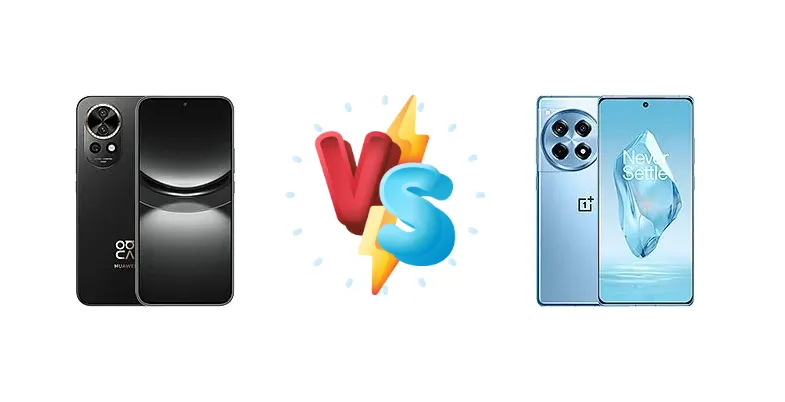
The OnePlus 12R and Huawei nova 12 represent compelling options in a crowded mid-range market. The 12R brings flagship-level processing power with the Snapdragon 8 Gen 2, while the nova 12 focuses on a stylish design and rapid charging. This comparison dissects their key differences to help you determine which device best suits your priorities.
🏆 Quick Verdict
For most users, the OnePlus 12R emerges as the stronger choice. Its Snapdragon 8 Gen 2 chipset delivers significantly superior performance and efficiency, backed by impressive 14:32 hour active use battery life and 100W charging. While the nova 12 offers a sleek aesthetic, it can't match the 12R's raw power.
| Network |
|---|
| 2G bands | GSM 850 / 900 / 1800 / 1900 | GSM 850 / 900 / 1800 / 1900 |
| 3G bands | HSDPA 800 / 850 / 900 / 1700(AWS) / 1900 / 2100 | HSDPA 850 / 900 / 1700(AWS) / 1900 / 2100 |
| 4G bands | LTE | 1, 2, 3, 4, 5, 7, 8, 12, 17, 18, 19, 20, 26, 28, 32, 38, 39, 40, 41, 66 |
| 5G bands | SA/NSA | 1, 2, 3, 5, 7, 8, 12, 20, 28, 38, 40, 41, 66, 77, 78 SA/NSA |
| Speed | HSPA, LTE, 5G | HSPA, LTE, 5G |
| Technology | GSM / CDMA / HSPA / CDMA2000 / LTE / 5G | GSM / CDMA / HSPA / LTE / 5G |
| Launch |
|---|
| Announced | 2023, December 26 | 2024, January 23 |
| Status | Available. Released 2024, January 05 | Available. Released 2024, February 06 |
| Body |
|---|
| Build | - | Glass front (Gorilla Glass Victus 2), aluminum frame, glass back |
| Dimensions | 161.5 x 75.4 x 7 mm (6.36 x 2.97 x 0.28 in) | 163.3 x 75.3 x 8.8 mm (6.43 x 2.96 x 0.35 in) |
| SIM | · Nano-SIM· Nano-SIM + Nano-SIM | · Nano-SIM + Nano-SIM + eSIM (max 2 at a time)· Nano-SIM + Nano-SIM |
| Weight | 191 g (6.74 oz) | 207 g (7.30 oz) |
| Display |
|---|
| Protection | - | Corning Gorilla Glass Victus 2 |
| Resolution | 1084 x 2412 pixels, 20:9 ratio (~395 ppi density) | 1264 x 2780 pixels (~450 ppi density) |
| Size | 6.7 inches, 108.3 cm2 (~88.9% screen-to-body ratio) | 6.78 inches, 111.7 cm2 (~90.9% screen-to-body ratio) |
| Type | OLED, 1B colors, HDR, 120Hz | LTPO4 AMOLED, 1B colors, 120Hz, HDR10+, Dolby Vision, 1600 nits (HBM), 4500 nits (peak) |
| Platform |
|---|
| CPU | Octa-core | Octa-core (1x3.2 GHz Cortex-X3 & 2x2.8 GHz Cortex-A715 & 2x2.8 GHz Cortex-A710 & 3x2.0 GHz Cortex-A510) |
| Chipset | Kirin 830 (7 nm)* the chipset is not officially confirmed | Qualcomm SM8550-AB Snapdragon 8 Gen 2 (4 nm) |
| GPU | - | Adreno 740 |
| OS | HarmonyOS 4.0 | Android 14, up to 3 major Android upgrades, OxygenOS 15 |
| Memory |
|---|
| Card slot | No | No |
| Internal | 256GB 8GB RAM, 512GB 8GB RAM | 128GB 8GB RAM, 256GB 8GB RAM, 256GB 12GB RAM, 256GB 16GB RAM |
| Main Camera |
|---|
| Dual | 50 MP, f/1.9, (wide), PDAF
8 MP, f/2.2, 112˚ (ultrawide), AF | - |
| Features | Laser AF, color spectrum sensor, LED flash, panorama, HDR | Laser AF, color spectrum sensor, LED flash, HDR, panorama |
| Triple | - | 50 MP, f/1.8, 24mm (wide), 1/1.56", 1.0µm, multi-directional PDAF, OIS
8 MP, f/2.2, 16mm, 112˚ (ultrawide), 1/4.0", 1.12µm
2 MP (macro) |
| Video | 4K, 1080p | 4K@30/60fps, 1080p@30/60/120/240fps, gyro-EIS, OIS |
| Selfie camera |
|---|
| Features | HDR, panorama | HDR, panorama |
| Single | 60 MP, f/2.4, 17mm, 100˚ (ultrawide) | 16 MP, f/2.4, 26mm (wide), 1/3", 1.0µm |
| Video | 4K@30fps, 1080p@30fps | 1080p@30fps, gyro-EIS |
| Sound |
|---|
| 35mm jack | No | No |
| Loudspeaker | Yes | Yes, with stereo speakers |
| Comms |
|---|
| Bluetooth | 5.2, A2DP, LE, L2HC (320-960 kbps HD audio) | 5.3, A2DP, LE, aptX HD |
| Infrared port | - | Yes |
| NFC | Yes | Yes |
| Positioning | GPS, GALILEO, GLONASS, BDS, QZSS | GPS, GALILEO, GLONASS, BDS, QZSS |
| Radio | No | No |
| USB | USB Type-C 2.0, OTG | USB Type-C 2.0 |
| WLAN | Wi-Fi 802.11 a/b/g/n/ac/6, dual-band, Wi-Fi Direct | Wi-Fi 802.11 a/b/g/n/ac/6/7, dual-band |
| Features |
|---|
| Sensors | Fingerprint (under display, optical), accelerometer, gyro, compass | Fingerprint (under display, optical), accelerometer, gyro, proximity, compass |
| Battery |
|---|
| Charging | 100W wired
5W reverse wired | 100W wired, 100% in 26 min |
| Type | 4600 mAh | Li-Ion 5500 mAh |
| Misc |
|---|
| Colors | Black, Blue, White | Iron Gray, Cool Blue, Electric Violet, Sunset Dune |
| Models | BLK-AL00 | CPH2609, CPH2585, CPH2611 |
| Price | About 380 EUR | € 410.84 / $ 399.95 / £ 649.00 |
| SAR | - | 1.19 W/kg (head) 0.82 W/kg (body) |
Huawei nova 12
- Stylish and modern design
- Ultra-fast 100W wired charging
- Potentially strong camera performance (based on Huawei's history)
- Less powerful Kirin 830 chipset
- Limited performance data available
- Potential software restrictions
OnePlus 12R
- Flagship-level Snapdragon 8 Gen 2 performance
- Excellent battery life (14:32h active use)
- Fast 100W charging (26 minutes to full)
- Design may be less visually striking than the nova 12
- Software experience may not appeal to all users
- Camera details are currently limited
Display Comparison
The OnePlus 12R boasts a bright display, reaching a measured peak brightness of 1181 nits, ensuring excellent visibility even in direct sunlight. While the nova 12’s display specifications are currently limited, Huawei typically focuses on color accuracy and vibrancy. The 12R’s panel likely benefits from a higher refresh rate, contributing to smoother scrolling and animations, a feature often found in devices targeting a similar price bracket. The 12R’s brightness advantage is a clear win for outdoor usability.
Camera Comparison
Without detailed camera specifications for the nova 12, a direct comparison is challenging. However, Huawei traditionally emphasizes camera capabilities. The 12R’s camera system, while not explicitly detailed in the provided data, will likely feature a robust main sensor and image processing algorithms. The absence of information regarding OIS on the nova 12 is a concern, as image stabilization is crucial for sharp photos and smooth videos. The 12R’s Snapdragon ISP (Image Signal Processor) is known for its excellent image quality and processing speed. We can assume the 12R will offer a more consistent and versatile camera experience.
Performance
The core difference lies in the chipsets. The OnePlus 12R’s Snapdragon 8 Gen 2 (4nm) is a significant leap ahead of the Huawei nova 12’s Kirin 830 (7nm). The Snapdragon 8 Gen 2’s architecture – 1x3.2 GHz Cortex-X3, 2x2.8 GHz Cortex-A715, 2x2.8 GHz Cortex-A710, and 3x2.0 GHz Cortex-A510 – provides superior multi-core performance and improved efficiency. The 4nm process node translates to less heat generation and better sustained performance during prolonged gaming or demanding applications. The Kirin 830, while capable, will likely struggle to match the 12R’s sustained performance, especially in graphically intensive scenarios. The 12R’s LPDDR5x RAM further enhances its performance capabilities.
Battery Life
The OnePlus 12R shines in battery performance, achieving an impressive 14 hours and 32 minutes of active use. Both devices support 100W wired charging, with the 12R reaching a full charge in just 26 minutes. While the nova 12 also offers 100W charging, the 12R’s larger battery capacity and more efficient chipset contribute to significantly longer real-world usage. The 5W reverse wired charging on the nova 12 is a niche feature, useful for topping up accessories, but doesn't significantly impact the overall battery experience.
Buying Guide
Buy the Huawei nova 12 if you prioritize a visually striking design and extremely fast 100W charging is paramount, and you're less concerned with demanding gaming or consistently high performance. Buy the OnePlus 12R if you need a phone capable of handling intensive tasks, extended gaming sessions, and benefit from a more powerful processor and longer battery life, all at a competitive price.
Frequently Asked Questions
❓ Is the Kirin 830 chipset in the Huawei nova 12 sufficient for demanding games like Genshin Impact?
While the Kirin 830 is a capable chipset, it's unlikely to deliver a consistently smooth experience in graphically intensive games like Genshin Impact at high settings. You may need to lower graphics settings to achieve playable frame rates, whereas the Snapdragon 8 Gen 2 in the OnePlus 12R will handle these games with ease.
❓ How does the 100W charging on the Huawei nova 12 compare to the OnePlus 12R in real-world usage?
Both phones offer 100W charging, with the OnePlus 12R taking 26 minutes to reach 100%. While the nova 12 also supports 100W, the 12R’s larger battery capacity means you’ll get significantly more usage time from a full charge, making the overall charging experience more practical.
❓ Does the OnePlus 12R experience significant throttling during extended gaming sessions?
The Snapdragon 8 Gen 2’s 4nm process node and the OnePlus 12R’s cooling system are designed to minimize throttling. While some heat generation is inevitable during prolonged gaming, the 12R is expected to maintain higher sustained performance levels compared to devices with less efficient chipsets.
❓ What software experience can I expect on the Huawei nova 12, and are there any limitations due to the current geopolitical situation?
The Huawei nova 12 runs on EMUI, Huawei’s custom Android skin. Due to ongoing restrictions, it does not come with full Google Mobile Services (GMS). This means you’ll need to rely on Huawei’s AppGallery and alternative methods for accessing popular apps like Google Maps and YouTube. This can be a significant limitation for some users.