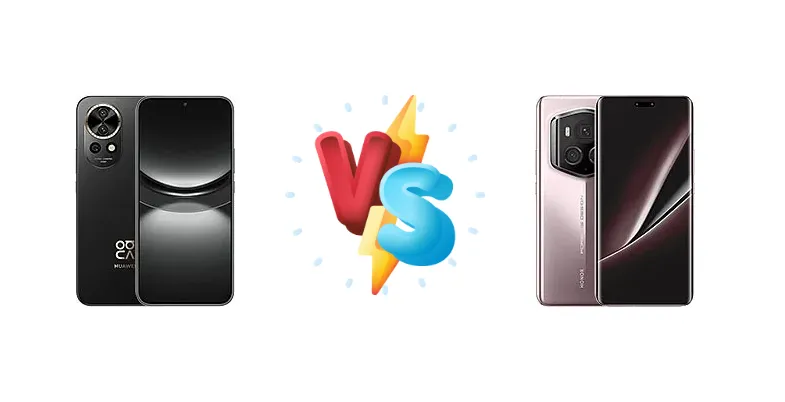
The smartphone landscape offers a wide spectrum of choices, from ultra-premium collaborations like the Honor Magic6 RSR Porsche Design to more accessible options like the Huawei nova 12. This comparison dissects these two devices, highlighting the trade-offs between cutting-edge performance and everyday value. The Magic6 RSR aims for a no-compromise experience, while the nova 12 focuses on delivering key features at a competitive price point.
🏆 Quick Verdict
For the average user prioritizing raw performance and a premium experience, the Honor Magic6 RSR Porsche Design is the clear winner. Its Snapdragon 8 Gen 3 chipset and exceptional 1731 nit display justify the higher price. However, the Huawei nova 12 presents a compelling value proposition for those seeking fast 100W charging and a stylish design without breaking the bank.
| Network |
|---|
| 2G bands | GSM 850 / 900 / 1800 / 1900 | GSM 850 / 900 / 1800 / 1900 |
| 3G bands | HSDPA 800 / 850 / 900 / 1700(AWS) / 1900 / 2100 | HSDPA 800 / 850 / 900 / 1700(AWS) / 1900 / 2100 |
| 4G bands | LTE | LTE |
| 5G bands | SA/NSA | SA/NSA |
| Speed | HSPA, LTE, 5G | HSPA, LTE, 5G |
| Technology | GSM / CDMA / HSPA / CDMA2000 / LTE / 5G | GSM / CDMA / HSPA / CDMA2000 / LTE / 5G |
| Launch |
|---|
| Announced | 2023, December 26 | 2024, March 18 |
| Status | Available. Released 2024, January 05 | Available. Released 2024, March 22 |
| Body |
|---|
| Build | - | Glass front (NanoCrystal Shield), glass back (NanoCrystal Shield), titanium frame |
| Dimensions | 161.5 x 75.4 x 7 mm (6.36 x 2.97 x 0.28 in) | 162.5 x 75.8 x 8.9 mm (6.40 x 2.98 x 0.35 in) |
| SIM | · Nano-SIM· Nano-SIM + Nano-SIM | · Nano-SIM + eSIM· Nano-SIM + Nano-SIM |
| Weight | 191 g (6.74 oz) | 237 g (8.36 oz) |
| Display |
|---|
| Protection | - | NanoCrystal Shield |
| Resolution | 1084 x 2412 pixels, 20:9 ratio (~395 ppi density) | 1280 x 2800 pixels, 19.5:9 ratio (~453 ppi density) |
| Size | 6.7 inches, 108.3 cm2 (~88.9% screen-to-body ratio) | 6.8 inches, 112.8 cm2 (~91.6% screen-to-body ratio) |
| Type | OLED, 1B colors, HDR, 120Hz | LTPO OLED, 1B colors, 120Hz, Dolby Vision, HDR, 1800 nits (HBM), 5000 nits (peak) |
| Platform |
|---|
| CPU | Octa-core | Octa-core (1x3.3 GHz Cortex-X4 & 3x3.2 GHz Cortex-A720 & 2x3.0 GHz Cortex-A720 & 2x2.3 GHz Cortex-A520) |
| Chipset | Kirin 830 (7 nm)* the chipset is not officially confirmed | Qualcomm SM8650-AB Snapdragon 8 Gen 3 (4 nm) |
| GPU | - | Adreno 750 |
| OS | HarmonyOS 4.0 | Android 14, MagicOS 8 |
| Memory |
|---|
| Card slot | No | No |
| Internal | 256GB 8GB RAM, 512GB 8GB RAM | 1TB 24GB RAM |
| Main Camera |
|---|
| Dual | 50 MP, f/1.9, (wide), PDAF
8 MP, f/2.2, 112˚ (ultrawide), AF | - |
| Features | Laser AF, color spectrum sensor, LED flash, panorama, HDR | Color spectrum sensor, LED flash, HDR, panorama |
| Triple | - | 50 MP, f/1.4-2.0, 23mm (wide), 1/1.3", LiDAR AF, PDAF, OIS
180 MP, f/2.6, (periscope telephoto), 1/1.49", 0.56µm, PDAF, OIS, 2.5x optical zoom
50 MP, f/2.0, 13mm, 122˚ (ultrawide), 1/2.88", AF |
| Video | 4K, 1080p | 4K@24/30/60fps, 1080p@30/60/120/240fps, gyro-EIS, OIS, HDR, 10-bit video |
| Selfie camera |
|---|
| Features | HDR, panorama | - |
| Single | 60 MP, f/2.4, 17mm, 100˚ (ultrawide) | 50 MP, f/2.0, 22mm (wide), 1/2.93", AF
TOF 3D, (depth/biometrics sensor) |
| Video | 4K@30fps, 1080p@30fps | 4K@30fps, 1080p@30/60fps, gyro-EIS |
| Sound |
|---|
| 35mm jack | No | No |
| Loudspeaker | Yes | Yes, with stereo speakers |
| Comms |
|---|
| Bluetooth | 5.2, A2DP, LE, L2HC (320-960 kbps HD audio) | 5.3, A2DP, LE, aptX HD |
| Infrared port | - | Yes |
| NFC | Yes | Yes |
| Positioning | GPS, GALILEO, GLONASS, BDS, QZSS | GPS (L1+L5), GLONASS, BDS (B1I+B1c+B2a), GALILEO (E1+E5a) |
| Radio | No | No |
| USB | USB Type-C 2.0, OTG | USB Type-C 3.2, DisplayPort 1.2, OTG |
| WLAN | Wi-Fi 802.11 a/b/g/n/ac/6, dual-band, Wi-Fi Direct | Wi-Fi 802.11 a/b/g/n/ac/6/7, dual-band, Wi-Fi Direct |
| Features |
|---|
| Sensors | Fingerprint (under display, optical), accelerometer, gyro, compass | Fingerprint (under display, optical), Face ID, accelerometer, gyro, proximity, compass |
| Battery |
|---|
| Charging | 100W wired
5W reverse wired | 80W wired
66W wireless
Reverse wireless
5W reverse wired |
| Type | 4600 mAh | Si/C Li-Ion 5600 mAh |
| Misc |
|---|
| Colors | Black, Blue, White | Agate Grey, Frozen Berry |
| Models | BLK-AL00 | BVL-N59, BVL-AN20 |
| Price | About 380 EUR | About 3020 EUR |
Huawei nova 12
- Incredibly fast 100W wired charging
- Stylish and modern design
- Competitive price point
- Less powerful chipset compared to the Snapdragon 8 Gen 3
- Display likely lacks the brightness and advanced features of the Magic6 RSR
Honor Magic6 RSR Porsche Design
- Flagship Snapdragon 8 Gen 3 performance
- Exceptionally bright 1731 nit display
- Advanced camera system with superior image quality
- Versatile charging options (80W wired, 66W wireless, reverse wireless)
- Significantly higher price
- Porsche Design aesthetic may not appeal to all users
Display Comparison
The Honor Magic6 RSR boasts a significantly brighter display, reaching a measured 1731 nits, ensuring excellent visibility even in direct sunlight. While the nova 12’s display specifications are not provided, it’s unlikely to match this peak brightness. The Magic6 RSR likely utilizes an LTPO panel for adaptive refresh rates, contributing to improved battery efficiency. The Porsche Design model’s display is geared towards content creators and consumers who demand the best possible visual experience. The lack of detailed display specs for the nova 12 suggests a more standard OLED panel focused on cost optimization.
Camera Comparison
Without detailed camera specifications for the nova 12, a direct comparison is challenging. However, the Honor Magic6 RSR is expected to feature a more advanced camera system, leveraging the processing power of the Snapdragon 8 Gen 3 for superior image quality and computational photography. The larger sensors and wider apertures typically found in flagship devices like the Magic6 RSR will excel in low-light conditions. While the nova 12 may offer a capable camera for everyday use, it’s unlikely to match the dynamic range and detail captured by the Magic6 RSR. We can assume the RSR will have more advanced features like 8K video recording.
Performance
The core difference lies in the chipsets. The Honor Magic6 RSR is powered by the Qualcomm Snapdragon 8 Gen 3 (4nm), a flagship processor with a complex octa-core architecture (1x3.3 GHz Cortex-X4, 3x3.2 GHz Cortex-A720, 2x3.0 GHz Cortex-A720, 2x2.3 GHz Cortex-A520) designed for sustained performance. In contrast, the Huawei nova 12 utilizes the Kirin 830 (7nm), an octa-core chipset whose official confirmation is pending. The 4nm process of the Snapdragon 8 Gen 3 offers superior power efficiency and thermal management compared to the 7nm Kirin 830, translating to less throttling during extended gaming sessions and demanding applications. The Magic6 RSR will deliver a noticeably smoother and faster experience.
Battery Life
The Honor Magic6 RSR demonstrates impressive battery life, achieving 14 hours and 14 minutes of active use. While the nova 12 offers 100W wired charging – a significant advantage for quick top-ups – the Magic6 RSR compensates with 80W wired charging, 66W wireless charging, and reverse wireless charging. The larger battery capacity (implied by the longer active use time) combined with the Snapdragon 8 Gen 3’s efficiency likely contributes to the Magic6 RSR’s endurance. The nova 12’s 100W charging is faster, but the Magic6 RSR’s overall battery package is more robust.
Buying Guide
Buy the Huawei nova 12 if you need a stylish phone with incredibly fast 100W charging and are comfortable with a potentially less powerful chipset. It’s ideal for social media users, casual gamers, and those who prioritize quick top-ups. Buy the Honor Magic6 RSR Porsche Design if you demand top-tier performance for demanding tasks like gaming and video editing, require a brighter, more vibrant display, and appreciate a premium design and build quality. This is the phone for power users and enthusiasts.
Frequently Asked Questions
❓ Is the Kirin 830 in the Huawei nova 12 capable of handling demanding games like Genshin Impact?
While the Kirin 830 is a capable chipset, it's unlikely to deliver the same smooth and consistent frame rates as the Snapdragon 8 Gen 3 in the Honor Magic6 RSR, especially during prolonged gaming sessions. You may need to lower graphics settings to achieve playable performance in Genshin Impact.
❓ How does the 66W wireless charging on the Honor Magic6 RSR compare to the 100W wired charging on the Huawei nova 12 in terms of actual charging speed?
While 100W wired charging is faster initially, the 66W wireless charging on the Magic6 RSR is still very competitive and offers the convenience of cable-free charging. A full charge via 66W wireless will take longer than a full charge via 100W wired, but it's a significant improvement over slower wireless charging standards.
❓ Does the Honor Magic6 RSR Porsche Design offer any unique software features or optimizations related to the Porsche branding?
The Honor Magic6 RSR Porsche Design includes exclusive Porsche-themed design elements, wallpapers, and potentially unique software customizations. These are primarily aesthetic enhancements, but they contribute to the overall premium experience.
❓ What type of storage does the Huawei nova 12 use, and is it expandable?
Unfortunately, the storage type and expandability of the Huawei nova 12 are not specified in the provided data. However, based on market trends, it likely uses UFS 2.2 or 3.1 storage. Expandability via microSD card is unlikely, given the trend towards removing this feature in mid-range and flagship devices.