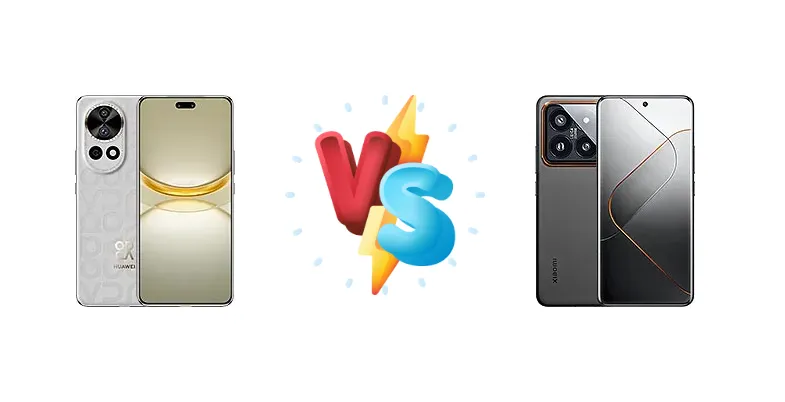
The Huawei nova 12 Ultra and Xiaomi 14 Pro represent distinct approaches to the modern flagship. The nova 12 Ultra aims to deliver a premium experience with a focus on design and fast charging, while the Xiaomi 14 Pro leverages Qualcomm’s latest silicon and a comprehensive feature set. This comparison dissects their key differences to determine which device best suits your needs.
🏆 Quick Verdict
For the average user prioritizing raw performance and a more versatile camera system, the Xiaomi 14 Pro emerges as the stronger contender. Its Snapdragon 8 Gen 3 chipset and advanced charging capabilities offer a noticeable advantage, despite the nova 12 Ultra’s impressive 100W charging.
| Network |
|---|
| 2G bands | GSM 850 / 900 / 1800 / 1900 | GSM 850 / 900 / 1800 / 1900 |
| 3G bands | HSDPA 800 / 850 / 900 / 1700(AWS) / 1900 / 2100 | HSDPA 800 / 850 / 900 / 1700(AWS) / 1900 / 2100 |
| 4G bands | LTE | 1, 3, 4, 5, 7, 8, 18, 19, 26, 28, 34, 38, 39, 40, 41, 42, 48, 66 |
| 5G bands | SA/NSA | 1, 3, 5, 7, 8, 28, 38, 40, 41, 48, 66, 77, 78, 79 SA/NSA |
| Speed | HSPA, LTE, 5G | HSPA, LTE, 5G |
| Technology | GSM / CDMA / HSPA / CDMA2000 / LTE / 5G | GSM / CDMA / HSPA / CDMA2000 / LTE / 5G |
| Launch |
|---|
| Announced | 2023, December 26 | 2023, October 26 |
| Status | Available. Released 2024, January 12 | Available. Released 2023, November 01 |
| Body |
|---|
| Build | Glass front, silicone polymer back (eco leather) | Glass front, aluminum frame or titanium frame, glass back |
| Dimensions | 163.1 x 75 x 7.7 mm (6.42 x 2.95 x 0.30 in) | 161.4 x 75.3 x 8.5 mm |
| SIM | · Nano-SIM· Nano-SIM + Nano-SIM | Nano-SIM + Nano-SIM |
| Weight | 198 g (6.98 oz) | 223 g or 230 g (7.87 oz) |
| Display |
|---|
| Protection | Kunlun Glass | Shatterproof glass |
| Resolution | 1224 x 2776 pixels (~449 ppi density) | 1440 x 3200 pixels, 20:9 ratio (~522 ppi density) |
| Size | 6.76 inches, 108.8 cm2 (~89.0% screen-to-body ratio) | 6.73 inches, 108.9 cm2 (~89.6% screen-to-body ratio) |
| Type | LTPO OLED, 1B colors, HDR, 120Hz | LTPO AMOLED, 68B colors, 120Hz, Dolby Vision, HDR10+, 3000 nits (peak) |
| Platform |
|---|
| CPU | Octa-core (1x2.62 GHz Taishan Big & 3x2.15 GHz Taishan Mid & 4x1.53GHz Cortex-A510) | Octa-core (1x3.3 GHz Cortex-X4 & 3x3.2 GHz Cortex-A720 & 2x3.0 GHz Cortex-A720 & 2x2.3 GHz Cortex-A520) |
| Chipset | Kirin 9000S (7 nm)* the chipset is not officially confirmed | Qualcomm SM8650-AB Snapdragon 8 Gen 3 (4 nm) |
| GPU | Maleoon 910 MP4 | Adreno 750 |
| OS | HarmonyOS 4.0 | Android 14, HyperOS |
| Memory |
|---|
| Card slot | No | No |
| Internal | 512GB 12GB RAM, 1TB 12GB RAM | 256GB 12GB RAM, 512GB 16GB RAM, 1TB 16GB RAM |
| Main Camera |
|---|
| Dual | 50 MP, f/1.4-4.0, 27mm (wide), PDAF
8 MP, f/2.2, 112˚ (ultrawide), AF | - |
| Features | Laser AF, color spectrum sensor, LED flash, panorama, HDR | Laser AF, color spectrum sensor, Leica lens, Dual-LED dual-tone flash, HDR, panorama |
| Triple | - | 50 MP, f/1.4-f/4.0, 23mm (wide), 1/1.31", 1.2µm, dual pixel PDAF, OIS
50 MP, f/2.0, 75mm (telephoto), PDAF (10cm - ∞), OIS, 3.2x optical zoom
50 MP, f/2.2, 14mm, 115˚ (ultrawide), AF |
| Video | 4K, 1080p, gyro-EIS | 8K@24fps (HDR), 4K@24/30/60fps (HDR10+, 10-bit Dolby Vision HDR, 10-bit LOG), 1080p@30/60/120/240/960fps, 720p@1920fps, gyro-EIS |
| Selfie camera |
|---|
| Dual | 8 MP, f/2.2, 52mm (telephoto), AF, 2x optical zoom
60 MP, f/2.4, 17mm, 100˚ (ultrawide), AF | - |
| Features | HDR, panorama | HDR, panorama |
| Single | - | 32 MP, f/2.0, 22mm (wide), 0.7µm |
| Video | 4K@30fps, 1080p@30fps, gyro-EIS | 4K@30/60fps, 1080p@30/60fps, gyro-EIS |
| Sound |
|---|
| 35mm jack | No | No |
| Loudspeaker | Yes, with stereo speakers | Yes, with stereo speakers |
| Comms |
|---|
| Bluetooth | 5.2, A2DP, LE, L2HC (320-960 kbps HD audio) | 5.4, A2DP, LE, aptX HD, aptX Adaptive |
| Infrared port | - | Yes |
| NFC | Yes | Yes |
| Positioning | GPS (L1+L5), GLONASS (L1), BDS (B1I+B1c+B2a+B2b), GALILEO (E1+E5a+E5b), QZSS (L1+L5), NavIC | GPS (L1+L5), GLONASS (G1), BDS (B1I+B1c+B2a), GALILEO (E1+E5a), QZSS (L1+L5), NavIC (L5) |
| Radio | No | No |
| USB | USB Type-C 2.0, OTG | USB Type-C 3.2 Gen 2, OTG |
| WLAN | Wi-Fi 802.11 a/b/g/n/ac/6, dual-band, Wi-Fi Direct | Wi-Fi 802.11 a/b/g/n/ac/6e/7, dual-band, Wi-Fi Direct |
| Features |
|---|
| Sensors | Fingerprint (under display, optical), accelerometer, gyro, compass | Fingerprint (under display, optical), accelerometer, proximity, gyro, compass, barometer |
| Battery |
|---|
| Charging | 100W wired, 3-60% in 10 min
5W reverse wired | 120W wired, PD3.0, QC4, 100% in 18 min
50W wireless, 100% in 40 min
10W reverse wireless |
| Type | 4600 mAh | Li-Po 4880 mAh |
| Misc |
|---|
| Colors | Black, Blue, White | Black, Silver, Titanium, Green |
| Models | ADA-AL00U | 23116PN5BC |
| Price | About 600 EUR | About 650 EUR |
Huawei nova 12 Ultra
- 100W Wired Charging: Extremely fast charging speeds.
- Sleek Design: Huawei is known for its aesthetic appeal.
- Potentially Competitive Price: Huawei often undercuts competitors.
- Kirin 9000S Chipset: Performance may lag behind Snapdragon.
- Software Ecosystem: Limited access to Google services.
- Limited Availability: Huawei faces restrictions in some markets.
Xiaomi 14 Pro
- Snapdragon 8 Gen 3: Top-tier performance and efficiency.
- Versatile Camera System: Advanced features and image quality.
- Comprehensive Charging: Fast wired, wireless, and reverse wireless.
- Potentially Higher Price: Flagship Snapdragon phones command a premium.
- MIUI Software: Can be polarizing due to bloatware.
- Larger Size: May not be ideal for users preferring compact phones.
Display Comparison
While specific display specs for the nova 12 Ultra are currently limited, both devices are expected to feature high-refresh-rate OLED panels. The Xiaomi 14 Pro likely benefits from a more advanced panel, potentially utilizing LTPO technology for adaptive refresh rates up to 120Hz, improving power efficiency. The Snapdragon 8 Gen 3’s ISP will also contribute to superior color accuracy and dynamic range. The Xiaomi 14 Pro’s display is also expected to achieve higher peak brightness, enhancing visibility in direct sunlight.
Camera Comparison
The Xiaomi 14 Pro is expected to feature a more sophisticated camera system. While both phones likely employ high-resolution main sensors, the Xiaomi 14 Pro’s larger sensor size and advanced image processing capabilities, powered by the Snapdragon 8 Gen 3’s ISP, will result in superior low-light performance and dynamic range. The Xiaomi 14 Pro’s optical image stabilization (OIS) is also likely more advanced. The nova 12 Ultra’s camera system, while capable, will likely focus on computational photography to compensate for potential hardware limitations.
Performance
The core difference lies in the chipsets. The Xiaomi 14 Pro’s Snapdragon 8 Gen 3 (4nm) is a clear advantage over the Huawei nova 12 Ultra’s Kirin 9000S (7nm). The 4nm process node of the Snapdragon offers significantly improved power efficiency and thermal performance, translating to sustained performance during intensive tasks. The Snapdragon 8 Gen 3’s CPU configuration – with a Cortex-X4 prime core clocked at 3.3 GHz – outperforms the Kirin 9000S’s Taishan architecture in both single-core and multi-core benchmarks. The Xiaomi 14 Pro also benefits from faster LPDDR5x RAM, further boosting performance.
Battery Life
The Xiaomi 14 Pro’s charging capabilities are more comprehensive. While the nova 12 Ultra boasts impressive 100W wired charging (claiming 30-60% in 10 minutes), the Xiaomi 14 Pro offers 120W wired charging (100% in 18 minutes), 50W wireless charging (100% in 40 minutes), and 10W reverse wireless charging. The Xiaomi 14 Pro’s faster wireless charging and reverse wireless charging provide greater convenience. The Snapdragon 8 Gen 3’s efficiency also contributes to better overall battery life, potentially offsetting any capacity differences.
Buying Guide
Buy the Huawei nova 12 Ultra if you prioritize a sleek design, exceptionally fast 100W wired charging, and are comfortable with the potential limitations of the Kirin 9000S chipset and its ecosystem. Buy the Xiaomi 14 Pro if you demand top-tier performance for gaming and demanding applications, a more robust camera system with advanced features, and the benefits of Qualcomm’s Snapdragon ecosystem.
Frequently Asked Questions
❓ Is the Kirin 9000S chipset capable of handling demanding games like Genshin Impact at high settings?
While the Kirin 9000S is a capable chipset, the Snapdragon 8 Gen 3 in the Xiaomi 14 Pro will provide a smoother and more consistent gaming experience, especially during prolonged sessions. The Snapdragon’s superior thermal management prevents throttling, maintaining higher frame rates.
❓ How does the camera processing differ between the Huawei nova 12 Ultra and the Xiaomi 14 Pro?
The Xiaomi 14 Pro’s Snapdragon 8 Gen 3 ISP offers more advanced image processing capabilities, resulting in more natural colors, better dynamic range, and improved detail in challenging lighting conditions. Huawei often employs more aggressive computational photography, which can sometimes lead to over-sharpened or artificial-looking images.
❓ Does the Xiaomi 14 Pro support 8K video recording at 60fps?
Yes, the Snapdragon 8 Gen 3 is capable of 8K video recording at 60fps, offering professional-grade video capabilities. The nova 12 Ultra’s video recording capabilities are likely limited to 4K at 60fps.
❓ What are the implications of Huawei's lack of full Google Mobile Services (GMS) on the nova 12 Ultra?
The absence of GMS means you'll rely on Huawei's AppGallery and potentially sideloading apps. While AppGallery has grown, it still lacks the breadth of apps available on the Google Play Store. Compatibility issues with certain apps may also arise.