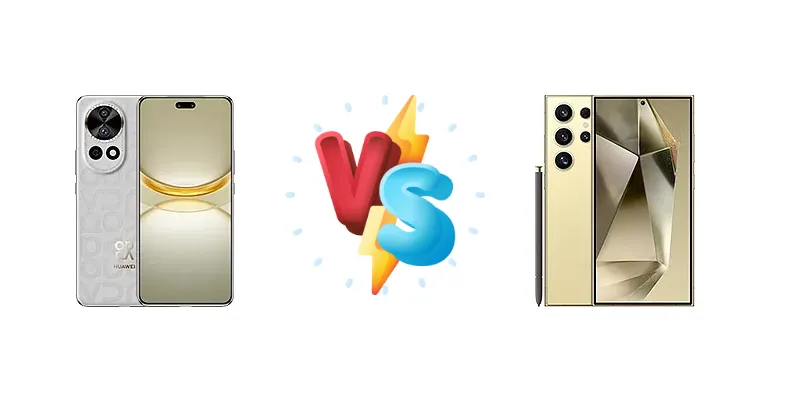
The Huawei nova 12 Ultra aims to disrupt the premium smartphone space with its rapid charging and potentially powerful Kirin 9000S chipset, while the Samsung Galaxy S24 Ultra continues to refine the established ultra-premium formula. This comparison dissects their key differences, helping you determine which device best suits your needs.
🏆 Quick Verdict
For the average user prioritizing all-around performance, a consistently excellent camera, and long-term software support, the Samsung Galaxy S24 Ultra is the clear winner. However, the Huawei nova 12 Ultra’s 100W charging and potentially competitive chipset offer a compelling alternative for those seeking speed and innovation.
| Network |
|---|
| 2G bands | GSM 850 / 900 / 1800 / 1900 | GSM 850 / 900 / 1800 / 1900 |
| 3G bands | HSDPA 800 / 850 / 900 / 1700(AWS) / 1900 / 2100 | HSDPA 850 / 900 / 1700(AWS) / 1900 / 2100 |
| 4G bands | LTE | 1, 2, 3, 4, 5, 7, 8, 12, 13, 17, 18, 19, 20, 25, 26, 28, 32, 38, 39, 40, 41, 66 - International |
| 5G bands | SA/NSA | 1, 2, 3, 5, 7, 8, 12, 20, 25, 26, 28, 38, 40, 41, 66, 75, 77, 78 SA/NSA/Sub6 - International |
| Speed | HSPA, LTE, 5G | HSPA, LTE (up to 7CA), 5G |
| Technology | GSM / CDMA / HSPA / CDMA2000 / LTE / 5G | GSM / CDMA / HSPA / EVDO / LTE / 5G |
| Launch |
|---|
| Announced | 2023, December 26 | 2024, January 17 |
| Status | Available. Released 2024, January 12 | Available. Released 2024, January 24 |
| Body |
|---|
| Build | Glass front, silicone polymer back (eco leather) | Glass front (Corning Gorilla Armor), glass back (Corning Gorilla Armor), titanium frame (grade 2) |
| Dimensions | 163.1 x 75 x 7.7 mm (6.42 x 2.95 x 0.30 in) | 162.3 x 79 x 8.6 mm (6.39 x 3.11 x 0.34 in) |
| SIM | · Nano-SIM· Nano-SIM + Nano-SIM | · Nano-SIM + Nano-SIM + eSIM + eSIM (max 2 at a time) - INT· Nano-SIM + eSIM + eSIM (max 2 at a time) - USA· Nano-SIM + Nano-SIM - CN |
| Weight | 198 g (6.98 oz) | 232 g or 233 g (8.18 oz) |
| Display |
|---|
| Protection | Kunlun Glass | Corning Gorilla Armor |
| Resolution | 1224 x 2776 pixels (~449 ppi density) | 1440 x 3120 pixels, 19.5:9 ratio (~505 ppi density) |
| Size | 6.76 inches, 108.8 cm2 (~89.0% screen-to-body ratio) | 6.8 inches, 113.5 cm2 (~88.5% screen-to-body ratio) |
| Type | LTPO OLED, 1B colors, HDR, 120Hz | Dynamic LTPO AMOLED 2X, 120Hz, HDR10+, 2600 nits (peak) |
| Platform |
|---|
| CPU | Octa-core (1x2.62 GHz Taishan Big & 3x2.15 GHz Taishan Mid & 4x1.53GHz Cortex-A510) | 8-core (1x3.39GHz Cortex-X4 & 3x3.1GHz Cortex-A720 & 2x2.9GHz Cortex-A720 & 2x2.2GHz Cortex-A520) |
| Chipset | Kirin 9000S (7 nm)* the chipset is not officially confirmed | Qualcomm SM8650-AC Snapdragon 8 Gen 3 (4 nm) |
| GPU | Maleoon 910 MP4 | Adreno 750 (1 GHz) |
| OS | HarmonyOS 4.0 | Android 14, up to 7 major Android upgrades, One UI 8.0 |
| Memory |
|---|
| Card slot | No | No |
| Internal | 512GB 12GB RAM, 1TB 12GB RAM | 256GB 12GB RAM, 512GB 12GB RAM, 1TB 12GB RAM |
| Main Camera |
|---|
| Dual | 50 MP, f/1.4-4.0, 27mm (wide), PDAF
8 MP, f/2.2, 112˚ (ultrawide), AF | - |
| Features | Laser AF, color spectrum sensor, LED flash, panorama, HDR | Laser AF, LED flash, auto-HDR, panorama |
| Quad | - | 200 MP, f/1.7, 24mm (wide), 1/1.3", 0.6µm, multi-directional PDAF, OIS
10 MP, f/2.4, 67mm (telephoto), 1/3.52", 1.12µm, PDAF, OIS, 3x optical zoom
50 MP, f/3.4, 111mm (periscope telephoto), 1/2.52", 0.7µm, PDAF, OIS, 5x optical zoom
12 MP, f/2.2, 13mm, 120˚ (ultrawide), 1/2.55", 1.4µm, dual pixel PDAF, Super Steady video |
| Video | 4K, 1080p, gyro-EIS | 8K@24/30fps, 4K@30/60/120fps, 1080p@30/60/120/240fps, HDR10+, stereo sound rec., gyro-EIS |
| Selfie camera |
|---|
| Dual | 8 MP, f/2.2, 52mm (telephoto), AF, 2x optical zoom
60 MP, f/2.4, 17mm, 100˚ (ultrawide), AF | - |
| Features | HDR, panorama | HDR, HDR10+ |
| Single | - | 12 MP, f/2.2, 26mm (wide), 1/3.2", 1.12µm, dual pixel PDAF |
| Video | 4K@30fps, 1080p@30fps, gyro-EIS | 4K@30/60fps, 1080p@30fps |
| Sound |
|---|
| 35mm jack | No | No |
| Loudspeaker | Yes, with stereo speakers | Yes, with stereo speakers |
| Comms |
|---|
| Bluetooth | 5.2, A2DP, LE, L2HC (320-960 kbps HD audio) | 5.3, A2DP, LE |
| NFC | Yes | Yes |
| Positioning | GPS (L1+L5), GLONASS (L1), BDS (B1I+B1c+B2a+B2b), GALILEO (E1+E5a+E5b), QZSS (L1+L5), NavIC | GPS, GLONASS, BDS, GALILEO, QZSS |
| Radio | No | No |
| USB | USB Type-C 2.0, OTG | USB Type-C 3.2, DisplayPort 1.2, OTG |
| WLAN | Wi-Fi 802.11 a/b/g/n/ac/6, dual-band, Wi-Fi Direct | Wi-Fi 802.11 a/b/g/n/ac/6e/7, tri-band, Wi-Fi Direct |
| Features |
|---|
| Sensors | Fingerprint (under display, optical), accelerometer, gyro, compass | Fingerprint (under display, ultrasonic), accelerometer, gyro, proximity, compass, barometer |
| Battery |
|---|
| Charging | 100W wired, 3-60% in 10 min
5W reverse wired | 45W wired, PD3.0, 65% in 30 min
15W wireless (Qi)
4.5W reverse wireless |
| Type | 4600 mAh | Li-Ion 5000 mAh |
| Misc |
|---|
| Colors | Black, Blue, White | Titanium Black, Titanium Gray, Titanium Violet, Titanium Yellow, Titanium Blue, Titanium Green, Titanium Orange |
| Models | ADA-AL00U | SM-S928B, SM-S928B/DS, SM-S928U, SM-S928U1, SM-S928W, SM-S928N, SM-S9280, SM-S928E, SM-S928E/DS |
| Price | About 600 EUR | $ 514.94 / C$ 929.99 / £ 630.00 / € 658.53 / ₹ 84,999 |
| SAR | - | 1.26 W/kg (head) 0.62 W/kg (body) |
| SAR EU | - | 1.06 W/kg (head) 1.30 W/kg (body) |
Huawei nova 12 Ultra
- Incredibly fast 100W wired charging
- Potentially competitive Kirin 9000S chipset
- Unique design aesthetic (based on Huawei's recent trends)
- Uncertainty regarding software updates and app ecosystem
- Limited information on camera specifications
- Potentially lower thermal efficiency due to 7nm process
Samsung Galaxy S24 Ultra
- Exceptional camera system with advanced features
- Bright and vibrant display with LTPO technology
- Powerful Snapdragon 8 Gen 3 processor
- Long-term software support and updates
- Slower 45W wired charging compared to Huawei
- Higher price point
- Large and bulky design
Display Comparison
The Samsung Galaxy S24 Ultra boasts a significantly brighter display, reaching a measured 1447 nits, ensuring excellent visibility even in direct sunlight. While the nova 12 Ultra’s display specs are currently unknown, Samsung’s panel likely benefits from LTPO technology for adaptive refresh rates, improving battery efficiency. The S24 Ultra’s superior brightness and likely higher resolution contribute to a more immersive viewing experience, particularly for HDR content.
Camera Comparison
While detailed camera specs for the nova 12 Ultra are currently limited, the Galaxy S24 Ultra’s camera system is a known quantity, offering exceptional versatility and image quality. The S24 Ultra’s larger sensors and advanced image processing algorithms excel in low-light conditions and deliver stunning detail. The S24 Ultra’s video capabilities are also superior, offering higher resolutions and frame rates. Without specific details on the nova 12 Ultra’s camera hardware, it’s difficult to make a direct comparison, but Samsung’s established camera expertise gives it a significant edge.
Performance
The Galaxy S24 Ultra’s Qualcomm Snapdragon 8 Gen 3 (4nm) represents a substantial leap in performance and efficiency over the Kirin 9000S (7nm) found in the nova 12 Ultra. The Snapdragon’s Cortex-X4 prime core, clocked at 3.39GHz, combined with its advanced architecture, delivers faster processing speeds and improved multitasking capabilities. The 4nm process node also translates to better thermal management, reducing the likelihood of performance throttling during demanding tasks. While the Kirin 9000S’s Taishan cores may offer competitive performance, the Snapdragon 8 Gen 3’s overall efficiency and raw power give Samsung a clear advantage.
Battery Life
The Samsung Galaxy S24 Ultra achieves an impressive 13:49 hours of active use, demonstrating excellent battery life. While the nova 12 Ultra’s battery capacity is unknown, its 100W wired charging is a standout feature, capable of charging from 30% to 60% in just 10 minutes. The S24 Ultra’s 45W charging, while supporting PD3.0, is considerably slower, taking 30 minutes to reach 65%. This difference in charging speed is a key differentiator, appealing to users who prioritize quick top-ups.
Buying Guide
Buy the Huawei nova 12 Ultra if you prioritize incredibly fast charging – reaching 60% in just 10 minutes – and are comfortable with a potentially less mature software ecosystem. Buy the Samsung Galaxy S24 Ultra if you demand the best possible camera system, a brighter and more refined display, and guaranteed long-term software updates and a more established app ecosystem.
Frequently Asked Questions
❓ How does the Kirin 9000S chipset compare to the Snapdragon 8 Gen 3 in real-world gaming performance?
While the Kirin 9000S is a capable chipset, the Snapdragon 8 Gen 3’s superior GPU and thermal management will likely result in higher and more sustained frame rates in demanding games. The Snapdragon’s Adreno 750 GPU offers a significant performance advantage, and its 4nm process helps prevent throttling during extended gaming sessions.
❓ Is the 100W charging on the Huawei nova 12 Ultra compatible with all USB-PD chargers?
While the nova 12 Ultra supports USB-PD, achieving the full 100W charging speed requires a compatible charger that specifically supports Huawei’s SuperCharge protocol. Using a standard USB-PD charger may result in slower charging speeds.
❓ What is Huawei’s current software update policy for the nova 12 Ultra, and will it receive long-term support?
Huawei’s software update policy has been inconsistent in recent years due to geopolitical factors. While the nova 12 Ultra will likely launch with a recent version of Android, long-term software support and access to Google Mobile Services remain uncertain. This is a key consideration for users who prioritize software updates and a seamless app experience.
❓ Does the Samsung Galaxy S24 Ultra overheat during prolonged use, and how effective is its cooling system?
The Snapdragon 8 Gen 3 in the S24 Ultra is more efficient than previous generations, minimizing overheating. Samsung has implemented a vapor chamber cooling system to further dissipate heat, allowing for sustained performance during demanding tasks like gaming and video recording. While some warmth is expected, the S24 Ultra is generally well-managed in terms of thermal performance.