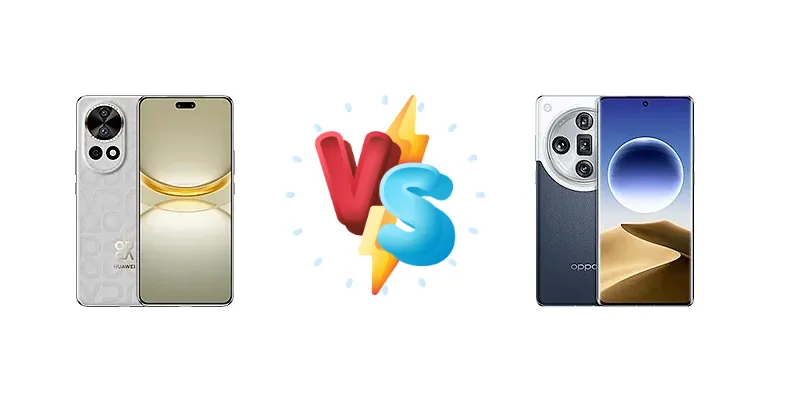
The Huawei nova 12 Ultra and Oppo Find X7 Ultra represent distinct approaches to the premium smartphone market. The nova 12 Ultra aims to deliver a high-end experience with Huawei’s proprietary Kirin chipset, while the Find X7 Ultra leverages the industry-leading Qualcomm Snapdragon 8 Gen 3. This comparison dissects their key differences to help you choose the right flagship for your needs.
🏆 Quick Verdict
For most users, the Oppo Find X7 Ultra emerges as the stronger contender. Its Snapdragon 8 Gen 3 chipset provides demonstrably superior performance and efficiency, coupled with excellent battery life and a brighter display. While the nova 12 Ultra offers competitive charging speeds, it can't match the overall package.
| Network |
|---|
| 2G bands | GSM 850 / 900 / 1800 / 1900 | GSM 850 / 900 / 1800 / 1900 |
| 3G bands | HSDPA 800 / 850 / 900 / 1700(AWS) / 1900 / 2100 | HSDPA 800 / 850 / 900 / 1700(AWS) / 1900 / 2100 |
| 4G bands | LTE | 1, 2, 3, 4, 5, 7, 8, 12, 17, 18, 19, 20, 26, 28, 34, 38, 39, 40, 41, 66 |
| 5G bands | SA/NSA | 1, 2, 3, 5, 7, 8, 20, 28, 38, 40, 41, 66, 77, 78, 79 SA/NSA |
| Speed | HSPA, LTE, 5G | HSPA, LTE, 5G |
| Technology | GSM / CDMA / HSPA / CDMA2000 / LTE / 5G | GSM / CDMA / HSPA / CDMA2000 / LTE / 5G |
| Launch |
|---|
| Announced | 2023, December 26 | 2024, January 08 |
| Status | Available. Released 2024, January 12 | Available. Released 2024, January 12 |
| Body |
|---|
| Build | Glass front, silicone polymer back (eco leather) | Glass front (Gorilla Glass Victus 2), glass back (Gorilla Glass) or eco leather back, aluminum frame |
| Dimensions | 163.1 x 75 x 7.7 mm (6.42 x 2.95 x 0.30 in) | 164.3 x 76.2 x 9.5 mm (6.47 x 3.00 x 0.37 in) |
| SIM | · Nano-SIM· Nano-SIM + Nano-SIM | Nano-SIM + Nano-SIM |
| Weight | 198 g (6.98 oz) | 221 g (7.80 oz) |
| Display |
|---|
| Protection | Kunlun Glass | Corning Gorilla Glass Victus 2 |
| Resolution | 1224 x 2776 pixels (~449 ppi density) | 1440 x 3168 pixels (~510 ppi density) |
| Size | 6.76 inches, 108.8 cm2 (~89.0% screen-to-body ratio) | 6.82 inches, 113.0 cm2 (~90.3% screen-to-body ratio) |
| Type | LTPO OLED, 1B colors, HDR, 120Hz | LTPO AMOLED, 1B colors, 120Hz, Dolby Vision, HDR10+, 1600 nits (typ), 2600 nits (HBM), 4500 nits (peak) |
| Platform |
|---|
| CPU | Octa-core (1x2.62 GHz Taishan Big & 3x2.15 GHz Taishan Mid & 4x1.53GHz Cortex-A510) | Octa-core (1x3.3 GHz Cortex-X4 & 3x3.2 GHz Cortex-A720 & 2x3.0 GHz Cortex-A720 & 2x2.3 GHz Cortex-A520) |
| Chipset | Kirin 9000S (7 nm)* the chipset is not officially confirmed | Qualcomm SM8650-AB Snapdragon 8 Gen 3 (4 nm) |
| GPU | Maleoon 910 MP4 | Adreno 750 |
| OS | HarmonyOS 4.0 | Android 14, up to 4 major Android upgrades, ColorOS 14 |
| Memory |
|---|
| Card slot | No | No |
| Internal | 512GB 12GB RAM, 1TB 12GB RAM | 256GB 12GB RAM, 256GB 16GB RAM, 512GB 16GB RAM |
| Main Camera |
|---|
| Dual | 50 MP, f/1.4-4.0, 27mm (wide), PDAF
8 MP, f/2.2, 112˚ (ultrawide), AF | - |
| Features | Laser AF, color spectrum sensor, LED flash, panorama, HDR | Laser AF, color spectrum sensor, Hasselblad Color Calibration, LED flash, HDR, panorama |
| Quad | - | 50 MP, f/1.8, 23mm (wide), 1.0"-type, 1.6µm, dual pixel PDAF, OIS
50 MP, f/2.6, 65mm (periscope telephoto), 1/1.56", 1.0µm, 2.8x optical zoom, multi-directional PDAF (25cm - ∞), OIS
50 MP, f/4.3, 135mm (periscope telephoto), 1/2.51", 0.7µm, 6x optical zoom, dual pixel PDAF (35cm - ∞), OIS
50 MP, f/2.0, 14mm, 123˚ (ultrawide), 1/1.95", 1.0µm, PDAF |
| Video | 4K, 1080p, gyro-EIS | 4K@30/60fps, 1080p@30/60/240fps; gyro-EIS; HDR, 10‑bit video, Dolby Vision |
| Selfie camera |
|---|
| Dual | 8 MP, f/2.2, 52mm (telephoto), AF, 2x optical zoom
60 MP, f/2.4, 17mm, 100˚ (ultrawide), AF | - |
| Features | HDR, panorama | Panorama |
| Single | - | 32 MP, f/2.4, 21mm (wide), 1/2.74", 0.8µm, PDAF |
| Video | 4K@30fps, 1080p@30fps, gyro-EIS | 4K@30/60fps, 1080p@30fps, gyro-EIS |
| Sound |
|---|
| 35mm jack | No | No |
| Loudspeaker | Yes, with stereo speakers | Yes, with stereo speakers |
| Comms |
|---|
| Bluetooth | 5.2, A2DP, LE, L2HC (320-960 kbps HD audio) | 5.4, A2DP, LE, aptX HD, LHDC |
| Infrared port | - | Yes |
| NFC | Yes | Yes |
| Positioning | GPS (L1+L5), GLONASS (L1), BDS (B1I+B1c+B2a+B2b), GALILEO (E1+E5a+E5b), QZSS (L1+L5), NavIC | GPS (L1+L5), BDS (B1I+B1c+B2a), GALILEO (E1+E5a), QZSS (L1+L5), GLONASS |
| Radio | No | No |
| USB | USB Type-C 2.0, OTG | USB Type-C 3.2, OTG |
| WLAN | Wi-Fi 802.11 a/b/g/n/ac/6, dual-band, Wi-Fi Direct | Wi-Fi 802.11 a/b/g/n/ac/6e/7, dual-band, Wi-Fi Direct |
| Features |
|---|
| Sensors | Fingerprint (under display, optical), accelerometer, gyro, compass | Fingerprint (under display, optical), accelerometer, gyro, proximity, compass |
| Battery |
|---|
| Charging | 100W wired, 3-60% in 10 min
5W reverse wired | 100W wired, PD, 50% in 10 min, 100% in 26 min
50W wireless
10W reverse wireless |
| Type | 4600 mAh | 5000 mAh |
| Misc |
|---|
| Colors | Black, Blue, White | Black, Dark Blue, Light Brown |
| Models | ADA-AL00U | PHY110, PHY120 |
| Price | About 600 EUR | $ 546.64 |
Huawei nova 12 Ultra
- Potentially unique Huawei software features
- Competitive 100W wired charging
- Stylish design (assumed based on Huawei's aesthetic)
- Less powerful Kirin 9000S chipset
- Unconfirmed display specifications
- Limited software ecosystem compared to Oppo
Oppo Find X7 Ultra
- Industry-leading Snapdragon 8 Gen 3 performance
- Bright and efficient display (1165 nits)
- Excellent battery life (12:47h active use)
- Potentially higher price point
- Oppo's ColorOS may not appeal to all users
- Larger size and weight (likely)
Display Comparison
The Oppo Find X7 Ultra boasts a significantly brighter display, reaching a measured peak of 1165 nits, ensuring excellent visibility even in direct sunlight. While the nova 12 Ultra’s display specifications are not provided, the Find X7 Ultra’s brightness advantage is substantial. The Find X7 Ultra likely utilizes LTPO technology for adaptive refresh rates, contributing to power efficiency, a feature not confirmed for the nova 12 Ultra. This makes the Find X7 Ultra the better choice for outdoor users and media consumption.
Camera Comparison
Without detailed camera specifications for the nova 12 Ultra, a direct comparison is limited. However, the Oppo Find X7 Ultra is expected to feature a sophisticated camera system leveraging large sensors and advanced image processing. The Find X7 Ultra’s focus on image quality and stabilization, combined with the processing power of the Snapdragon 8 Gen 3, will likely result in superior photo and video capabilities. The absence of details regarding the nova 12 Ultra’s sensor sizes and OIS suggests it may not compete at the highest level in this category.
Performance
The core difference lies in the chipsets. The Oppo Find X7 Ultra’s Qualcomm Snapdragon 8 Gen 3 (4nm) is a clear step ahead of the Huawei nova 12 Ultra’s Kirin 9000S (7nm). The Snapdragon 8 Gen 3’s Cortex-X4 prime core, clocked at 3.3 GHz, combined with its more efficient 4nm process, delivers superior CPU and GPU performance. The Kirin 9000S, while utilizing a Taishan architecture, is likely to exhibit higher thermal throttling under sustained load. The Find X7 Ultra’s LPDDR5x RAM further enhances performance, providing faster data access compared to the unspecified RAM type in the nova 12 Ultra.
Battery Life
The Oppo Find X7 Ultra demonstrates a strong real-world battery performance, achieving 12 hours and 47 minutes of active use. Both devices support 100W wired charging, with the Find X7 Ultra reaching 50% charge in 10 minutes and a full charge in 26 minutes. The nova 12 Ultra claims 3-60% in 10 minutes, but lacks a full charge time. The Find X7 Ultra also offers 50W wireless charging and 10W reverse wireless charging, features that provide greater versatility compared to the nova 12 Ultra’s 5W reverse wired charging.
Buying Guide
Buy the Huawei nova 12 Ultra if you prioritize a unique design aesthetic and are deeply embedded within the Huawei ecosystem, potentially benefiting from software optimizations tailored to their hardware. Buy the Oppo Find X7 Ultra if you demand top-tier performance for gaming and demanding applications, require a consistently bright and vibrant display, and value the broader compatibility and established reputation of the Snapdragon platform.
Frequently Asked Questions
❓ Is the Kirin 9000S chipset in the Huawei nova 12 Ultra prone to overheating under heavy gaming loads?
Given the 7nm process node and the Snapdragon 8 Gen 3's superior thermal efficiency, the Kirin 9000S is likely to experience more thermal throttling during extended gaming sessions. While Huawei employs cooling solutions, the fundamental process advantage favors the Oppo Find X7 Ultra for sustained performance.
❓ Does the Oppo Find X7 Ultra support high frame rate gaming (90fps or 120fps) in popular titles like PUBG Mobile or Genshin Impact?
The Snapdragon 8 Gen 3's Adreno GPU is more than capable of handling high frame rates in demanding games. The Oppo Find X7 Ultra is expected to support 90fps or even 120fps in optimized titles like PUBG Mobile and Genshin Impact, providing a smoother and more responsive gaming experience.
❓ How does the 50W wireless charging on the Oppo Find X7 Ultra compare to the 5W reverse wired charging on the Huawei nova 12 Ultra?
The 50W wireless charging on the Find X7 Ultra is significantly faster and more convenient than the 5W reverse wired charging on the nova 12 Ultra. The Find X7 Ultra can wirelessly charge at a speed comparable to many wired chargers, while the nova 12 Ultra’s reverse charging is primarily for accessories like earbuds.