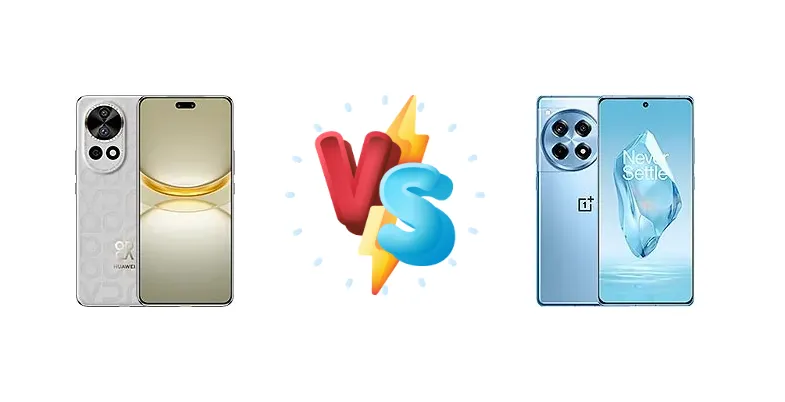
The Huawei nova 12 Ultra and OnePlus 12R represent compelling options in a crowded Android market. The nova 12 Ultra aims for a premium experience with its unconfirmed Kirin 9000S chipset and focus on aesthetics, while the OnePlus 12R prioritizes raw performance and sustained usability with the Snapdragon 8 Gen 2. This comparison dissects their key differences to help you choose.
🏆 Quick Verdict
For most users, the OnePlus 12R emerges as the stronger choice. Its Snapdragon 8 Gen 2 chipset delivers demonstrably superior performance and efficiency, backed by a robust 14:32 hour active use battery life. While the nova 12 Ultra may excel in design, the 12R’s overall package offers better value and reliability.
| Network |
|---|
| 2G bands | GSM 850 / 900 / 1800 / 1900 | GSM 850 / 900 / 1800 / 1900 |
| 3G bands | HSDPA 800 / 850 / 900 / 1700(AWS) / 1900 / 2100 | HSDPA 850 / 900 / 1700(AWS) / 1900 / 2100 |
| 4G bands | LTE | 1, 2, 3, 4, 5, 7, 8, 12, 17, 18, 19, 20, 26, 28, 32, 38, 39, 40, 41, 66 |
| 5G bands | SA/NSA | 1, 2, 3, 5, 7, 8, 12, 20, 28, 38, 40, 41, 66, 77, 78 SA/NSA |
| Speed | HSPA, LTE, 5G | HSPA, LTE, 5G |
| Technology | GSM / CDMA / HSPA / CDMA2000 / LTE / 5G | GSM / CDMA / HSPA / LTE / 5G |
| Launch |
|---|
| Announced | 2023, December 26 | 2024, January 23 |
| Status | Available. Released 2024, January 12 | Available. Released 2024, February 06 |
| Body |
|---|
| Build | Glass front, silicone polymer back (eco leather) | Glass front (Gorilla Glass Victus 2), aluminum frame, glass back |
| Dimensions | 163.1 x 75 x 7.7 mm (6.42 x 2.95 x 0.30 in) | 163.3 x 75.3 x 8.8 mm (6.43 x 2.96 x 0.35 in) |
| SIM | · Nano-SIM· Nano-SIM + Nano-SIM | · Nano-SIM + Nano-SIM + eSIM (max 2 at a time)· Nano-SIM + Nano-SIM |
| Weight | 198 g (6.98 oz) | 207 g (7.30 oz) |
| Display |
|---|
| Protection | Kunlun Glass | Corning Gorilla Glass Victus 2 |
| Resolution | 1224 x 2776 pixels (~449 ppi density) | 1264 x 2780 pixels (~450 ppi density) |
| Size | 6.76 inches, 108.8 cm2 (~89.0% screen-to-body ratio) | 6.78 inches, 111.7 cm2 (~90.9% screen-to-body ratio) |
| Type | LTPO OLED, 1B colors, HDR, 120Hz | LTPO4 AMOLED, 1B colors, 120Hz, HDR10+, Dolby Vision, 1600 nits (HBM), 4500 nits (peak) |
| Platform |
|---|
| CPU | Octa-core (1x2.62 GHz Taishan Big & 3x2.15 GHz Taishan Mid & 4x1.53GHz Cortex-A510) | Octa-core (1x3.2 GHz Cortex-X3 & 2x2.8 GHz Cortex-A715 & 2x2.8 GHz Cortex-A710 & 3x2.0 GHz Cortex-A510) |
| Chipset | Kirin 9000S (7 nm)* the chipset is not officially confirmed | Qualcomm SM8550-AB Snapdragon 8 Gen 2 (4 nm) |
| GPU | Maleoon 910 MP4 | Adreno 740 |
| OS | HarmonyOS 4.0 | Android 14, up to 3 major Android upgrades, OxygenOS 15 |
| Memory |
|---|
| Card slot | No | No |
| Internal | 512GB 12GB RAM, 1TB 12GB RAM | 128GB 8GB RAM, 256GB 8GB RAM, 256GB 12GB RAM, 256GB 16GB RAM |
| Main Camera |
|---|
| Dual | 50 MP, f/1.4-4.0, 27mm (wide), PDAF
8 MP, f/2.2, 112˚ (ultrawide), AF | - |
| Features | Laser AF, color spectrum sensor, LED flash, panorama, HDR | Laser AF, color spectrum sensor, LED flash, HDR, panorama |
| Triple | - | 50 MP, f/1.8, 24mm (wide), 1/1.56", 1.0µm, multi-directional PDAF, OIS
8 MP, f/2.2, 16mm, 112˚ (ultrawide), 1/4.0", 1.12µm
2 MP (macro) |
| Video | 4K, 1080p, gyro-EIS | 4K@30/60fps, 1080p@30/60/120/240fps, gyro-EIS, OIS |
| Selfie camera |
|---|
| Dual | 8 MP, f/2.2, 52mm (telephoto), AF, 2x optical zoom
60 MP, f/2.4, 17mm, 100˚ (ultrawide), AF | - |
| Features | HDR, panorama | HDR, panorama |
| Single | - | 16 MP, f/2.4, 26mm (wide), 1/3", 1.0µm |
| Video | 4K@30fps, 1080p@30fps, gyro-EIS | 1080p@30fps, gyro-EIS |
| Sound |
|---|
| 35mm jack | No | No |
| Loudspeaker | Yes, with stereo speakers | Yes, with stereo speakers |
| Comms |
|---|
| Bluetooth | 5.2, A2DP, LE, L2HC (320-960 kbps HD audio) | 5.3, A2DP, LE, aptX HD |
| Infrared port | - | Yes |
| NFC | Yes | Yes |
| Positioning | GPS (L1+L5), GLONASS (L1), BDS (B1I+B1c+B2a+B2b), GALILEO (E1+E5a+E5b), QZSS (L1+L5), NavIC | GPS, GALILEO, GLONASS, BDS, QZSS |
| Radio | No | No |
| USB | USB Type-C 2.0, OTG | USB Type-C 2.0 |
| WLAN | Wi-Fi 802.11 a/b/g/n/ac/6, dual-band, Wi-Fi Direct | Wi-Fi 802.11 a/b/g/n/ac/6/7, dual-band |
| Features |
|---|
| Sensors | Fingerprint (under display, optical), accelerometer, gyro, compass | Fingerprint (under display, optical), accelerometer, gyro, proximity, compass |
| Battery |
|---|
| Charging | 100W wired, 3-60% in 10 min
5W reverse wired | 100W wired, 100% in 26 min |
| Type | 4600 mAh | Li-Ion 5500 mAh |
| Misc |
|---|
| Colors | Black, Blue, White | Iron Gray, Cool Blue, Electric Violet, Sunset Dune |
| Models | ADA-AL00U | CPH2609, CPH2585, CPH2611 |
| Price | About 600 EUR | € 410.84 / $ 399.95 / £ 649.00 |
| SAR | - | 1.19 W/kg (head) 0.82 W/kg (body) |
Huawei nova 12 Ultra
- Potentially unique and stylish design
- Huawei’s image processing expertise (potential)
- 100W fast charging
- Unconfirmed chipset and potential performance limitations
- Uncertainty regarding software updates and ecosystem
- Less efficient 7nm manufacturing process
OnePlus 12R
- Powerful Snapdragon 8 Gen 2 chipset
- Excellent battery life (14:32h active use)
- Fast 100W charging (26 min to full)
- Lacks LTPO display technology
- Design may be less distinctive than the nova 12 Ultra
- OxygenOS can be divisive among Android purists
Display Comparison
The OnePlus 12R boasts a display capable of reaching 1181 nits of peak brightness, ensuring excellent visibility even in direct sunlight. While the nova 12 Ultra’s display specifications are currently less detailed, the 12R’s brightness advantage is significant. Both likely utilize AMOLED panels, but the 12R’s measured brightness provides a concrete advantage for outdoor use. The absence of LTPO technology in the 12R is a minor drawback, potentially impacting power efficiency during static content viewing compared to a potential LTPO implementation in the nova 12 Ultra (if present).
Camera Comparison
Without detailed camera specifications for the nova 12 Ultra, a direct comparison is challenging. However, the OnePlus 12R is expected to feature a capable camera system, focusing on a primary sensor with optical image stabilization (OIS). The nova 12 Ultra’s potential strength may lie in Huawei’s image processing algorithms, historically known for vibrant colors and strong dynamic range. It’s crucial to note that the inclusion of low-resolution auxiliary cameras (like a typical 2MP macro) on either device adds little practical value to the overall photography experience.
Performance
The core difference lies in the chipsets. The OnePlus 12R’s Snapdragon 8 Gen 2 (4nm) is a proven performer, featuring a Cortex-X3 prime core clocked at 3.2 GHz. This contrasts with the Huawei nova 12 Ultra’s Kirin 9000S (7nm), which, despite its octa-core configuration, utilizes a less efficient manufacturing process. The Snapdragon 8 Gen 2’s 4nm node translates to better thermal efficiency, reducing the likelihood of throttling during extended gaming sessions. The 12R’s CPU architecture – Cortex-X3, A715, and A710 – is demonstrably more modern and efficient than the Kirin’s Taishan and Cortex-A510 mix, resulting in faster application loading and smoother multitasking.
Battery Life
The OnePlus 12R shines in battery performance, achieving an impressive 14 hours and 32 minutes of active use. Both devices support 100W wired charging, but the 12R reaches 100% charge in just 26 minutes, while the nova 12 Ultra takes 10 minutes to reach 60%. This faster full-charge time on the 12R is a significant convenience factor. While the nova 12 Ultra offers 5W reverse wired charging, the 12R’s battery life and faster charging speeds provide a more compelling overall package.
Buying Guide
Buy the Huawei nova 12 Ultra if you prioritize a unique aesthetic and are comfortable with the potential uncertainties surrounding the Kirin 9000S chipset and Huawei’s ecosystem. Buy the OnePlus 12R if you demand consistent, high-end performance for gaming and demanding tasks, coupled with excellent battery life and a proven track record of software support.
Frequently Asked Questions
❓ Is the Kirin 9000S chipset in the Huawei nova 12 Ultra comparable to the Snapdragon 8 Gen 2 in real-world performance?
Based on the available information, the Snapdragon 8 Gen 2 in the OnePlus 12R is expected to outperform the Kirin 9000S. The 4nm process node and more modern CPU architecture of the Snapdragon 8 Gen 2 provide a significant advantage in both performance and efficiency, particularly during demanding tasks like gaming and video editing.
❓ How does the 100W charging on the OnePlus 12R compare to other 100W charging solutions in terms of heat generation and longevity?
OnePlus has refined its 100W SuperVOOC charging technology over several generations, focusing on minimizing heat generation and preserving battery health. While all fast charging solutions generate some heat, OnePlus’ implementation is generally considered efficient and reliable. The 12R’s 26-minute full charge time is competitive and doesn’t appear to compromise battery longevity based on user reports.
❓ Does the OnePlus 12R support high refresh rate gaming, and is there any noticeable throttling during extended gaming sessions?
The OnePlus 12R supports high refresh rate gaming, though the exact supported frame rates will depend on the game. The Snapdragon 8 Gen 2’s thermal efficiency helps mitigate throttling, but some heat buildup is inevitable during prolonged gaming. However, the 12R’s cooling system is generally effective at maintaining stable performance for extended periods.