
Huawei nova 12 Ultra vs. Apple iPhone 15 Pro Max: A Deep Dive Comparison
| Phones Images | |||||
|---|---|---|---|---|---|
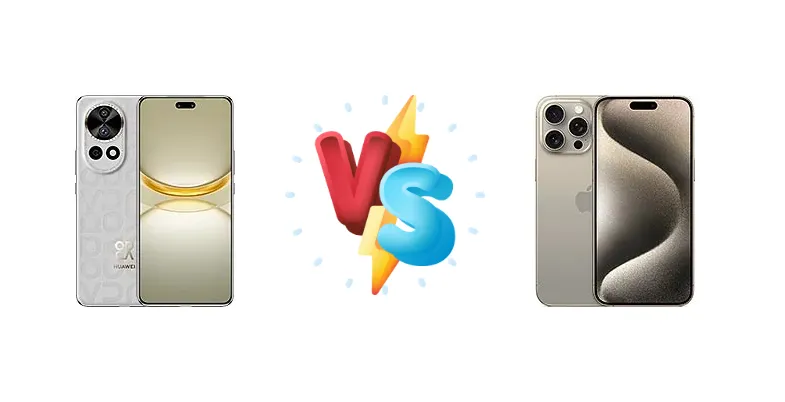
|
🏆 Quick Verdict
For the average user prioritizing a seamless experience, robust app ecosystem, and long-term software support, the Apple iPhone 15 Pro Max is the superior choice. However, the Huawei nova 12 Ultra’s 100W charging and potentially competitive performance offer a compelling alternative for those less reliant on the Apple ecosystem.
| PHONES | ||
|---|---|---|
| Phone Names | Huawei nova 12 Ultra | Apple iPhone 15 Pro Max |
| Network | ||
|---|---|---|
| 2G bands | GSM 850 / 900 / 1800 / 1900 | GSM 850 / 900 / 1800 / 1900 |
| 3G bands | HSDPA 800 / 850 / 900 / 1700(AWS) / 1900 / 2100 | HSDPA 850 / 900 / 1700(AWS) / 1900 / 2100 |
| 4G bands | LTE | 1, 2, 3, 4, 5, 7, 8, 12, 13, 17, 18, 19, 20, 25, 26, 28, 30, 32, 34, 38, 39, 40, 41, 42, 46, 48, 53, 66 - A3106 |
| 5G bands | SA/NSA | 1, 2, 3, 5, 7, 8, 12, 20, 25, 26, 28, 30, 38, 40, 41, 48, 53, 66, 70, 77, 78, 79 SA/NSA/Sub6 - A3106 |
| Speed | HSPA, LTE, 5G | HSPA, LTE, 5G, EV-DO Rev.A 3.1 Mbps |
| Technology | GSM / CDMA / HSPA / CDMA2000 / LTE / 5G | GSM / CDMA / HSPA / EVDO / LTE / 5G |
| Launch | ||
|---|---|---|
| Announced | 2023, December 26 | 2023, September 12 |
| Status | Available. Released 2024, January 12 | Available. Released 2023, September 22 |
| Body | ||
|---|---|---|
| Build | Glass front, silicone polymer back (eco leather) | Glass front, glass back, titanium frame (grade 5) |
| Dimensions | 163.1 x 75 x 7.7 mm (6.42 x 2.95 x 0.30 in) | 159.9 x 76.7 x 8.3 mm (6.30 x 3.02 x 0.33 in) |
| SIM | · Nano-SIM· Nano-SIM + Nano-SIM | · Nano-SIM + eSIM + eSIM (max 2 at a time; International)· eSIM + eSIM (8 or more, max 2 at a time; USA)· Nano-SIM + Nano-SIM (China) |
| Weight | 198 g (6.98 oz) | 221 g (7.80 oz) |
| Display | ||
|---|---|---|
| Protection | Kunlun Glass | Ceramic Shield glass |
| Resolution | 1224 x 2776 pixels (~449 ppi density) | 1290 x 2796 pixels, 19.5:9 ratio (~460 ppi density) |
| Size | 6.76 inches, 108.8 cm2 (~89.0% screen-to-body ratio) | 6.7 inches, 110.2 cm2 (~89.8% screen-to-body ratio) |
| Type | LTPO OLED, 1B colors, HDR, 120Hz | LTPO Super Retina XDR OLED, 120Hz, HDR10, Dolby Vision, 1000 nits (typ), 2000 nits (HBM) |
| Platform | ||
|---|---|---|
| CPU | Octa-core (1x2.62 GHz Taishan Big & 3x2.15 GHz Taishan Mid & 4x1.53GHz Cortex-A510) | Hexa-core (2x3.78 GHz + 4x2.11 GHz) |
| Chipset | Kirin 9000S (7 nm)* the chipset is not officially confirmed | Apple A17 Pro (3 nm) |
| GPU | Maleoon 910 MP4 | Apple GPU (6-core graphics) |
| OS | HarmonyOS 4.0 | iOS 17, upgradable to iOS 26.1 |
| Memory | ||
|---|---|---|
| Card slot | No | No |
| Internal | 512GB 12GB RAM, 1TB 12GB RAM | 256GB 8GB RAM, 512GB 8GB RAM, 1TB 8GB RAM |
| Main Camera | ||
|---|---|---|
| Dual | 50 MP, f/1.4-4.0, 27mm (wide), PDAF 8 MP, f/2.2, 112˚ (ultrawide), AF | - |
| Features | Laser AF, color spectrum sensor, LED flash, panorama, HDR | Dual-LED dual-tone flash, HDR (photo/panorama) |
| Triple | - | 48 MP, f/1.8, 24mm (wide), 1/1.28", 1.22µm, dual pixel PDAF, sensor-shift OIS 12 MP, f/2.8, 120mm (periscope telephoto), 1/3.06", 1.12µm, dual pixel PDAF, 3D sensor‑shift OIS, 5x optical zoom 12 MP, f/2.2, 13mm, 120˚ (ultrawide), 1/2.55", 1.4µm, dual pixel PDAF TOF 3D LiDAR scanner (depth) |
| Video | 4K, 1080p, gyro-EIS | 4K@24/25/30/60fps, 1080p@25/30/60/120/240fps, 10-bit HDR, Dolby Vision HDR (up to 60fps), ProRes, 3D (spatial) video, stereo sound rec. |
| Selfie camera | ||
|---|---|---|
| Dual | 8 MP, f/2.2, 52mm (telephoto), AF, 2x optical zoom 60 MP, f/2.4, 17mm, 100˚ (ultrawide), AF | - |
| Features | HDR, panorama | HDR, Dolby Vision HDR |
| Single | - | 12 MP, f/1.9, 23mm (wide), 1/3.6", 1.0µm, PDAF, OIS SL 3D, (depth/biometrics sensor) |
| Video | 4K@30fps, 1080p@30fps, gyro-EIS | 4K@24/25/30/60fps, 1080p@25/30/60/120fps, gyro-EIS |
| Sound | ||
|---|---|---|
| 35mm jack | No | No |
| Loudspeaker | Yes, with stereo speakers | Yes, with stereo speakers |
| Comms | ||
|---|---|---|
| Bluetooth | 5.2, A2DP, LE, L2HC (320-960 kbps HD audio) | 5.3, A2DP, LE |
| NFC | Yes | Yes |
| Positioning | GPS (L1+L5), GLONASS (L1), BDS (B1I+B1c+B2a+B2b), GALILEO (E1+E5a+E5b), QZSS (L1+L5), NavIC | GPS (L1+L5), GLONASS, GALILEO, BDS, QZSS, NavIC |
| Radio | No | No |
| USB | USB Type-C 2.0, OTG | USB Type-C 3.2 Gen 2, DisplayPort |
| WLAN | Wi-Fi 802.11 a/b/g/n/ac/6, dual-band, Wi-Fi Direct | Wi-Fi 802.11 a/b/g/n/ac/6e, tri-band, hotspot |
| Features | ||
|---|---|---|
| Sensors | Fingerprint (under display, optical), accelerometer, gyro, compass | Face ID, accelerometer, gyro, proximity, compass, barometer |
| Battery | ||
|---|---|---|
| Charging | 100W wired, 3-60% in 10 min 5W reverse wired | Wired, PD2.0, 50% in 30 min 15W wireless (MagSafe) 15W wireless (Qi2) - requires iOS 17.2 update 4.5W reverse wired |
| Type | 4600 mAh | Li-Ion 4441 mAh |
| Misc | ||
|---|---|---|
| Colors | Black, Blue, White | Black Titanium, White Titanium, Blue Titanium, Natural Titanium |
| Models | ADA-AL00U | A2849, A3105, A3106, A3108, iPhone16,2 |
| Price | About 600 EUR | € 758.79 / $ 579.87 / £ 628.29 |
| SAR | - | 1.07 W/kg (head) 1.11 W/kg (body) |
| SAR EU | - | 0.98 W/kg (head) 0.98 W/kg (body) |
Huawei nova 12 Ultra
- 100W SuperCharge delivers incredibly fast charging.
- Potentially competitive performance with the Kirin 9000S.
- Android OS offers greater customization options.
- Uncertainty surrounding Kirin 9000S performance and efficiency.
- Limited access to Google services due to ongoing restrictions.
Apple iPhone 15 Pro Max
- Industry-leading A17 Pro chipset for exceptional performance.
- Superior camera system with excellent video recording.
- Long-term software support and ecosystem integration.
- Slower charging speeds compared to the Huawei nova 12 Ultra.
- Higher price point.
Display Comparison
The iPhone 15 Pro Max boasts a peak brightness of 1787 nits, ensuring excellent visibility even in direct sunlight. While the nova 12 Ultra’s display specifications are currently unavailable, Huawei typically employs OLED panels with vibrant colors. The iPhone’s ProMotion technology (adaptive refresh rate) is a key advantage, offering smoother scrolling and animations, a feature likely absent on the nova 12 Ultra. The iPhone’s superior brightness and adaptive refresh rate provide a more visually engaging experience.
Camera Comparison
The iPhone 15 Pro Max is renowned for its exceptional video recording capabilities and computational photography. While the nova 12 Ultra’s camera specs are not fully detailed, Huawei often focuses on high megapixel counts. However, sensor size and image processing are crucial. The iPhone’s larger sensor and advanced image pipeline deliver superior dynamic range and low-light performance. The iPhone’s cinematic mode and ProRes video recording are features the nova 12 Ultra likely won’t match. The iPhone’s consistent image quality and video prowess make it the winner in this category.
Performance
The core difference lies in the chipsets: Apple’s 3nm A17 Pro (Hexa-core, 2x3.78 GHz + 4x2.11 GHz) versus Huawei’s unconfirmed Kirin 9000S (7nm, Octa-core). The A17 Pro’s smaller node size translates to greater power efficiency and higher transistor density, resulting in superior performance and thermal management. While the Kirin 9000S’s Taishan architecture aims to compete, the A17 Pro’s architectural advantages and optimized software integration give it a significant edge, particularly in demanding tasks like video editing and gaming. The iPhone 15 Pro Max will likely exhibit less throttling under sustained load.
Battery Life
The iPhone 15 Pro Max achieves an impressive 16:01h of active use and an endurance rating of 118h, demonstrating excellent battery life. The nova 12 Ultra compensates with its 100W wired charging, capable of charging from 30-60% in just 10 minutes. The iPhone 15 Pro Max takes 30 minutes to reach 50% with wired charging. While the iPhone offers 15W wireless charging (MagSafe/Qi2), the nova 12 Ultra’s charging speed is significantly faster. The trade-off is battery capacity; the iPhone’s optimized power management offsets any capacity difference, but the nova 12 Ultra’s charging speed is a game-changer for users who frequently need to top up quickly.
Buying Guide
Buy the Huawei nova 12 Ultra if you prioritize incredibly fast charging, are comfortable with the Android ecosystem, and seek a potentially powerful processor at a potentially lower price point. Buy the Apple iPhone 15 Pro Max if you value a polished user experience, a mature app ecosystem, industry-leading video recording capabilities, and guaranteed software updates for years to come.