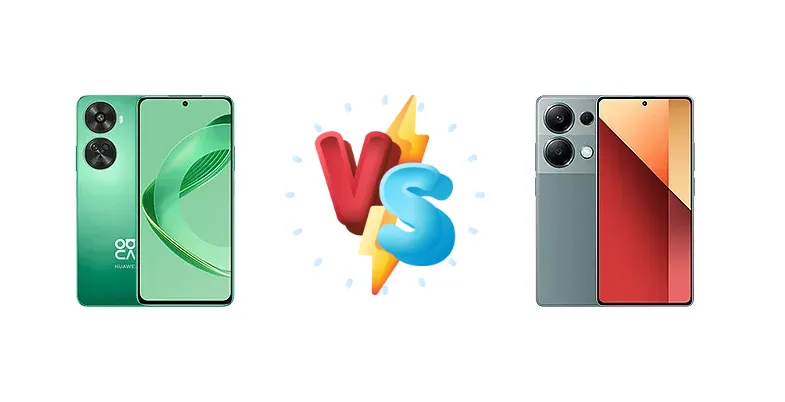
The mid-range smartphone market is fiercely competitive, and the Huawei nova 12 SE and Xiaomi Redmi Note 13 Pro 4G represent compelling options for budget-conscious buyers. While both aim to deliver a premium experience without the flagship price tag, they take different approaches to achieving this. This comparison dives deep into their specifications to determine which device offers the best value.
🏆 Quick Verdict
For the average user prioritizing sustained performance and a brighter display, the Xiaomi Redmi Note 13 Pro 4G emerges as the stronger contender. Its Mediatek Helio G99 Ultra chipset and 1047 nit display offer a noticeable advantage over the Snapdragon 680-powered nova 12 SE, despite the Huawei's faster charging.
| Network |
|---|
| 2G bands | GSM 850 / 900 / 1800 / 1900 | GSM 850 / 900 / 1800 / 1900 |
| 3G bands | HSDPA 850 / 900 / 1900 / 2100 | HSDPA 850 / 900 / 1700(AWS) / 1900 / 2100 |
| 4G bands | 1, 3, 5, 7, 8, 20, 28, 34, 38, 40, 41 | 1, 2, 3, 4, 5, 7, 8, 12, 13, 17, 18, 19, 20, 26, 28, 38, 40, 41, 66 |
| Speed | HSPA, LTE | HSPA, LTE |
| Technology | GSM / HSPA / LTE | GSM / HSPA / LTE |
| Launch |
|---|
| Announced | 2024, March 19 | 2024, January 15 |
| Status | Available. Released 2024, April 06 | Available. Released 2024, January 15 |
| Body |
|---|
| Build | - | Glass front (Gorilla Glass 5), plastic frame, plastic back |
| Dimensions | 162.4 x 75.5 x 7.4 mm (6.39 x 2.97 x 0.29 in) | 161.1 x 75 x 8 mm (6.34 x 2.95 x 0.31 in) |
| SIM | · Nano-SIM· Nano-SIM + Nano-SIM | Nano-SIM + Nano-SIM |
| Weight | 186 g (6.56 oz) | 188 g (6.63 oz) |
| Display |
|---|
| Protection | - | Corning Gorilla Glass 5 |
| Resolution | 1080 x 2400 pixels, 20:9 ratio (~395 ppi density) | 1080 x 2400 pixels, 20:9 ratio (~395 ppi density) |
| Size | 6.67 inches, 107.4 cm2 (~87.6% screen-to-body ratio) | 6.67 inches, 107.4 cm2 (~88.9% screen-to-body ratio) |
| Type | OLED, 1B colors, 90Hz | AMOLED, 1B colors, 120Hz, 500 nits (typ), 1000 nits (HBM), 1300 nits (peak) |
| Platform |
|---|
| CPU | Octa-core (4x2.4 GHz Cortex-A73 & 4x1.9 GHz Cortex-A53) | Octa-core (2x2.2 GHz Cortex-A76 & 6x2.0 GHz Cortex-A55) |
| Chipset | Qualcomm Snapdragon 680 4G (6 nm) | Mediatek Helio G99 Ultra |
| GPU | Adreno 610 | Mali-G57 MC2 |
| OS | EMUI 14, no Google Play Services | Android 13, up to 3 major Android upgrades, HyperOS |
| Memory |
|---|
| Card slot | No | microSDXC (uses shared SIM slot) |
| Internal | 256GB 8GB RAM | 128GB 8GB RAM, 256GB 8GB RAM, 256GB 12GB RAM, 512GB 8GB RAM, 512GB 12GB RAM |
| Main Camera |
|---|
| Features | LED flash, HDR, panorama | LED flash, HDR, panorama |
| Triple | 108 MP, f/1.9, (wide), 1/1.67", 0.64µm, PDAF
8 MP, f/2.2, 112˚ (ultrawide)
2 MP (macro) | 200 MP, f/1.7, 23mm (wide), 1/1.4", 0.56µm, multi-directional PDAF, OIS
8 MP, f/2.2, 15mm, 120˚ (ultrawide), 1/4.4", 1.0µm
2 MP (macro) |
| Video | 1080p@30fps, gyro-EIS | 1080p@30/60fps |
| Selfie camera |
|---|
| Single | 32 MP, f/2.5, (wide) | 16 MP, f/2.4, (wide), 1/3.0", 1.0µm |
| Video | 1080p@30fps | 1080p@30/60fps |
| Sound |
|---|
| 35mm jack | No | Yes |
| Loudspeaker | Yes | Yes, with dual speakers |
| Comms |
|---|
| Bluetooth | 5.0, A2DP, LE | 5.2, A2DP, LE |
| Infrared port | - | Yes |
| NFC | Yes | Yes (market/region dependent) |
| Positioning | GPS, GLONASS, GALILEO, BDS, QZSS | GPS, GLONASS, GALILEO, BDS |
| Radio | No | FM radio |
| USB | USB Type-C 2.0 | USB Type-C 2.0, OTG |
| WLAN | Wi-Fi 802.11 a/b/g/n/ac, dual-band | Wi-Fi 802.11 a/b/g/n/ac, dual-band |
| Features |
|---|
| Sensors | Fingerprint (side-mounted), accelerometer, gyro, proximity, compass | Fingerprint (under display, optical), accelerometer, gyro, compass |
| Battery |
|---|
| Charging | 66W wired, 3-100% in 32 min
5W reverse wired | 67W wired, 50% in 16 min, 100% in 46 min |
| Type | Li-Po 4500 mAh | 5000 mAh |
| Misc |
|---|
| Colors | Green, Black | Midnight Black, Lavender Purple, Forest Green |
| Models | BNE-LX1 | 23117RA68G, 2312FPCA6G |
| Price | About 340 EUR | € 92.00 / $ 269.99 / £ 299.99 |
| SAR | - | 1.09 W/kg (head) 1.09 W/kg (body) |
| SAR EU | - | 0.99 W/kg (head) 0.99 W/kg (body) |
Huawei nova 12 SE
- Extremely fast 66W wired charging
- 5W reverse wired charging for accessories
- Potentially more efficient Snapdragon 680 chipset
- Less powerful Snapdragon 680 processor
- Likely dimmer display compared to the Redmi Note 13 Pro 4G
Xiaomi Redmi Note 13 Pro 4G
- Brighter 1047 nit display for outdoor visibility
- More powerful Mediatek Helio G99 Ultra processor
- Longer battery life during active use (11:36h)
- Slower 67W charging compared to the Huawei
- Lacks reverse wireless charging
Display Comparison
The Xiaomi Redmi Note 13 Pro 4G boasts a significantly brighter display, peaking at 1047 nits, making it far more usable under direct sunlight compared to the nova 12 SE (brightness data unavailable). While both likely utilize LCD panels given their price points, the Redmi Note 13 Pro 4G’s higher peak brightness is a clear advantage. Bezels appear comparable based on available imagery, but color accuracy and panel technology details (like PWM dimming frequency) are currently unknown for both devices, impacting their suitability for users sensitive to flicker.
Camera Comparison
Detailed camera analysis is hampered by a lack of sensor size and aperture information for both devices. However, the Redmi Note 13 Pro 4G’s camera system is likely to be more versatile, assuming it follows Xiaomi’s typical strategy of including a higher-resolution main sensor. The presence of OIS (Optical Image Stabilization) on the Redmi Note 13 Pro 4G, if present, would further enhance image quality, particularly in low-light conditions. The 2MP macro cameras on both devices are unlikely to deliver significant photographic value.
Performance
The Redmi Note 13 Pro 4G’s Mediatek Helio G99 Ultra chipset, with its 2x2.2 GHz Cortex-A76 cores, offers a performance edge over the Huawei nova 12 SE’s Snapdragon 680. The G99 Ultra’s Cortex-A76 cores are architecturally superior to the Snapdragon 680’s Cortex-A73 cores, translating to faster application loading and smoother multitasking. While both are 4G-only devices, the G99 Ultra’s GPU is likely to provide a better gaming experience. The Snapdragon 680’s 6nm process node is more efficient, but the architectural advantage of the G99 Ultra likely outweighs this.
Battery Life
The Xiaomi Redmi Note 13 Pro 4G demonstrates superior battery performance with an active use score of 11 hours and 36 minutes. While the Huawei nova 12 SE’s 66W charging is faster – 32 minutes to 100% versus the Redmi’s 46 minutes – the Redmi Note 13 Pro 4G’s longer battery life offsets the slower charging speed for most users. The nova 12 SE also offers 5W reverse wired charging, a feature absent on the Redmi Note 13 Pro 4G, allowing it to top up accessories.
Buying Guide
Buy the Huawei nova 12 SE if you prioritize extremely fast charging – reaching 100% in just 32 minutes – and prefer the Huawei ecosystem. Buy the Xiaomi Redmi Note 13 Pro 4G if you value a brighter, more visible display in outdoor conditions, longer battery life during active use, and a chipset geared towards more demanding tasks like gaming.
Frequently Asked Questions
❓ Does the Mediatek Helio G99 Ultra in the Redmi Note 13 Pro 4G struggle with demanding games like PUBG or Genshin Impact?
While not a flagship-level chipset, the Helio G99 Ultra is capable of running PUBG and Genshin Impact at medium settings. Expect frame rate drops during intense scenes, but the G99 Ultra’s GPU provides a better gaming experience than the Snapdragon 680, making it the preferable choice for casual gamers.
❓ Is the 66W charging on the Huawei nova 12 SE significantly faster in real-world use compared to the Redmi Note 13 Pro 4G’s 67W charging?
Yes, the Huawei nova 12 SE charges from 0-100% in 32 minutes, while the Redmi Note 13 Pro 4G takes 46 minutes. This 14-minute difference is noticeable, especially for users who frequently need to quickly top up their battery. However, the Redmi Note 13 Pro 4G’s longer battery life may reduce the need for frequent charging.
❓ How does the camera performance differ between these two phones in low-light conditions?
Without detailed camera specs, it's difficult to say definitively. However, if the Redmi Note 13 Pro 4G includes OIS (Optical Image Stabilization), it will likely capture brighter and sharper images in low light compared to the nova 12 SE. Both phones will likely struggle in extremely dark environments.