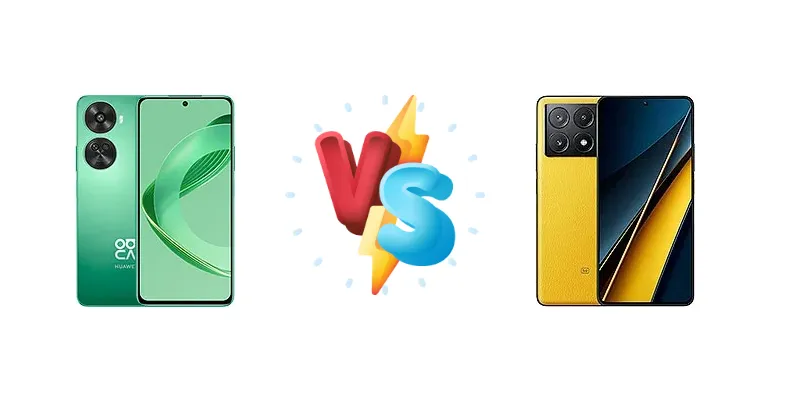
The mid-range smartphone market is fiercely competitive, and the Huawei nova 12 SE and Xiaomi Poco X6 Pro represent distinct approaches. The nova 12 SE focuses on a refined user experience and efficient power management, while the Poco X6 Pro aims for raw performance with a more aggressive chipset. This comparison dissects their key differences to help you choose the right device.
🏆 Quick Verdict
For most users, the Xiaomi Poco X6 Pro is the superior choice. Its Mediatek Dimensity 8300 Ultra chipset provides a substantial performance leap over the Snapdragon 680 in the nova 12 SE, making it better suited for gaming and demanding applications. However, the nova 12 SE’s 66W charging is slightly faster and offers a more streamlined software experience.
| Network |
|---|
| 2G bands | GSM 850 / 900 / 1800 / 1900 | GSM 850 / 900 / 1800 / 1900 |
| 3G bands | HSDPA 850 / 900 / 1900 / 2100 | HSDPA 850 / 900 / 1700(AWS) / 1900 / 2100 |
| 4G bands | 1, 3, 5, 7, 8, 20, 28, 34, 38, 40, 41 | 1, 2, 3, 4, 5, 7, 8, 18, 19, 20, 28, 38, 40, 41, 48, 66 |
| 5G bands | - | 1, 2, 3, 5, 7, 8, 20, 28, 38, 40, 41, 48, 77, 78 SA/NSA/Sub6 |
| Speed | HSPA, LTE | HSPA, LTE, 5G |
| Technology | GSM / HSPA / LTE | GSM / HSPA / LTE / 5G |
| Launch |
|---|
| Announced | 2024, March 19 | 2024, January 11 |
| Status | Available. Released 2024, April 06 | Available. Released 2024, January 12 |
| Body |
|---|
| Build | - | Glass front (Gorilla Glass 5), plastic frame, plastic back or silicone polymer back (eco leather) |
| Dimensions | 162.4 x 75.5 x 7.4 mm (6.39 x 2.97 x 0.29 in) | 160.5 x 74.3 x 8.3 mm (6.32 x 2.93 x 0.33 in) |
| SIM | · Nano-SIM· Nano-SIM + Nano-SIM | Nano-SIM + Nano-SIM |
| Weight | 186 g (6.56 oz) | 186 g or 190 g (6.56 oz) |
| Display |
|---|
| Protection | - | Corning Gorilla Glass 5 |
| Resolution | 1080 x 2400 pixels, 20:9 ratio (~395 ppi density) | 1220 x 2712 pixels, 20:9 ratio (~446 ppi density) |
| Size | 6.67 inches, 107.4 cm2 (~87.6% screen-to-body ratio) | 6.67 inches, 107.4 cm2 (~90.1% screen-to-body ratio) |
| Type | OLED, 1B colors, 90Hz | AMOLED, 68B colors, 120Hz, 1920Hz PWM, HDR10+, Dolby Vision, 500 nits (typ), 1200 nits (HBM), 1800 nits (peak) |
| Platform |
|---|
| CPU | Octa-core (4x2.4 GHz Cortex-A73 & 4x1.9 GHz Cortex-A53) | Octa-core (1x3.35 GHz Cortex-A715 & 3x3.20 GHz Cortex-A715 & 4x2.20 GHz Cortex-A510) |
| Chipset | Qualcomm Snapdragon 680 4G (6 nm) | Mediatek Dimensity 8300 Ultra (4 nm) |
| GPU | Adreno 610 | Mali G615-MC6 |
| OS | EMUI 14, no Google Play Services | Android 14, up to 3 major Android upgrades, HyperOS |
| Memory |
|---|
| Card slot | No | No |
| Internal | 256GB 8GB RAM | 256GB 8GB RAM, 256GB 12GB RAM, 512GB 12GB RAM |
| Main Camera |
|---|
| Features | LED flash, HDR, panorama | LED flash, HDR, panorama |
| Triple | 108 MP, f/1.9, (wide), 1/1.67", 0.64µm, PDAF
8 MP, f/2.2, 112˚ (ultrawide)
2 MP (macro) | 64 MP, f/1.7, 25mm (wide), 1/2.0", 0.7µm, PDAF, OIS
8 MP, f/2.2, 120˚ (ultrawide), 1/4.0", 1.12µm
2 MP (macro) |
| Video | 1080p@30fps, gyro-EIS | 4K@24/30fps, 1080p@30/60fps, gyro-EIS |
| Selfie camera |
|---|
| Features | - | HDR, panorama |
| Single | 32 MP, f/2.5, (wide) | 16 MP, f/2.4, (wide), 1/3.06", 1.0µm |
| Video | 1080p@30fps | 1080p@30/60fps |
| Sound |
|---|
| 35mm jack | No | No |
| Loudspeaker | Yes | Yes, with dual speakers |
| Comms |
|---|
| Bluetooth | 5.0, A2DP, LE | 5.4, A2DP, LE, aptX HD |
| Infrared port | - | Yes |
| NFC | Yes | Yes (market/region dependent) |
| Positioning | GPS, GLONASS, GALILEO, BDS, QZSS | GPS, GALILEO, GLONASS, QZSS, BDS (B1I+B1c) |
| Radio | No | No |
| USB | USB Type-C 2.0 | USB Type-C 2.0, OTG |
| WLAN | Wi-Fi 802.11 a/b/g/n/ac, dual-band | Wi-Fi 802.11 a/b/g/n/ac/6, dual-band, Wi-Fi Direct |
| Features |
|---|
| Sensors | Fingerprint (side-mounted), accelerometer, gyro, proximity, compass | Fingerprint (under display, optical), accelerometer, gyro, compass |
| Battery |
|---|
| Charging | 66W wired, 3-100% in 32 min
5W reverse wired | 67W wired, QC2.0, PD3.0, 100% in 45 min |
| Type | Li-Po 4500 mAh | 5000 mAh |
| Misc |
|---|
| Colors | Green, Black | Black, Yellow, Gray |
| Models | BNE-LX1 | 2311DRK48G, 2311DRK48I |
| Price | About 340 EUR | € 195.30 / $ 209.79 / £ 274.99 / ₹ 21,999 |
| SAR EU | - | 0.99 W/kg (head) 1.00 W/kg (body) |
Huawei nova 12 SE
- Faster 66W charging (32 minutes to 100%)
- Potentially cleaner software experience (Huawei's EMUI)
- Efficient Snapdragon 680 chipset for everyday tasks
- Significantly weaker performance compared to the Poco X6 Pro
- Limited gaming capabilities
- Missing display specifications (brightness, refresh rate)
Xiaomi Poco X6 Pro
- Powerful Mediatek Dimensity 8300 Ultra chipset
- High peak display brightness (1148 nits)
- Excellent battery life (11:46h active use)
- Slightly slower charging than the nova 12 SE (45 minutes to 100%)
- Potentially more aggressive software (Xiaomi's MIUI)
- May run warmer under sustained load
Display Comparison
The Poco X6 Pro boasts a significantly brighter display, reaching a measured peak of 1148 nits, compared to an unspecified brightness for the nova 12 SE. This higher brightness translates to better visibility outdoors under direct sunlight. While panel technology details for the nova 12 SE are missing, the X6 Pro’s brightness advantage is a clear win. The absence of refresh rate information for the nova 12 SE makes a direct comparison difficult, but the X6 Pro’s brightness is a standout feature.
Camera Comparison
Detailed camera specifications for both devices are limited. However, the focus should be on the main sensor capabilities. While both likely feature multi-camera setups, the absence of sensor size information for the nova 12 SE makes a direct comparison difficult. The Poco X6 Pro’s camera system is likely to benefit from the Dimensity 8300 Ultra’s advanced image signal processor (ISP), enabling faster processing and potentially better image quality. The usefulness of a 2MP macro lens on either device is questionable, and should not be a primary consideration.
Performance
The performance gap between these devices is substantial. The Poco X6 Pro’s Mediatek Dimensity 8300 Ultra (4nm) is a flagship-level chipset, featuring an octa-core configuration with a prime Cortex-A715 core clocked at 3.35 GHz. This contrasts sharply with the Huawei nova 12 SE’s Qualcomm Snapdragon 680 (6nm), which utilizes older Cortex-A73 cores at 2.4 GHz. The Dimensity 8300 Ultra’s 4nm process node also offers superior power efficiency and thermal management, reducing the likelihood of throttling during sustained workloads. The X6 Pro will deliver a far smoother experience in graphically intensive games and demanding applications.
Battery Life
The Poco X6 Pro demonstrates impressive battery endurance, achieving an active use score of 11 hours and 46 minutes. While the nova 12 SE’s battery capacity is unknown, the X6 Pro’s runtime suggests a well-optimized system. Both devices support fast charging – 67W for the Poco X6 Pro and 66W for the nova 12 SE. The Poco X6 Pro takes 45 minutes to reach 100%, while the nova 12 SE achieves a full charge in 32 minutes. The nova 12 SE’s slightly faster charging speed is a minor advantage, but the X6 Pro’s longer battery life is more impactful.
Buying Guide
Buy the Huawei nova 12 SE if you prioritize a smooth, everyday experience with a focus on efficient battery usage and appreciate a potentially cleaner software experience. Buy the Xiaomi Poco X6 Pro if you demand strong performance for gaming, multitasking, or content creation, and are willing to trade some battery life for significantly more processing power. The X6 Pro is the clear choice for power users.
Frequently Asked Questions
❓ Does the Poco X6 Pro's Dimensity 8300 Ultra chipset get hot during extended gaming sessions?
While the Dimensity 8300 Ultra is a powerful chip, its 4nm process node and the Poco X6 Pro's thermal design help mitigate overheating. Some warmth is expected during prolonged gaming, but the device is unlikely to experience significant throttling, maintaining consistent performance for extended periods.
❓ Is the Huawei nova 12 SE a good choice for mobile gaming?
The Huawei nova 12 SE's Snapdragon 680 is not ideally suited for demanding mobile games. While it can handle less intensive titles, you'll likely experience frame drops and lag in more graphically complex games. The Poco X6 Pro is a far better option for gamers.
❓ What kind of charging protocol does the Poco X6 Pro support, and does it come with a charger in the box?
The Poco X6 Pro supports 67W wired charging with QC2.0 and PD3.0 protocols. Whether a charger is included in the box varies by region, so it's best to confirm with the retailer before purchasing. Using a compatible PD charger will allow for the fastest charging speeds.
❓ How does Huawei's EMUI software compare to Xiaomi's MIUI on the Poco X6 Pro?
MIUI is known for its extensive customization options and feature set, but can also include pre-installed bloatware. EMUI generally offers a cleaner, more streamlined experience, but with fewer customization options. Software preference is subjective, but EMUI is often favored by users who prefer a less cluttered interface.