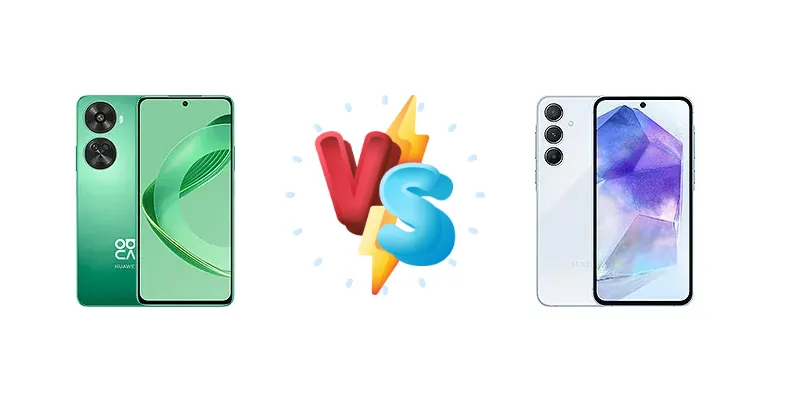
The mid-range smartphone market is fiercely competitive, and the Huawei nova 12 SE and Samsung Galaxy A55 represent compelling options. The nova 12 SE focuses on rapid charging and a streamlined experience, while the Galaxy A55 prioritizes a brighter display and a more powerful, modern chipset. This comparison dives deep into the specifics to determine which device delivers the best value.
🏆 Quick Verdict
For the average user prioritizing sustained performance and a brighter, more visible display, the Samsung Galaxy A55 is the stronger choice. Its Exynos 1480 chipset, coupled with excellent battery life, offers a smoother experience than the Huawei nova 12 SE’s Snapdragon 680, despite the latter’s faster charging.
| Network |
|---|
| 2G bands | GSM 850 / 900 / 1800 / 1900 | GSM 850 / 900 / 1800 / 1900 |
| 3G bands | HSDPA 850 / 900 / 1900 / 2100 | HSDPA 850 / 900 / 1700(AWS) / 1900 / 2100 |
| 4G bands | 1, 3, 5, 7, 8, 20, 28, 34, 38, 40, 41 | 1, 2, 3, 4, 5, 7, 8, 12, 17, 20, 25, 26, 28, 32, 38, 40, 41, 66 |
| 5G bands | - | 1, 3, 5, 7, 8, 20, 28, 38, 40, 41, 66, 77, 78 SA/NSA/Sub6 |
| Speed | HSPA, LTE | HSPA, LTE, 5G |
| Technology | GSM / HSPA / LTE | GSM / HSPA / LTE / 5G |
| Launch |
|---|
| Announced | 2024, March 19 | 2024, March 11 |
| Status | Available. Released 2024, April 06 | Available. Released 2024, March 15 |
| Body |
|---|
| Build | - | Glass front (Gorilla Glass Victus+), glass back (Gorilla Glass), aluminum frame |
| Dimensions | 162.4 x 75.5 x 7.4 mm (6.39 x 2.97 x 0.29 in) | 161.1 x 77.4 x 8.2 mm (6.34 x 3.05 x 0.32 in) |
| SIM | · Nano-SIM· Nano-SIM + Nano-SIM | · Nano-SIM· Nano-SIM + eSIM· Nano-SIM + Nano-SIM· Nano-SIM + Nano-SIM + eSIM (max 2 at a time) |
| Weight | 186 g (6.56 oz) | 213 g (7.51 oz) |
| Display |
|---|
| Protection | - | Corning Gorilla Glass Victus+ |
| Resolution | 1080 x 2400 pixels, 20:9 ratio (~395 ppi density) | 1080 x 2340 pixels, 19.5:9 ratio (~390 ppi density) |
| Size | 6.67 inches, 107.4 cm2 (~87.6% screen-to-body ratio) | 6.6 inches, 106.9 cm2 (~85.8% screen-to-body ratio) |
| Type | OLED, 1B colors, 90Hz | Super AMOLED, 120Hz, HDR10+, 1000 nits (HBM) |
| Platform |
|---|
| CPU | Octa-core (4x2.4 GHz Cortex-A73 & 4x1.9 GHz Cortex-A53) | Octa-core (4x2.75 GHz Cortex-A78 & 4x2.0 GHz Cortex-A55) |
| Chipset | Qualcomm Snapdragon 680 4G (6 nm) | Exynos 1480 (4 nm) |
| GPU | Adreno 610 | Xclipse 530 |
| OS | EMUI 14, no Google Play Services | Android 14, up to 4 major Android upgrades, One UI 6.1 |
| Memory |
|---|
| Card slot | No | microSDXC (uses shared SIM slot) |
| Internal | 256GB 8GB RAM | 128GB 6GB RAM, 128GB 8GB RAM, 256GB 6GB RAM, 256GB 8GB RAM, 256GB 12GB RAM |
| Main Camera |
|---|
| Features | LED flash, HDR, panorama | LED flash, panorama, HDR |
| Triple | 108 MP, f/1.9, (wide), 1/1.67", 0.64µm, PDAF
8 MP, f/2.2, 112˚ (ultrawide)
2 MP (macro) | 50 MP, f/1.8, (wide), 1/1.56", 1.0µm, PDAF, OIS
12 MP, f/2.2, 123˚ (ultrawide), 1/3.06", 1.12µm
5 MP (macro) |
| Video | 1080p@30fps, gyro-EIS | 4K@30fps, 1080p@30/60fps, gyro-EIS |
| Selfie camera |
|---|
| Single | 32 MP, f/2.5, (wide) | 32 MP, f/2.2, 26mm (wide), 1/2.74", 0.8µm |
| Video | 1080p@30fps | 4K@30fps, 1080p@30/60fps |
| Sound |
|---|
| 35mm jack | No | No |
| Loudspeaker | Yes | Yes, with stereo speakers |
| Comms |
|---|
| Bluetooth | 5.0, A2DP, LE | 5.3, A2DP, LE |
| NFC | Yes | Yes (market/region dependent) |
| Positioning | GPS, GLONASS, GALILEO, BDS, QZSS | GPS, GALILEO, GLONASS, BDS, QZSS |
| Radio | No | No |
| USB | USB Type-C 2.0 | USB Type-C 2.0, OTG |
| WLAN | Wi-Fi 802.11 a/b/g/n/ac, dual-band | Wi-Fi 802.11 a/b/g/n/ac/6, dual-band, Wi-Fi Direct |
| Features |
|---|
| Sensors | Fingerprint (side-mounted), accelerometer, gyro, proximity, compass | Fingerprint (under display, optical), accelerometer, gyro, compass |
| Battery |
|---|
| Charging | 66W wired, 3-100% in 32 min
5W reverse wired | 25W wired |
| Type | Li-Po 4500 mAh | Li-Ion 5000 mAh |
| Misc |
|---|
| Colors | Green, Black | Iceblue, Lilac, Navy, Lemon |
| Models | BNE-LX1 | SM-A556V, SM-A556B, SM-A556B/DS, SM-A556E, SM-A556E/DS, SM-A5560 |
| Price | About 340 EUR | $ 324.99 / £ 251.50 / € 319.99 / ₹ 23,998 |
| SAR EU | - | 0.68 W/kg (head) 1.04 W/kg (body) |
Huawei nova 12 SE
- Extremely fast 66W charging
- Potentially lower price point
- Lightweight design (likely)
- Less powerful Snapdragon 680 chipset
- Likely lower display brightness
- Potentially limited software updates
Samsung Galaxy A55
- More powerful Exynos 1480 chipset
- Brighter and more vibrant display
- Excellent battery life (13:27h active use)
- Slower 25W charging
- Potentially higher price
- Samsung’s One UI can be resource intensive
Display Comparison
The Samsung Galaxy A55 boasts a significantly brighter display, reaching a measured 1010 nits. This is crucial for outdoor visibility, a clear advantage over the nova 12 SE, which lacks published brightness data but is expected to be lower given its chipset and price point. While both likely utilize AMOLED panels for vibrant colors, the A55’s higher peak brightness and potentially superior color calibration (based on Samsung’s display expertise) provide a more premium viewing experience. The A55’s panel is also likely to have a higher refresh rate, contributing to smoother scrolling and animations.
Camera Comparison
Without detailed camera specs for the nova 12 SE, a direct comparison is limited. However, given the price difference, the Galaxy A55 likely features a more sophisticated camera system. The A55’s image processing benefits from Samsung’s extensive software optimization. While both phones likely include a standard, wide, and potentially ultrawide lens, the A55’s sensor size and aperture are likely larger, resulting in better low-light performance. The inclusion of Optical Image Stabilization (OIS) on the A55, if present, would further enhance image clarity and stability.
Performance
The core difference lies in the chipsets. The Samsung Galaxy A55’s Exynos 1480 (4nm) is a clear step up from the Huawei nova 12 SE’s Snapdragon 680 (6nm). The Exynos 1480 utilizes Cortex-A78 cores, offering significantly better single-core performance than the A73 cores in the Snapdragon 680. This translates to snappier app launches and smoother multitasking. The 4nm process node of the Exynos 1480 also contributes to improved thermal efficiency, reducing the likelihood of throttling during extended gaming sessions. While the Snapdragon 680 is adequate for basic tasks, the Exynos 1480 provides headroom for more demanding applications.
Battery Life
The Samsung Galaxy A55 demonstrates a clear advantage in battery endurance, achieving 13 hours and 27 minutes of active use. While the nova 12 SE’s battery capacity is unknown, its Snapdragon 680 chipset is less power-efficient than the Exynos 1480. The nova 12 SE compensates with a significantly faster 66W wired charging, reaching 100% in just 32 minutes, compared to the A55’s 25W charging. However, the A55’s superior battery life minimizes the need for frequent top-ups, making the faster charging less critical for most users.
Buying Guide
Buy the Huawei nova 12 SE if you absolutely prioritize the fastest possible charging speeds and a lighter price tag, and your usage is primarily focused on social media, messaging, and light web browsing. Buy the Samsung Galaxy A55 if you value a brighter, more vibrant display, longer-lasting battery life for demanding tasks, and a more capable processor for gaming and multitasking.
Frequently Asked Questions
❓ Does the Exynos 1480 in the Galaxy A55 tend to overheat during prolonged gaming sessions?
The Exynos 1480’s 4nm process node and Samsung’s thermal management solutions are designed to mitigate overheating. While some warmth is expected during intensive gaming, the A55 is unlikely to experience significant throttling, offering sustained performance for longer periods compared to the Snapdragon 680.
❓ Is the 66W charging on the Huawei nova 12 SE truly as fast as advertised, and does it impact battery health over time?
Huawei claims a 3-100% charge in 32 minutes with 66W charging. While this is exceptionally fast, consistently utilizing extremely fast charging *can* contribute to slightly faster battery degradation over the long term. However, modern battery management systems mitigate this effect, and the convenience of rapid charging often outweighs the minor impact on battery lifespan.
❓ How does the software experience differ between Samsung’s One UI and Huawei’s EMUI (or HarmonyOS)?
Samsung’s One UI is feature-rich and highly customizable, but can sometimes feel bloated. Huawei’s EMUI (or HarmonyOS, depending on the region) is generally more streamlined, but lacks the breadth of app compatibility due to the ongoing restrictions on Google Mobile Services. This means accessing popular apps like Gmail and YouTube requires workarounds.