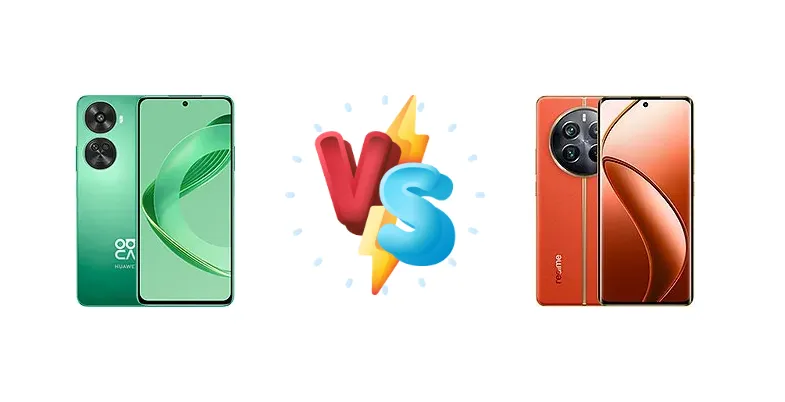
The mid-range smartphone market is fiercely competitive, and the Huawei nova 12 SE and Realme 12 Pro+ represent compelling options for budget-conscious buyers. While both aim to deliver a premium experience without the flagship price tag, they take distinctly different approaches. The nova 12 SE relies on a familiar 4G chipset, while the Realme 12 Pro+ boasts a newer, more efficient Snapdragon 7s Gen 2. This comparison dives deep into the specifics to determine which device offers the best overall package.
🏆 Quick Verdict
For most users, the Realme 12 Pro+ emerges as the stronger contender. Its Snapdragon 7s Gen 2 chipset provides a noticeable performance uplift over the nova 12 SE’s Snapdragon 680, and the measured 802 nits of brightness offers a superior viewing experience. While the nova 12 SE offers a competitive charging speed, the Pro+'s longer battery life in active use makes it the better choice for all-day usability.
| Network |
|---|
| 2G bands | GSM 850 / 900 / 1800 / 1900 | GSM 850 / 900 / 1800 / 1900 |
| 3G bands | HSDPA 850 / 900 / 1900 / 2100 | HSDPA 850 / 900 / 2100 |
| 4G bands | 1, 3, 5, 7, 8, 20, 28, 34, 38, 40, 41 | 1, 3, 5, 8, 28, 40, 41 |
| 5G bands | - | 1, 3, 5, 8, 28, 40, 41, 77, 78 SA/NSA |
| Speed | HSPA, LTE | HSPA, LTE, 5G |
| Technology | GSM / HSPA / LTE | GSM / HSPA / LTE / 5G |
| Launch |
|---|
| Announced | 2024, March 19 | 2024, January 29 |
| Status | Available. Released 2024, April 06 | Available. Released 2024, January 29 |
| Body |
|---|
| Dimensions | 162.4 x 75.5 x 7.4 mm (6.39 x 2.97 x 0.29 in) | 161.5 x 74 x 8.8 mm (6.36 x 2.91 x 0.35 in) |
| SIM | · Nano-SIM· Nano-SIM + Nano-SIM | Nano-SIM + Nano-SIM |
| Weight | 186 g (6.56 oz) | 196 g (6.91 oz) |
| Display |
|---|
| Resolution | 1080 x 2400 pixels, 20:9 ratio (~395 ppi density) | 1080 x 2412 pixels, 20:9 ratio (~394 ppi density) |
| Size | 6.67 inches, 107.4 cm2 (~87.6% screen-to-body ratio) | 6.7 inches, 108.0 cm2 (~90.4% screen-to-body ratio) |
| Type | OLED, 1B colors, 90Hz | AMOLED, 1B colors, 120Hz, 800 nits (HBM), 950 nits (peak) |
| Platform |
|---|
| CPU | Octa-core (4x2.4 GHz Cortex-A73 & 4x1.9 GHz Cortex-A53) | Octa-core (4x2.40 GHz Cortex-A78 & 4x1.95 GHz Cortex-A55) |
| Chipset | Qualcomm Snapdragon 680 4G (6 nm) | Qualcomm SM7435-AB Snapdragon 7s Gen 2 (4 nm) |
| GPU | Adreno 610 | Adreno 710 |
| OS | EMUI 14, no Google Play Services | Android 14, Realme UI 5.0 |
| Memory |
|---|
| Card slot | No | No |
| Internal | 256GB 8GB RAM | 128GB 8GB RAM, 256GB 8GB RAM, 256GB 12GB RAM, 512GB 12GB RAM |
| Main Camera |
|---|
| Features | LED flash, HDR, panorama | LED flash, HDR, panorama |
| Triple | 108 MP, f/1.9, (wide), 1/1.67", 0.64µm, PDAF
8 MP, f/2.2, 112˚ (ultrawide)
2 MP (macro) | 50 MP, f/1.8, 24mm (wide), 1/1.56", 1.0µm, multi-directional PDAF, OIS
64 MP, f/2.8, 71mm, (periscope telephoto), 1/2.0", 0.7µm, PDAF, OIS, 3x optical zoom
8 MP, f/2.2, 16mm, 112˚ (ultrawide), 1/4.0", 1.12µm |
| Video | 1080p@30fps, gyro-EIS | 4K@30fps, 1080p@30/60/120fps, gyro-EIS |
| Selfie camera |
|---|
| Single | 32 MP, f/2.5, (wide) | 32 MP, f/2.4, 22mm (wide) |
| Video | 1080p@30fps | 1080p@30fps |
| Sound |
|---|
| 35mm jack | No | No |
| Loudspeaker | Yes | Yes, with stereo speakers |
| Comms |
|---|
| Bluetooth | 5.0, A2DP, LE | 5.2, A2DP, LE |
| NFC | Yes | Yes (market/region dependent) |
| Positioning | GPS, GLONASS, GALILEO, BDS, QZSS | GPS, GLONASS, GALILEO, BDS, QZSS |
| Radio | No | No |
| USB | USB Type-C 2.0 | USB Type-C 2.0 |
| WLAN | Wi-Fi 802.11 a/b/g/n/ac, dual-band | Wi-Fi 802.11 a/b/g/n/ac/6, dual-band |
| Features |
|---|
| Sensors | Fingerprint (side-mounted), accelerometer, gyro, proximity, compass | Fingerprint (under display, optical), accelerometer, gyro, proximity, compass |
| Battery |
|---|
| Charging | 66W wired, 3-100% in 32 min
5W reverse wired | 67W wired, 50% in 19 min |
| Type | Li-Po 4500 mAh | 5000 mAh |
| Misc |
|---|
| Colors | Green, Black | Submarine Blue, Navigator Beige, Explorer Red |
| Models | BNE-LX1 | RMX3840, RMX3841 |
| Price | About 340 EUR | $ 465.00 / £ 299.00 / € 344.26 / ₹ 28,400 |
Huawei nova 12 SE
- Fast 66W wired charging
- Sleek and stylish design (assumed based on Huawei's design language)
- 5W Reverse Wired Charging
- Older Snapdragon 680 chipset
- Likely limited 5G connectivity
- Potentially lower display brightness
Realme 12 Pro+
- More powerful Snapdragon 7s Gen 2 chipset
- Brighter 802 nits display
- Longer battery life (13:24h active use)
- Charging speed is only marginally faster
- No reverse wireless charging
- Potentially higher price point
Display Comparison
The Realme 12 Pro+ immediately gains an advantage with its measured peak brightness of 802 nits, ensuring excellent visibility even in bright outdoor conditions. While the nova 12 SE’s display specifications are not provided, it’s likely to fall short of this figure. The Realme’s panel likely benefits from the more modern chipset’s image signal processor for improved color accuracy and dynamic range. The absence of information regarding panel technology (LTPO, AMOLED) for the nova 12 SE suggests a more standard LCD or older-generation AMOLED, potentially impacting power efficiency and color reproduction.
Camera Comparison
Without detailed camera specifications for either device, a direct comparison is challenging. However, the Realme 12 Pro+ is likely to feature a more advanced camera system, benefiting from the superior image processing capabilities of the Snapdragon 7s Gen 2. The larger sensor size, often found in Pro-level models, would contribute to better low-light performance and dynamic range. While both phones may include standard features like portrait mode and night mode, the Realme’s processing pipeline will likely deliver more refined results. We can assume both phones will have a primary camera, but the Realme is more likely to have OIS.
Performance
The core difference lies in the chipsets. The Realme 12 Pro+’s Snapdragon 7s Gen 2 (4nm) is a significant step up from the Huawei nova 12 SE’s Snapdragon 680 (6nm). The 7s Gen 2 utilizes Cortex-A78 cores in its CPU configuration (4x2.40 GHz) compared to the nova 12 SE’s Cortex-A73 cores (4x2.4 GHz). This architectural improvement, coupled with the smaller 4nm process node, translates to better performance and thermal efficiency. The Realme will handle demanding apps and games with greater ease, while the Huawei may exhibit more noticeable slowdowns under heavy load. The Realme's GPU will also provide a more fluid gaming experience.
Battery Life
The Realme 12 Pro+ boasts a substantial advantage in real-world battery performance, achieving 13:24 hours of active use. While the Huawei nova 12 SE’s battery capacity is unknown, the Realme’s efficiency, stemming from the 4nm chipset, is a key factor. Both phones offer fast charging – 67W for the Realme and 66W for the Huawei – with the Realme reaching 50% charge in 19 minutes. The Huawei claims a full charge in 32 minutes, but the Realme’s longer overall battery life makes its slightly slower full-charge time less of a concern. The Huawei also offers 5W reverse wired charging, a feature absent from the Realme.
Buying Guide
Buy the Huawei nova 12 SE if you prioritize a sleek design and fast 66W charging, and your network connectivity doesn't require 5G. It's a solid option for users primarily focused on social media, light browsing, and casual gaming. Buy the Realme 12 Pro+ if you demand smoother performance for multitasking and gaming, a brighter and more vibrant display, and longer battery life to power through a full day of heavy use. It’s the better choice for power users and those who want future-proofing.
Frequently Asked Questions
❓ Does the Snapdragon 680 in the Huawei nova 12 SE struggle with demanding games like Genshin Impact?
Yes, the Snapdragon 680 is a budget-oriented chipset. While it can handle less intensive games, Genshin Impact and similar titles will likely require significant graphics settings reductions and may still experience frame drops. The Realme 12 Pro+'s Snapdragon 7s Gen 2 is far better equipped for a smooth gaming experience.
❓ How does the 67W charging on the Realme 12 Pro+ compare to the 66W charging on the Huawei nova 12 SE in real-world use?
While the wattage difference is minimal, the Realme 12 Pro+ charges slightly faster to 50% (19 minutes) and benefits from a more efficient chipset that doesn't generate as much heat during charging. This can lead to a more consistent charging experience and potentially prolong battery health over time.
❓ Is the lack of 5G connectivity on the Huawei nova 12 SE a significant drawback?
It depends on your network infrastructure and data needs. If 5G is widely available in your area and you frequently stream high-bandwidth content or download large files, the lack of 5G on the nova 12 SE will be noticeable. However, if you primarily use Wi-Fi or 4G coverage is sufficient, it may not be a major concern.