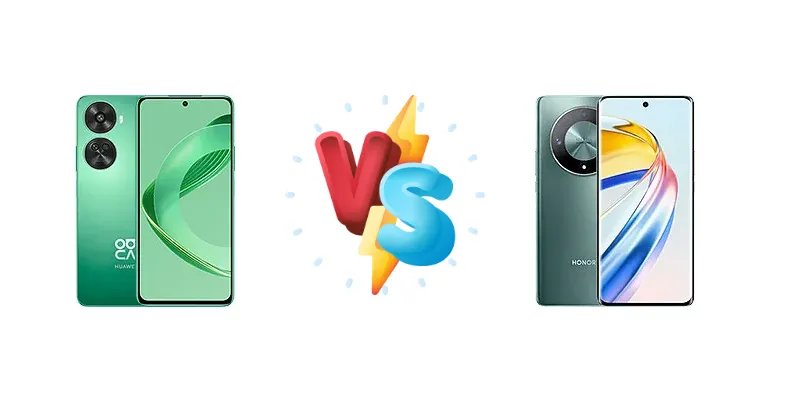
The Huawei nova 12 SE and Honor X9b represent compelling options in the crowded mid-range smartphone market. Both leverage Qualcomm Snapdragon chipsets, but diverge significantly in their implementation and overall feature set. This comparison dissects the key differences, focusing on performance, charging speed, and value to determine which device best suits your needs.
🏆 Quick Verdict
For the average user prioritizing sustained performance and future-proofing, the Honor X9b emerges as the stronger contender. Its Snapdragon 6 Gen 1, built on a more efficient 4nm process, delivers a noticeable performance uplift over the nova 12 SE’s Snapdragon 680, despite the latter’s faster 66W charging.
| Network |
|---|
| 2G bands | GSM 850 / 900 / 1800 / 1900 | GSM 850 / 900 / 1800 / 1900 |
| 3G bands | HSDPA 850 / 900 / 1900 / 2100 | HSDPA 850 / 900 / 1900 / 2100 |
| 4G bands | 1, 3, 5, 7, 8, 20, 28, 34, 38, 40, 41 | 1, 2, 3, 4, 5, 7, 8, 20, 28, 32, 38, 40, 41 |
| 5G bands | - | 1, 3, 7, 8, 20, 28, 38, 40, 41, 77, 78 SA/NSA |
| Speed | HSPA, LTE | HSPA, LTE, 5G |
| Technology | GSM / HSPA / LTE | GSM / HSPA / LTE / 5G |
| Launch |
|---|
| Announced | 2024, March 19 | 2023, October 18 |
| Status | Available. Released 2024, April 06 | Available. Released 2023, October |
| Body |
|---|
| Dimensions | 162.4 x 75.5 x 7.4 mm (6.39 x 2.97 x 0.29 in) | 163.6 x 75.5 x 8 mm (6.44 x 2.97 x 0.31 in) |
| SIM | · Nano-SIM· Nano-SIM + Nano-SIM | Nano-SIM + Nano-SIM |
| Weight | 186 g (6.56 oz) | 185 g (6.53 oz) |
| Display |
|---|
| Resolution | 1080 x 2400 pixels, 20:9 ratio (~395 ppi density) | 1220 x 2652 pixels, 19.5:9 ratio (~431 ppi density) |
| Size | 6.67 inches, 107.4 cm2 (~87.6% screen-to-body ratio) | 6.78 inches, 112.6 cm2 (~91.2% screen-to-body ratio) |
| Type | OLED, 1B colors, 90Hz | AMOLED, 1B colors, 120Hz, 1200 nits (peak) |
| Platform |
|---|
| CPU | Octa-core (4x2.4 GHz Cortex-A73 & 4x1.9 GHz Cortex-A53) | Octa-core (4x2.2 GHz Cortex-A78 & 4x1.8 GHz Cortex-A55) |
| Chipset | Qualcomm Snapdragon 680 4G (6 nm) | Qualcomm SM6450 Snapdragon 6 Gen 1 (4 nm) |
| GPU | Adreno 610 | Adreno 710 |
| OS | EMUI 14, no Google Play Services | Android 13, Magic OS 7.2 |
| Memory |
|---|
| Card slot | No | No |
| Internal | 256GB 8GB RAM | 256GB 8GB RAM, 256GB 12GB RAM, 512GB 8GB RAM, 512GB 12GB RAM |
| Main Camera |
|---|
| Features | LED flash, HDR, panorama | LED flash, panorama, HDR |
| Triple | 108 MP, f/1.9, (wide), 1/1.67", 0.64µm, PDAF
8 MP, f/2.2, 112˚ (ultrawide)
2 MP (macro) | 108 MP, f/1.8, (wide), 1/1.67", PDAF
5 MP, f/2.2, (ultrawide)
2 MP (macro) |
| Video | 1080p@30fps, gyro-EIS | 4K@30fps, 1080p@30fps |
| Selfie camera |
|---|
| Single | 32 MP, f/2.5, (wide) | 16 MP, f/2.5, (wide) |
| Video | 1080p@30fps | 1080p@30fps |
| Sound |
|---|
| 35mm jack | No | No |
| Loudspeaker | Yes | Yes |
| Comms |
|---|
| Bluetooth | 5.0, A2DP, LE | 5.1, A2DP, LE |
| Infrared port | - | Yes |
| NFC | Yes | Yes (market/region dependent) |
| Positioning | GPS, GLONASS, GALILEO, BDS, QZSS | GPS, GLONASS, GALILEO, BDS |
| Radio | No | No |
| USB | USB Type-C 2.0 | USB Type-C 2.0, OTG |
| WLAN | Wi-Fi 802.11 a/b/g/n/ac, dual-band | Wi-Fi 802.11 a/b/g/n/ac, dual-band, Wi-Fi Direct |
| Features |
|---|
| Sensors | Fingerprint (side-mounted), accelerometer, gyro, proximity, compass | Fingerprint (under display, optical), accelerometer, gyro, proximity, compass |
| Battery |
|---|
| Charging | 66W wired, 3-100% in 32 min
5W reverse wired | 35W wired
Reverse wired |
| Type | Li-Po 4500 mAh | Li-Po 5800 mAh |
| Misc |
|---|
| Colors | Green, Black | Sunrise Orange, Midnight Black, Emerald Green |
| Models | BNE-LX1 | ALI-NX1 |
| Price | About 340 EUR | About 970 EUR |
Huawei nova 12 SE
- Significantly faster 66W charging
- 5W reverse wired charging capability
- Potentially lower price point (depending on region)
- Less powerful Snapdragon 680 chipset
- Less efficient 6nm manufacturing process
- Potentially more throttling under sustained load
Honor X9b
- More powerful Snapdragon 6 Gen 1 chipset
- More efficient 4nm manufacturing process
- Improved CPU architecture for smoother performance
- Slower 35W charging
- No reverse wired charging
- Potentially higher price point
Display Comparison
Neither device boasts a standout display. While specific panel details (OLED vs LCD, peak brightness) are absent, the focus here is on processing power impacting UI smoothness. Both likely feature FHD+ resolution displays typical of this price bracket. The absence of high refresh rates on either device suggests a focus on battery life over visual fluidity.
Camera Comparison
Without detailed camera specs, a direct comparison is limited. However, the chipset’s ISP (Image Signal Processor) plays a crucial role. The Snapdragon 6 Gen 1’s ISP is more advanced, enabling better image processing, noise reduction, and potentially improved dynamic range. While both phones likely feature a multi-camera setup, the X9b’s chipset provides a foundation for superior image quality, particularly in challenging lighting conditions. We can assume both will have a primary camera, ultrawide, and potentially a macro lens, but the processing capabilities will differ.
Performance
The core difference lies in the chipsets. The Honor X9b’s Snapdragon 6 Gen 1 (4nm) represents a significant architectural leap over the nova 12 SE’s Snapdragon 680 (6nm). The 6 Gen 1 utilizes Cortex-A78 cores clocked at 2.2 GHz, offering substantially improved single-core and multi-core performance compared to the 680’s Cortex-A73 cores at 2.4 GHz. The 4nm process further enhances efficiency, translating to less heat generation and potentially reduced throttling during prolonged use. This benefits gamers and users running demanding applications. The X9b’s CPU architecture is more modern, leading to better instruction set efficiency.
Battery Life
The Huawei nova 12 SE’s 66W wired charging is a clear advantage, promising a 3-100% charge in just 32 minutes. The Honor X9b’s 35W charging is considerably slower. However, the Snapdragon 6 Gen 1’s superior efficiency may offset some of this difference in real-world usage. While battery capacity isn’t specified, the 6 Gen 1’s lower power draw could result in comparable or even better battery life despite potentially having a smaller battery cell. The nova 12 SE also offers 5W reverse wired charging, a feature absent on the X9b.
Buying Guide
Buy the Huawei nova 12 SE if you prioritize extremely fast charging and are primarily focused on everyday tasks like social media, calls, and light web browsing. The 66W charging is a significant advantage for those who frequently top up their phones. Buy the Honor X9b if you value smoother multitasking, better gaming performance, and a more efficient chipset that will likely hold up better over time. The Snapdragon 6 Gen 1 offers a more robust experience for demanding users.
Frequently Asked Questions
❓ Will the Snapdragon 6 Gen 1 in the Honor X9b handle demanding games like PUBG Mobile smoothly?
Yes, the Snapdragon 6 Gen 1 is capable of running PUBG Mobile at medium to high settings with stable frame rates. While it won't deliver a flagship gaming experience, it offers a noticeable improvement over the Snapdragon 680 in the nova 12 SE, particularly in sustained performance and reduced frame drops.
❓ How much faster is the 66W charging on the Huawei nova 12 SE compared to the 35W charging on the Honor X9b in real-world use?
The 66W charging on the nova 12 SE can fully charge the device in approximately 32 minutes. The 35W charging on the X9b will likely take over an hour and a half to reach 100%. This difference is significant for users who frequently need to quickly top up their battery.
❓ Does the Snapdragon 6 Gen 1 in the Honor X9b get noticeably warmer than the Snapdragon 680 in the Huawei nova 12 SE during extended gaming sessions?
While both chipsets will generate heat during gaming, the Snapdragon 6 Gen 1’s 4nm process is more efficient, meaning it will likely run cooler and experience less thermal throttling than the Snapdragon 680’s 6nm process. This translates to more consistent performance over longer gaming sessions.