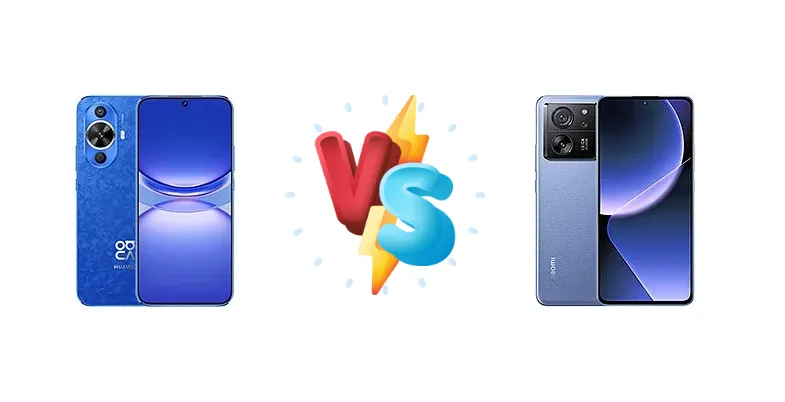
The Huawei nova 12 Lite and Xiaomi 13T Pro represent compelling options in the increasingly competitive mid-range smartphone market. The nova 12 Lite aims for a balance of style and functionality, while the 13T Pro aggressively targets performance with flagship-level silicon. This comparison dissects their key differences to determine which device best suits your needs.
🏆 Quick Verdict
For most users, the Xiaomi 13T Pro is the superior choice. Its Mediatek Dimensity 9200+ chipset delivers significantly faster performance, coupled with blazing-fast 120W charging and excellent battery endurance. While the nova 12 Lite offers a more streamlined experience, it can't match the 13T Pro's raw power.
| Network |
|---|
| 2G bands | GSM 850 / 900 / 1800 / 1900 | GSM 850 / 900 / 1800 / 1900 |
| 3G bands | HSDPA 800 / 850 / 900 / 1700(AWS) / 1900 / 2100 | HSDPA 800 / 850 / 900 / 1700(AWS) / 1900 / 2100 |
| 4G bands | LTE | 1, 2, 3, 4, 5, 7, 8, 12, 13, 17, 18, 19, 20, 25, 26, 28, 32, 38, 39, 40, 41, 42, 48, 66 |
| 5G bands | - | 1, 3, 5, 7, 8, 20, 28, 38, 40, 41, 66, 75, 77, 78 SA/NSA |
| Speed | HSPA, LTE | HSPA, LTE, 5G |
| Technology | GSM / CDMA / HSPA / CDMA2000 / LTE | GSM / HSPA / LTE / 5G |
| Launch |
|---|
| Announced | 2023, December 26 | 2023, September 26 |
| Status | Available. Released 2024, January 05 | Available. Released 2023, September 26 |
| Body |
|---|
| Build | - | Glass front (Gorilla Glass 5), glass back or silicone polymer back, plastic frame |
| Dimensions | 161.3 x 75 x 6.9 mm (6.35 x 2.95 x 0.27 in) | 162.2 x 75.7 x 8.5 mm (6.39 x 2.98 x 0.33 in) |
| SIM | · Nano-SIM· Nano-SIM + Nano-SIM | · Nano-SIM + eSIM· Nano-SIM + Nano-SIM |
| Weight | 168 g (5.93 oz) | 200 g or 206 g (7.05 oz) |
| Display |
|---|
| Protection | - | Corning Gorilla Glass 5 |
| Resolution | 1084 x 2412 pixels, 20:9 ratio (~395 ppi density) | 1220 x 2712 pixels, 20:9 ratio (~446 ppi density) |
| Size | 6.7 inches, 108.3 cm2 (~89.5% screen-to-body ratio) | 6.67 inches, 107.4 cm2 (~87.5% screen-to-body ratio) |
| Type | OLED, 1B colors, HDR, 120Hz | AMOLED, 68B colors, 144Hz, Dolby Vision, HDR10+, 1200 nits (HBM), 2600 nits (peak) |
| Platform |
|---|
| CPU | Octa-core (4x2.4 GHz Kryo 670 & 4x1.8 GHz Kryo 670) | Octa-core (1x3.35 GHz Cortex-X3 & 3x3.0 GHz Cortex-A715 & 4x2.0 GHz Cortex-A510) |
| Chipset | Qualcomm SM7325 Snapdragon 778G 4G (6 nm) | Mediatek Dimensity 9200+ (4 nm) |
| GPU | Adreno 642L | Immortalis-G715 MC11 |
| OS | HarmonyOS 4.0 | Android 13, up to 4 major Android upgrades, HyperOS |
| Memory |
|---|
| Card slot | No | No |
| Internal | 256GB 8GB RAM, 512GB 8GB RAM | 256GB 12GB RAM, 512GB 12GB RAM, 1TB 16GB RAM |
| Main Camera |
|---|
| Dual | 50 MP, f/1.9, (wide), PDAF
8 MP, f/2.2, 112˚ (ultrawide), AF | - |
| Features | Laser AF, color spectrum sensor, LED flash, panorama, HDR | Leica lens, color spectrum sensor, LED flash, HDR, panorama |
| Triple | - | 50 MP, f/1.9, 24mm (wide), 1/1.28", 1.22µm, PDAF, OIS
50 MP, f/1.9, 50mm (telephoto), 1/2.88", 0.61µm, PDAF, 2x optical zoom
12 MP, f/2.2, 15mm (ultrawide), 1/3.06", 1.12µm |
| Video | 4K, 1080p, 720p@960fps | 8K@24fps, 4K@24/30/60fps, 4K/1080p@30fps HDR10+, 1080p@30/60/120/240fps; 10-bit LOG, gyro-EIS |
| Selfie camera |
|---|
| Features | HDR, panorama | HDR |
| Single | 60 MP, f/2.4, 17mm, 100˚ (ultrawide) | 20 MP, f/2.2, (wide), 0.8µm |
| Video | 4K@30fps, 1080p@30fps | 1080p@30fps, HDR10+ |
| Sound |
|---|
| 35mm jack | No | No |
| Loudspeaker | Yes | Yes, with stereo speakers |
| Comms |
|---|
| Bluetooth | 5.2, A2DP, LE | 5.4, A2DP, LE |
| Infrared port | - | Yes |
| NFC | Yes | Yes |
| Positioning | GPS (L1+L5), GLONASS, BDS (B1I+B1c+B2a), GALILEO (E1+E5a), QZSS (L1+L5), NavIC | GPS (L1+L5), GLONASS (G1), GALILEO (E1+E5a), NavIC (L5), BDS |
| Radio | No | No |
| USB | USB Type-C 2.0, OTG | USB Type-C 2.0, OTG |
| WLAN | Wi-Fi 802.11 a/b/g/n/ac/6, dual-band, Wi-Fi Direct | Wi-Fi 802.11 a/b/g/n/ac/6e/7, dual/tri-band (market/region dependent), Wi-Fi Direct |
| Features |
|---|
| Sensors | Fingerprint (under display, optical), accelerometer, gyro, compass | Fingerprint (under display, optical), accelerometer, gyro, proximity, compass |
| Battery |
|---|
| Charging | 66W wired, 3-60% in 31 min
5W reverse wired | 120W wired, PD3.0, QC4, 100% in 19 min |
| Type | 4500 mAh | Li-Po 5000 mAh |
| Misc |
|---|
| Colors | Black, Blue, White | Alpine Blue, Meadow Green, Black |
| Models | FIN-AL60, FIN-AL60a | 23078PND5G |
| Price | About 320 EUR | $ 370.00 / £ 482.55 / € 301.99 |
| SAR EU | - | 1.00 W/kg (head) 0.99 W/kg (body) |
Huawei nova 12 Lite
- Sleek and lightweight design
- Potentially strong selfie camera (based on Huawei's reputation)
- 66W fast charging is still respectable
- 4G connectivity limits data speeds
- Significantly less powerful chipset than the 13T Pro
- Likely inferior camera performance compared to the 13T Pro
Xiaomi 13T Pro
- Flagship-level performance with Dimensity 9200+
- Blazing-fast 120W charging
- Excellent battery life and endurance
- May be larger and heavier than the nova 12 Lite
- Potentially higher price point
- Software experience may not appeal to all users
Display Comparison
The Xiaomi 13T Pro boasts a significantly brighter display, reaching a measured peak of 1094 nits, compared to an unspecified brightness for the nova 12 Lite. This higher brightness translates to better visibility outdoors. While both likely utilize OLED panels, the 13T Pro’s superior brightness and potential for higher refresh rates (not specified for either) provide a more immersive viewing experience. The absence of LTPO technology in either device suggests both will rely on adaptive refresh rates to conserve battery, but the 13T Pro’s panel is likely more advanced.
Camera Comparison
While both phones likely feature multi-camera systems, the Xiaomi 13T Pro is expected to have a more sophisticated setup. The context data doesn't provide specific sensor details for either device, but Xiaomi typically prioritizes camera performance in its 'T' series. The 13T Pro likely features a larger main sensor and more advanced image processing algorithms. The nova 12 Lite may focus on selfie capabilities, a common strength of Huawei phones, but the 13T Pro’s overall camera system is likely more versatile and capable in various lighting conditions. We can assume both will have a standard wide, ultrawide, and potentially macro lens, but the quality will differ significantly.
Performance
The performance gap between these devices is substantial. The Xiaomi 13T Pro’s Mediatek Dimensity 9200+ (4nm) is a flagship-grade chipset featuring a Cortex-X3 prime core clocked at 3.35 GHz, vastly outperforming the Huawei nova 12 Lite’s Qualcomm Snapdragon 778G 4G (6nm). The Dimensity 9200+’s more efficient 4nm process also contributes to better thermal management. The Snapdragon 778G is still capable for everyday tasks, but will struggle with demanding games and applications. The 13T Pro’s superior CPU and GPU architecture will deliver a smoother, more responsive experience.
Battery Life
The Xiaomi 13T Pro excels in battery performance and charging speed. Its 120W wired charging, supporting PD3.0 and QC4, can fully charge the device in just 19 minutes. In contrast, the nova 12 Lite’s 66W charging takes 31 minutes to reach 30-60% charge. The 13T Pro also boasts an impressive active use battery score of 11:50h and an endurance rating of 102h, indicating significantly longer battery life than the nova 12 Lite, despite the battery capacity being unspecified for both.
Buying Guide
Buy the Huawei nova 12 Lite if you prioritize a lighter, more compact design and are comfortable with 4G connectivity. It’s a good fit for users who primarily use social media, messaging, and light web browsing. Buy the Xiaomi 13T Pro if you demand top-tier performance for gaming, content creation, or multitasking, and value incredibly fast charging and long battery life. It’s the clear choice for power users.
Frequently Asked Questions
❓ Does the Snapdragon 778G in the nova 12 Lite struggle with graphically intensive games like Genshin Impact?
Yes, the Snapdragon 778G is a capable mid-range chip, but it will likely require significant graphics settings reductions to achieve playable frame rates in demanding titles like Genshin Impact. Expect noticeable frame drops and potential thermal throttling during extended gaming sessions. The Dimensity 9200+ in the 13T Pro handles these games with ease at high settings.
❓ Is the 120W charging on the Xiaomi 13T Pro safe for long-term battery health?
Xiaomi incorporates multiple safety mechanisms into its 120W charging system to protect battery health. While fast charging generates more heat, the 13T Pro’s charging circuitry and software algorithms are designed to minimize battery degradation. However, consistently using the fastest charging speeds *may* slightly accelerate battery aging over several years compared to slower charging methods.
❓ Given the nova 12 Lite only supports 4G, how much of a real-world impact will that have on data speeds?
The impact of 4G-only connectivity will be significant, especially in areas with strong 5G coverage. Download and upload speeds will be considerably slower on the nova 12 Lite compared to the 13T Pro. Streaming high-resolution video, downloading large files, and online gaming will all be noticeably slower and potentially more prone to buffering.