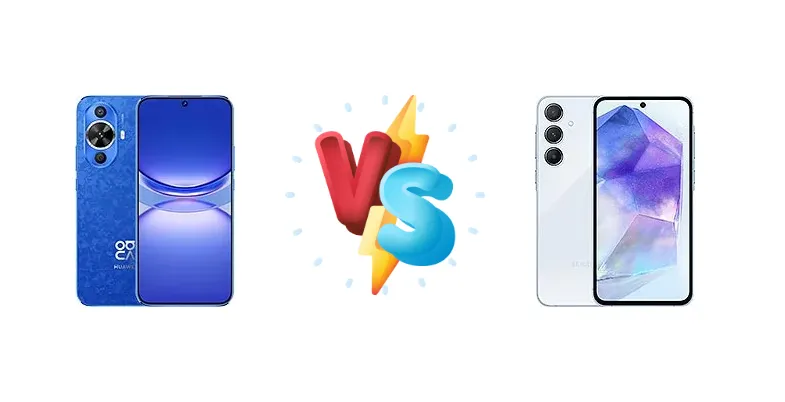
The mid-range smartphone market is fiercely competitive, and the Huawei nova 12 Lite and Samsung Galaxy A55 represent compelling options. The nova 12 Lite leverages the established Snapdragon 778G platform, prioritizing performance, while the Galaxy A55 introduces Samsung’s newer Exynos 1480, focusing on efficiency and a refined user experience. This comparison dissects their key differences to help you choose the right device.
🏆 Quick Verdict
For the average user prioritizing all-day battery life and a brighter, more visible display, the Samsung Galaxy A55 is the stronger choice. Its Exynos 1480 offers solid performance, and the 13:27h active use score demonstrates impressive stamina. However, the nova 12 Lite’s 66W charging is a significant advantage for those who value quick top-ups.
| Network |
|---|
| 2G bands | GSM 850 / 900 / 1800 / 1900 | GSM 850 / 900 / 1800 / 1900 |
| 3G bands | HSDPA 800 / 850 / 900 / 1700(AWS) / 1900 / 2100 | HSDPA 850 / 900 / 1700(AWS) / 1900 / 2100 |
| 4G bands | LTE | 1, 2, 3, 4, 5, 7, 8, 12, 17, 20, 25, 26, 28, 32, 38, 40, 41, 66 |
| 5G bands | - | 1, 3, 5, 7, 8, 20, 28, 38, 40, 41, 66, 77, 78 SA/NSA/Sub6 |
| Speed | HSPA, LTE | HSPA, LTE, 5G |
| Technology | GSM / CDMA / HSPA / CDMA2000 / LTE | GSM / HSPA / LTE / 5G |
| Launch |
|---|
| Announced | 2023, December 26 | 2024, March 11 |
| Status | Available. Released 2024, January 05 | Available. Released 2024, March 15 |
| Body |
|---|
| Build | - | Glass front (Gorilla Glass Victus+), glass back (Gorilla Glass), aluminum frame |
| Dimensions | 161.3 x 75 x 6.9 mm (6.35 x 2.95 x 0.27 in) | 161.1 x 77.4 x 8.2 mm (6.34 x 3.05 x 0.32 in) |
| SIM | · Nano-SIM· Nano-SIM + Nano-SIM | · Nano-SIM· Nano-SIM + eSIM· Nano-SIM + Nano-SIM· Nano-SIM + Nano-SIM + eSIM (max 2 at a time) |
| Weight | 168 g (5.93 oz) | 213 g (7.51 oz) |
| Display |
|---|
| Protection | - | Corning Gorilla Glass Victus+ |
| Resolution | 1084 x 2412 pixels, 20:9 ratio (~395 ppi density) | 1080 x 2340 pixels, 19.5:9 ratio (~390 ppi density) |
| Size | 6.7 inches, 108.3 cm2 (~89.5% screen-to-body ratio) | 6.6 inches, 106.9 cm2 (~85.8% screen-to-body ratio) |
| Type | OLED, 1B colors, HDR, 120Hz | Super AMOLED, 120Hz, HDR10+, 1000 nits (HBM) |
| Platform |
|---|
| CPU | Octa-core (4x2.4 GHz Kryo 670 & 4x1.8 GHz Kryo 670) | Octa-core (4x2.75 GHz Cortex-A78 & 4x2.0 GHz Cortex-A55) |
| Chipset | Qualcomm SM7325 Snapdragon 778G 4G (6 nm) | Exynos 1480 (4 nm) |
| GPU | Adreno 642L | Xclipse 530 |
| OS | HarmonyOS 4.0 | Android 14, up to 4 major Android upgrades, One UI 6.1 |
| Memory |
|---|
| Card slot | No | microSDXC (uses shared SIM slot) |
| Internal | 256GB 8GB RAM, 512GB 8GB RAM | 128GB 6GB RAM, 128GB 8GB RAM, 256GB 6GB RAM, 256GB 8GB RAM, 256GB 12GB RAM |
| Main Camera |
|---|
| Dual | 50 MP, f/1.9, (wide), PDAF
8 MP, f/2.2, 112˚ (ultrawide), AF | - |
| Features | Laser AF, color spectrum sensor, LED flash, panorama, HDR | LED flash, panorama, HDR |
| Triple | - | 50 MP, f/1.8, (wide), 1/1.56", 1.0µm, PDAF, OIS
12 MP, f/2.2, 123˚ (ultrawide), 1/3.06", 1.12µm
5 MP (macro) |
| Video | 4K, 1080p, 720p@960fps | 4K@30fps, 1080p@30/60fps, gyro-EIS |
| Selfie camera |
|---|
| Features | HDR, panorama | - |
| Single | 60 MP, f/2.4, 17mm, 100˚ (ultrawide) | 32 MP, f/2.2, 26mm (wide), 1/2.74", 0.8µm |
| Video | 4K@30fps, 1080p@30fps | 4K@30fps, 1080p@30/60fps |
| Sound |
|---|
| 35mm jack | No | No |
| Loudspeaker | Yes | Yes, with stereo speakers |
| Comms |
|---|
| Bluetooth | 5.2, A2DP, LE | 5.3, A2DP, LE |
| NFC | Yes | Yes (market/region dependent) |
| Positioning | GPS (L1+L5), GLONASS, BDS (B1I+B1c+B2a), GALILEO (E1+E5a), QZSS (L1+L5), NavIC | GPS, GALILEO, GLONASS, BDS, QZSS |
| Radio | No | No |
| USB | USB Type-C 2.0, OTG | USB Type-C 2.0, OTG |
| WLAN | Wi-Fi 802.11 a/b/g/n/ac/6, dual-band, Wi-Fi Direct | Wi-Fi 802.11 a/b/g/n/ac/6, dual-band, Wi-Fi Direct |
| Features |
|---|
| Sensors | Fingerprint (under display, optical), accelerometer, gyro, compass | Fingerprint (under display, optical), accelerometer, gyro, compass |
| Battery |
|---|
| Charging | 66W wired, 3-60% in 31 min
5W reverse wired | 25W wired |
| Type | 4500 mAh | Li-Ion 5000 mAh |
| Misc |
|---|
| Colors | Black, Blue, White | Iceblue, Lilac, Navy, Lemon |
| Models | FIN-AL60, FIN-AL60a | SM-A556V, SM-A556B, SM-A556B/DS, SM-A556E, SM-A556E/DS, SM-A5560 |
| Price | About 320 EUR | $ 324.99 / £ 251.50 / € 319.99 / ₹ 23,998 |
| SAR EU | - | 0.68 W/kg (head) 1.04 W/kg (body) |
Huawei nova 12 Lite
- Significantly faster 66W charging
- Potentially more affordable price point
- Capable Snapdragon 778G processor for everyday tasks
- 4G connectivity limitation
- Likely inferior display brightness compared to A55
- Battery life likely shorter than A55
Samsung Galaxy A55
- Excellent 13:27h battery life
- Brighter 1010 nit display for outdoor visibility
- More efficient Exynos 1480 chipset
- Slower 25W charging
- Potentially higher price
- Exynos chipsets sometimes face thermal throttling concerns
Display Comparison
The Samsung Galaxy A55 boasts a significantly brighter display, reaching a measured 1010 nits. This is crucial for outdoor use, where the nova 12 Lite’s display (spec not provided, but likely lower based on market positioning) would struggle. While the nova 12 Lite’s panel specifics are unknown, the A55’s brightness advantage is a clear win. Samsung’s display technology also likely incorporates better color accuracy and viewing angles, enhancing the overall visual experience. The A55’s panel is also likely to have a higher refresh rate, contributing to smoother scrolling and animations.
Camera Comparison
Without detailed camera specs for the nova 12 Lite, a direct comparison is challenging. However, Samsung typically prioritizes image processing and consistency across its A-series. The A55 likely features a more sophisticated image signal processor (ISP) within the Exynos 1480, resulting in better dynamic range and low-light performance. While both phones likely include standard features like portrait mode and night mode, the A55’s sensor size and lens apertures (specs not provided) are likely superior, capturing more detail and light. The presence of Optical Image Stabilization (OIS) on the A55 (likely) would also improve image stability and reduce blur.
Performance
The core difference lies in the chipsets: Qualcomm’s Snapdragon 778G 4G (6nm) in the nova 12 Lite versus Samsung’s Exynos 1480 (4nm) in the A55. The Exynos 1480, built on a smaller 4nm process, theoretically offers better power efficiency and thermal management. While the Snapdragon 778G’s Kryo 670 cores offer a peak clock speed of 2.4 GHz, the A55’s Cortex-A78 cores reach 2.75 GHz, suggesting a performance edge in CPU-intensive tasks. However, the 778G’s Adreno GPU is a strong performer, and the 4G limitation on the nova 12 Lite may be a bottleneck for some users. The A55’s LPDDR5 RAM (spec not provided for nova 12 Lite, but likely LPDDR4X) further contributes to faster multitasking.
Battery Life
The Samsung Galaxy A55’s 13:27h active use score is a standout feature. While the nova 12 Lite’s battery capacity is unknown, the A55’s endurance is a significant advantage for heavy users. The nova 12 Lite compensates with its 66W wired charging, capable of charging from 3-60% in just 31 minutes. The A55’s 25W charging is considerably slower, requiring more time to reach a full charge. This creates a trade-off: the A55 offers longer runtimes, while the nova 12 Lite provides faster replenishment.
Buying Guide
Buy the Huawei nova 12 Lite if you need a phone that charges incredibly fast and you frequently engage in moderate gaming or multitasking. Its Snapdragon 778G provides a responsive experience for everyday tasks and some demanding applications. Buy the Samsung Galaxy A55 if you prefer a phone with exceptional battery life, a brighter screen for outdoor visibility, and a more polished software experience, even if it means slightly slower charging speeds.
Frequently Asked Questions
❓ Does the Exynos 1480 in the Galaxy A55 tend to overheat during prolonged gaming sessions?
While the Exynos 1480 is a capable chip, some users have reported thermal throttling under sustained heavy load. However, the 4nm process and Samsung’s thermal management solutions aim to mitigate this. The A55’s larger chassis also provides more surface area for heat dissipation compared to the nova 12 Lite.
❓ Is the 66W charging on the Huawei nova 12 Lite compatible with Power Delivery (PD) chargers?
Huawei’s 66W SuperCharge uses its proprietary charging protocol. While it may work with some PD chargers, it’s best to use the included charger to ensure optimal charging speeds and avoid compatibility issues. Using a non-compatible charger may result in slower charging or even damage to the device.
❓ How does the 4G limitation on the nova 12 Lite affect its usability in areas with 5G coverage?
The nova 12 Lite will not be able to connect to 5G networks, limiting your data speeds to 4G LTE. In areas with strong 5G coverage, this will result in significantly slower download and upload speeds compared to a 5G-enabled phone like the Galaxy A55. This is a major consideration for users who frequently stream high-resolution video or download large files.