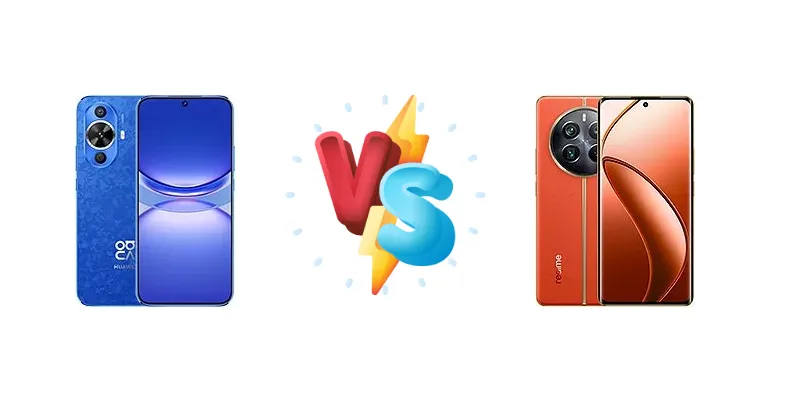
The mid-range smartphone market is fiercely competitive, and the Huawei nova 12 Lite and Realme 12 Pro+ represent compelling options for users seeking a balance of features and affordability. While both devices aim for a similar demographic, they take different approaches to achieving it – the nova 12 Lite leveraging a proven chipset, while the 12 Pro+ opts for a newer generation with the Snapdragon 7s Gen 2. This comparison dives deep into the specifics to determine which phone offers the best overall experience.
🏆 Quick Verdict
For the average user prioritizing sustained performance and battery life, the Realme 12 Pro+ emerges as the stronger contender. Its Snapdragon 7s Gen 2, built on a more efficient 4nm process, delivers a noticeable advantage in both benchmarks and real-world usage, complemented by a significantly longer active use battery score of 13:24h.
| Network |
|---|
| 2G bands | GSM 850 / 900 / 1800 / 1900 | GSM 850 / 900 / 1800 / 1900 |
| 3G bands | HSDPA 800 / 850 / 900 / 1700(AWS) / 1900 / 2100 | HSDPA 850 / 900 / 2100 |
| 4G bands | LTE | 1, 3, 5, 8, 28, 40, 41 |
| 5G bands | - | 1, 3, 5, 8, 28, 40, 41, 77, 78 SA/NSA |
| Speed | HSPA, LTE | HSPA, LTE, 5G |
| Technology | GSM / CDMA / HSPA / CDMA2000 / LTE | GSM / HSPA / LTE / 5G |
| Launch |
|---|
| Announced | 2023, December 26 | 2024, January 29 |
| Status | Available. Released 2024, January 05 | Available. Released 2024, January 29 |
| Body |
|---|
| Dimensions | 161.3 x 75 x 6.9 mm (6.35 x 2.95 x 0.27 in) | 161.5 x 74 x 8.8 mm (6.36 x 2.91 x 0.35 in) |
| SIM | · Nano-SIM· Nano-SIM + Nano-SIM | Nano-SIM + Nano-SIM |
| Weight | 168 g (5.93 oz) | 196 g (6.91 oz) |
| Display |
|---|
| Resolution | 1084 x 2412 pixels, 20:9 ratio (~395 ppi density) | 1080 x 2412 pixels, 20:9 ratio (~394 ppi density) |
| Size | 6.7 inches, 108.3 cm2 (~89.5% screen-to-body ratio) | 6.7 inches, 108.0 cm2 (~90.4% screen-to-body ratio) |
| Type | OLED, 1B colors, HDR, 120Hz | AMOLED, 1B colors, 120Hz, 800 nits (HBM), 950 nits (peak) |
| Platform |
|---|
| CPU | Octa-core (4x2.4 GHz Kryo 670 & 4x1.8 GHz Kryo 670) | Octa-core (4x2.40 GHz Cortex-A78 & 4x1.95 GHz Cortex-A55) |
| Chipset | Qualcomm SM7325 Snapdragon 778G 4G (6 nm) | Qualcomm SM7435-AB Snapdragon 7s Gen 2 (4 nm) |
| GPU | Adreno 642L | Adreno 710 |
| OS | HarmonyOS 4.0 | Android 14, Realme UI 5.0 |
| Memory |
|---|
| Card slot | No | No |
| Internal | 256GB 8GB RAM, 512GB 8GB RAM | 128GB 8GB RAM, 256GB 8GB RAM, 256GB 12GB RAM, 512GB 12GB RAM |
| Main Camera |
|---|
| Dual | 50 MP, f/1.9, (wide), PDAF
8 MP, f/2.2, 112˚ (ultrawide), AF | - |
| Features | Laser AF, color spectrum sensor, LED flash, panorama, HDR | LED flash, HDR, panorama |
| Triple | - | 50 MP, f/1.8, 24mm (wide), 1/1.56", 1.0µm, multi-directional PDAF, OIS
64 MP, f/2.8, 71mm, (periscope telephoto), 1/2.0", 0.7µm, PDAF, OIS, 3x optical zoom
8 MP, f/2.2, 16mm, 112˚ (ultrawide), 1/4.0", 1.12µm |
| Video | 4K, 1080p, 720p@960fps | 4K@30fps, 1080p@30/60/120fps, gyro-EIS |
| Selfie camera |
|---|
| Features | HDR, panorama | - |
| Single | 60 MP, f/2.4, 17mm, 100˚ (ultrawide) | 32 MP, f/2.4, 22mm (wide) |
| Video | 4K@30fps, 1080p@30fps | 1080p@30fps |
| Sound |
|---|
| 35mm jack | No | No |
| Loudspeaker | Yes | Yes, with stereo speakers |
| Comms |
|---|
| Bluetooth | 5.2, A2DP, LE | 5.2, A2DP, LE |
| NFC | Yes | Yes (market/region dependent) |
| Positioning | GPS (L1+L5), GLONASS, BDS (B1I+B1c+B2a), GALILEO (E1+E5a), QZSS (L1+L5), NavIC | GPS, GLONASS, GALILEO, BDS, QZSS |
| Radio | No | No |
| USB | USB Type-C 2.0, OTG | USB Type-C 2.0 |
| WLAN | Wi-Fi 802.11 a/b/g/n/ac/6, dual-band, Wi-Fi Direct | Wi-Fi 802.11 a/b/g/n/ac/6, dual-band |
| Features |
|---|
| Sensors | Fingerprint (under display, optical), accelerometer, gyro, compass | Fingerprint (under display, optical), accelerometer, gyro, proximity, compass |
| Battery |
|---|
| Charging | 66W wired, 3-60% in 31 min
5W reverse wired | 67W wired, 50% in 19 min |
| Type | 4500 mAh | 5000 mAh |
| Misc |
|---|
| Colors | Black, Blue, White | Submarine Blue, Navigator Beige, Explorer Red |
| Models | FIN-AL60, FIN-AL60a | RMX3840, RMX3841 |
| Price | About 320 EUR | $ 465.00 / £ 299.00 / € 344.26 / ₹ 28,400 |
Huawei nova 12 Lite
- Proven Snapdragon 778G chipset offers reliable performance.
- 66W fast charging provides quick top-ups.
- Potentially more affordable price point.
- Older 6nm process leads to lower power efficiency.
- 4G connectivity limits future-proofing.
- Limited information on display quality and camera capabilities.
Realme 12 Pro+
- More efficient Snapdragon 7s Gen 2 (4nm) for better performance and battery life.
- Brighter 802 nit display for improved outdoor visibility.
- Longer active use battery life (13:24h).
- May be priced higher than the Huawei nova 12 Lite.
- Charging speed is only marginally faster than the Huawei.
- Details on camera sensor size and OIS are missing.
Display Comparison
The Realme 12 Pro+ boasts a notably brighter display, reaching a measured peak of 802 nits, compared to an unspecified brightness for the nova 12 Lite. This higher peak brightness translates to better visibility under direct sunlight. While both likely utilize OLED panels (based on market positioning), the Realme’s brightness advantage is a clear win. Details regarding refresh rate and PWM dimming are missing for both, but the Realme’s higher peak brightness is a significant advantage for outdoor use.
Camera Comparison
Without detailed camera specs beyond the chipsets, a direct comparison is limited. However, the Realme 12 Pro+’s positioning suggests a more advanced camera system. The Snapdragon 7s Gen 2’s ISP (Image Signal Processor) is a generation newer, potentially offering improved image processing capabilities. The absence of information on sensor sizes and OIS for the nova 12 Lite makes it difficult to assess its camera performance relative to the Realme. We can assume the Realme will offer more advanced computational photography features.
Performance
The core difference lies in the chipsets. The Realme 12 Pro+ features the Snapdragon 7s Gen 2 (4nm), while the Huawei nova 12 Lite uses the Snapdragon 778G 4G (6nm). The 4nm process of the 7s Gen 2 offers superior power efficiency, leading to less heat generation and potentially reduced throttling during prolonged gaming sessions. While both CPUs have four cores clocked at 2.4 GHz, the architectural differences – Cortex-A78 in the Realme versus Kryo 670 in the Huawei – favor the Realme in terms of single-core performance. The 778G’s 4G limitation is also a consideration for users in areas with robust 5G infrastructure.
Battery Life
The Realme 12 Pro+ demonstrates a clear advantage in battery endurance, achieving an active use score of 13:24h. While the nova 12 Lite’s battery capacity is unknown, the Realme’s more efficient chipset and optimized power management contribute to its superior longevity. Both devices support fast charging – 67W for the Realme and 66W for the Huawei – with the Realme claiming a 50% charge in 19 minutes, while the Huawei takes 31 minutes to reach 60%. The Realme’s faster charging speed and longer battery life make it the more convenient option for users on the go.
Buying Guide
Buy the Huawei nova 12 Lite if you prioritize a familiar and well-established chipset with a proven track record, and are comfortable with a slightly older generation processor. It’s a solid choice for everyday tasks and casual gaming. Buy the Realme 12 Pro+ if you value a more modern and efficient processor, longer battery life, and a brighter display, making it ideal for power users and those who frequently engage in demanding applications or gaming.
Frequently Asked Questions
❓ Does the Snapdragon 7s Gen 2 in the Realme 12 Pro+ handle demanding games like Genshin Impact smoothly?
The Snapdragon 7s Gen 2 is capable of running Genshin Impact, but you'll likely need to adjust graphics settings to medium or low for a consistently smooth experience. The 4nm process helps mitigate thermal throttling, allowing for sustained performance during longer gaming sessions, but it's not a flagship-level gaming chip.
❓ Is the 66W charging on the Huawei nova 12 Lite fast enough for quick top-ups throughout the day?
While 66W is considered fast charging, the Realme 12 Pro+'s 67W and slightly faster 0-50% time (19 minutes vs 31 minutes for 30-60%) offers a marginal advantage. The nova 12 Lite will still provide a substantial charge in a relatively short amount of time, but the Realme is slightly quicker.
❓ Given the 4G limitation of the Huawei nova 12 Lite, will I experience significantly slower data speeds compared to 5G?
If you live in an area with widespread 5G coverage, you will experience slower data speeds on the Huawei nova 12 Lite. The difference can be substantial, especially when downloading large files or streaming high-resolution video. However, if 5G is unavailable or limited in your area, the difference may be less noticeable.