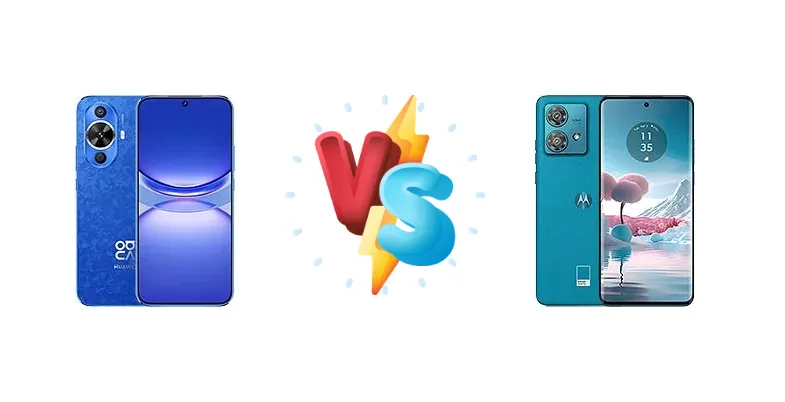
The mid-range smartphone market is fiercely competitive, and the Huawei nova 12 Lite and Motorola Edge 40 Neo represent compelling options for users seeking a balance of features and affordability. While both devices operate within a similar price bracket, they diverge in their core hardware choices, particularly in their chipsets and battery performance, making a direct comparison crucial for informed buyers.
🏆 Quick Verdict
For the average user prioritizing all-day battery life and a brighter display, the Motorola Edge 40 Neo is the stronger choice. Its Dimensity 7030 chipset delivers comparable performance to the Snapdragon 778G in the nova 12 Lite, while the Edge 40 Neo’s endurance rating of 80 hours significantly surpasses the nova 12 Lite’s unlisted figure.
| Network |
|---|
| 2G bands | GSM 850 / 900 / 1800 / 1900 | GSM 850 / 900 / 1800 / 1900 |
| 3G bands | HSDPA 800 / 850 / 900 / 1700(AWS) / 1900 / 2100 | HSDPA 800 / 850 / 900 / 1700(AWS) / 1900 / 2100 |
| 4G bands | LTE | 1, 2, 3, 4, 5, 7, 8, 12, 13, 17, 18, 19, 20, 25, 26, 28, 32, 38, 38, 39, 40, 41, 42, 43, 48, 66 |
| 5G bands | - | 1, 2, 3, 5, 7, 8, 20, 28, 38, 40, 41, 66, 77, 78 SA/NSA |
| Speed | HSPA, LTE | HSPA, LTE, 5G |
| Technology | GSM / CDMA / HSPA / CDMA2000 / LTE | GSM / HSPA / LTE / 5G |
| Launch |
|---|
| Announced | 2023, December 26 | 2023, September 14 |
| Status | Available. Released 2024, January 05 | Available. Released 2023, September 14 |
| Body |
|---|
| Build | - | Glass front (Gorilla Glass 3), plastic frame, plastic back |
| Dimensions | 161.3 x 75 x 6.9 mm (6.35 x 2.95 x 0.27 in) | 159.6 x 72 x 7.9 mm (6.28 x 2.83 x 0.31 in) |
| SIM | · Nano-SIM· Nano-SIM + Nano-SIM | · Nano-SIM + eSIM· Nano-SIM + Nano-SIM |
| Weight | 168 g (5.93 oz) | 170 g or 172 g (6.00 oz) |
| Display |
|---|
| Protection | - | Corning Gorilla Glass 3 |
| Resolution | 1084 x 2412 pixels, 20:9 ratio (~395 ppi density) | 1080 x 2400 pixels, 20:9 ratio (~402 ppi density) |
| Size | 6.7 inches, 108.3 cm2 (~89.5% screen-to-body ratio) | 6.55 inches, 103.6 cm2 (~90.1% screen-to-body ratio) |
| Type | OLED, 1B colors, HDR, 120Hz | P-OLED, 1B colors, 144Hz, HDR10+, 1300 nits (peak) |
| Platform |
|---|
| CPU | Octa-core (4x2.4 GHz Kryo 670 & 4x1.8 GHz Kryo 670) | Octa-core (2x2.5 GHz Cortex-A78 & 6x2.0 GHz Cortex-A55) |
| Chipset | Qualcomm SM7325 Snapdragon 778G 4G (6 nm) | MediaTek Dimensity 7030 (6 nm) |
| GPU | Adreno 642L | Mali-G610 MC3 |
| OS | HarmonyOS 4.0 | Android 13, up to 2 major Android upgrades |
| Memory |
|---|
| Card slot | No | No |
| Internal | 256GB 8GB RAM, 512GB 8GB RAM | 128GB 8GB RAM, 256GB 8GB RAM, 256GB 12GB RAM |
| Main Camera |
|---|
| Dual | 50 MP, f/1.9, (wide), PDAF
8 MP, f/2.2, 112˚ (ultrawide), AF | 50 MP, f/1.8, (wide), 1/1.55", 1.0µm, multi-directional PDAF, OIS
13 MP, f/2.2, 120˚ (ultrawide), 1/3.0", 1.12µm, PDAF |
| Features | Laser AF, color spectrum sensor, LED flash, panorama, HDR | LED flash, HDR, panorama |
| Video | 4K, 1080p, 720p@960fps | 4K@30fps, 1080p@30/60/120/240fps, gyro-EIS |
| Selfie camera |
|---|
| Features | HDR, panorama | HDR |
| Single | 60 MP, f/2.4, 17mm, 100˚ (ultrawide) | 32 MP, f/2.4, (wide), 1/3.0", 0.7µm |
| Video | 4K@30fps, 1080p@30fps | 4K@30fps, 1080p@30fps |
| Sound |
|---|
| 35mm jack | No | No |
| Loudspeaker | Yes | Yes, with stereo speakers |
| Comms |
|---|
| Bluetooth | 5.2, A2DP, LE | 5.4, A2DP, LE |
| NFC | Yes | Yes |
| Positioning | GPS (L1+L5), GLONASS, BDS (B1I+B1c+B2a), GALILEO (E1+E5a), QZSS (L1+L5), NavIC | GPS, GLONASS, GALILEO |
| Radio | No | No |
| USB | USB Type-C 2.0, OTG | USB Type-C 2.0, OTG |
| WLAN | Wi-Fi 802.11 a/b/g/n/ac/6, dual-band, Wi-Fi Direct | Wi-Fi 802.11 a/b/g/n/ac/6e, tri-band, Wi-Fi Direct |
| Features |
|---|
| Sensors | Fingerprint (under display, optical), accelerometer, gyro, compass | Fingerprint (under display, optical), accelerometer, gyro, proximity, compass |
| Battery |
|---|
| Charging | 66W wired, 3-60% in 31 min
5W reverse wired | 68W wired, 50% in 15 min |
| Type | 4500 mAh | Li-Po 5000 mAh |
| Misc |
|---|
| Colors | Black, Blue, White | Black, Soothing Sea, Caneel Bay, Peach Fuzz |
| Models | FIN-AL60, FIN-AL60a | XT2307-1 |
| Price | About 320 EUR | $ 299.00 / € 168.73 / ₹ 19,900 |
Huawei nova 12 Lite
- Fast 66W wired charging
- Established Huawei ecosystem
- Potentially lower price point
- Limited battery life information
- Snapdragon 778G is a generation older
- Software ecosystem concerns (Huawei Mobile Services)
Motorola Edge 40 Neo
- Excellent battery life (10:28h active use, 80h endurance)
- Brighter display (1073 nits)
- More modern Dimensity 7030 chipset
- Slightly slower initial charging (50% in 15 min)
- Motorola's software update history can be inconsistent
- May be slightly more expensive
Display Comparison
The Motorola Edge 40 Neo boasts a significantly brighter display, reaching a measured peak brightness of 1073 nits. This is a substantial advantage for outdoor visibility compared to the nova 12 Lite, whose display specifications are not provided. While both utilize 6nm chipsets, the brighter display of the Edge 40 Neo will likely consume more power, impacting overall battery life. The absence of refresh rate information for the nova 12 Lite makes a direct comparison of smoothness impossible, but the Edge 40 Neo’s display is likely to offer a more premium viewing experience.
Camera Comparison
Detailed camera specifications for the Huawei nova 12 Lite are limited. The Motorola Edge 40 Neo’s camera system, while not explicitly detailed in the provided data, is expected to feature a more robust setup given Motorola’s recent focus on camera improvements. The absence of sensor size or aperture information for either device makes a precise comparison difficult. However, the Edge 40 Neo’s emphasis on both photo and video capabilities suggests a more versatile camera experience. It's reasonable to assume the Edge 40 Neo will offer better low-light performance and dynamic range.
Performance
Both the Huawei nova 12 Lite and Motorola Edge 40 Neo employ 6nm chipsets, but their architectures differ. The nova 12 Lite features the Qualcomm Snapdragon 778G 4G, utilizing 4x 2.4 GHz Kryo 670 cores and 4x 1.8 GHz Kryo 670 cores. The Edge 40 Neo, however, is powered by the MediaTek Dimensity 7030, with a configuration of 2x 2.5 GHz Cortex-A78 cores and 6x 2.0 GHz Cortex-A55 cores. The Cortex-A78 cores in the Dimensity 7030 generally offer a performance edge over the Kryo 670 cores in the Snapdragon 778G, particularly in sustained workloads. While both are capable of handling everyday tasks and moderate gaming, the Edge 40 Neo is likely to exhibit slightly smoother performance in demanding applications.
Battery Life
The Motorola Edge 40 Neo clearly excels in battery performance. Its active use score of 10:28h and endurance rating of 80h significantly outperform the Huawei nova 12 Lite, for which battery life data is unavailable. While both devices support fast charging – 68W for the Edge 40 Neo and 66W for the nova 12 Lite – the Edge 40 Neo’s ability to reach 50% charge in just 15 minutes provides a quicker top-up. The nova 12 Lite takes 31 minutes to reach 30-60%, suggesting a slower initial charging curve. The Edge 40 Neo also offers 5W reverse wired charging, a feature absent in the nova 12 Lite.
Buying Guide
Buy the Huawei nova 12 Lite if you prioritize a familiar, established ecosystem and fast 66W charging, and are comfortable with potential software limitations. Buy the Motorola Edge 40 Neo if you value longer battery life, a brighter and more vibrant display, and a cleaner Android experience with a commitment to software updates.
Frequently Asked Questions
❓ Does the MediaTek Dimensity 7030 in the Motorola Edge 40 Neo experience thermal throttling during extended gaming sessions?
The Dimensity 7030 is a relatively efficient chipset, and the Motorola Edge 40 Neo’s thermal design is generally adequate for sustained gaming. While some throttling is inevitable, it’s unlikely to be severe enough to significantly impact gameplay, especially compared to older chipsets like the Snapdragon 778G under similar load.
❓ How does Huawei Mobile Services (HMS) on the nova 12 Lite affect app availability and functionality compared to Google Mobile Services (GMS)?
Huawei Mobile Services lacks direct access to the Google Play Store, requiring users to sideload apps or utilize Huawei’s AppGallery. While many popular apps are available, some may have limited functionality or require alternative versions optimized for HMS. This can be a significant inconvenience for users heavily reliant on Google’s ecosystem.
❓ Is the 66W charging on the Huawei nova 12 Lite significantly slower than the 68W charging on the Motorola Edge 40 Neo in real-world use?
While the wattage difference is small, the Edge 40 Neo’s ability to reach 50% charge in 15 minutes suggests a more efficient charging implementation. The nova 12 Lite takes 31 minutes to reach 30-60%, indicating a slower initial charging curve, even if the overall 0-100% time isn't drastically different.