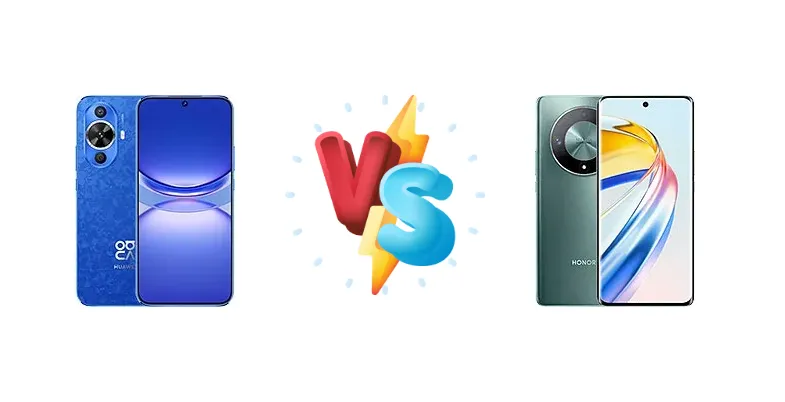
The Huawei nova 12 Lite and Honor X9b represent compelling options in the crowded mid-range smartphone market. While both aim for affordability, they diverge in their core processing power and charging capabilities. The nova 12 Lite leverages the established Snapdragon 778G 4G, while the X9b debuts with the newer, 4nm Snapdragon 6 Gen 1. This comparison dissects these key differences to determine which device delivers the best value for your money.
🏆 Quick Verdict
For users prioritizing sustained performance and faster charging, the Huawei nova 12 Lite emerges as the stronger choice. Its Snapdragon 778G, despite being a generation older, offers a noticeable performance edge, and the 66W charging significantly reduces downtime. However, the Honor X9b’s efficiency gains from the 4nm process are noteworthy.
| Network |
|---|
| 2G bands | GSM 850 / 900 / 1800 / 1900 | GSM 850 / 900 / 1800 / 1900 |
| 3G bands | HSDPA 800 / 850 / 900 / 1700(AWS) / 1900 / 2100 | HSDPA 850 / 900 / 1900 / 2100 |
| 4G bands | LTE | 1, 2, 3, 4, 5, 7, 8, 20, 28, 32, 38, 40, 41 |
| 5G bands | - | 1, 3, 7, 8, 20, 28, 38, 40, 41, 77, 78 SA/NSA |
| Speed | HSPA, LTE | HSPA, LTE, 5G |
| Technology | GSM / CDMA / HSPA / CDMA2000 / LTE | GSM / HSPA / LTE / 5G |
| Launch |
|---|
| Announced | 2023, December 26 | 2023, October 18 |
| Status | Available. Released 2024, January 05 | Available. Released 2023, October |
| Body |
|---|
| Dimensions | 161.3 x 75 x 6.9 mm (6.35 x 2.95 x 0.27 in) | 163.6 x 75.5 x 8 mm (6.44 x 2.97 x 0.31 in) |
| SIM | · Nano-SIM· Nano-SIM + Nano-SIM | Nano-SIM + Nano-SIM |
| Weight | 168 g (5.93 oz) | 185 g (6.53 oz) |
| Display |
|---|
| Resolution | 1084 x 2412 pixels, 20:9 ratio (~395 ppi density) | 1220 x 2652 pixels, 19.5:9 ratio (~431 ppi density) |
| Size | 6.7 inches, 108.3 cm2 (~89.5% screen-to-body ratio) | 6.78 inches, 112.6 cm2 (~91.2% screen-to-body ratio) |
| Type | OLED, 1B colors, HDR, 120Hz | AMOLED, 1B colors, 120Hz, 1200 nits (peak) |
| Platform |
|---|
| CPU | Octa-core (4x2.4 GHz Kryo 670 & 4x1.8 GHz Kryo 670) | Octa-core (4x2.2 GHz Cortex-A78 & 4x1.8 GHz Cortex-A55) |
| Chipset | Qualcomm SM7325 Snapdragon 778G 4G (6 nm) | Qualcomm SM6450 Snapdragon 6 Gen 1 (4 nm) |
| GPU | Adreno 642L | Adreno 710 |
| OS | HarmonyOS 4.0 | Android 13, Magic OS 7.2 |
| Memory |
|---|
| Card slot | No | No |
| Internal | 256GB 8GB RAM, 512GB 8GB RAM | 256GB 8GB RAM, 256GB 12GB RAM, 512GB 8GB RAM, 512GB 12GB RAM |
| Main Camera |
|---|
| Dual | 50 MP, f/1.9, (wide), PDAF
8 MP, f/2.2, 112˚ (ultrawide), AF | - |
| Features | Laser AF, color spectrum sensor, LED flash, panorama, HDR | LED flash, panorama, HDR |
| Triple | - | 108 MP, f/1.8, (wide), 1/1.67", PDAF
5 MP, f/2.2, (ultrawide)
2 MP (macro) |
| Video | 4K, 1080p, 720p@960fps | 4K@30fps, 1080p@30fps |
| Selfie camera |
|---|
| Features | HDR, panorama | - |
| Single | 60 MP, f/2.4, 17mm, 100˚ (ultrawide) | 16 MP, f/2.5, (wide) |
| Video | 4K@30fps, 1080p@30fps | 1080p@30fps |
| Sound |
|---|
| 35mm jack | No | No |
| Loudspeaker | Yes | Yes |
| Comms |
|---|
| Bluetooth | 5.2, A2DP, LE | 5.1, A2DP, LE |
| Infrared port | - | Yes |
| NFC | Yes | Yes (market/region dependent) |
| Positioning | GPS (L1+L5), GLONASS, BDS (B1I+B1c+B2a), GALILEO (E1+E5a), QZSS (L1+L5), NavIC | GPS, GLONASS, GALILEO, BDS |
| Radio | No | No |
| USB | USB Type-C 2.0, OTG | USB Type-C 2.0, OTG |
| WLAN | Wi-Fi 802.11 a/b/g/n/ac/6, dual-band, Wi-Fi Direct | Wi-Fi 802.11 a/b/g/n/ac, dual-band, Wi-Fi Direct |
| Features |
|---|
| Sensors | Fingerprint (under display, optical), accelerometer, gyro, compass | Fingerprint (under display, optical), accelerometer, gyro, proximity, compass |
| Battery |
|---|
| Charging | 66W wired, 3-60% in 31 min
5W reverse wired | 35W wired
Reverse wired |
| Type | 4500 mAh | Li-Po 5800 mAh |
| Misc |
|---|
| Colors | Black, Blue, White | Sunrise Orange, Midnight Black, Emerald Green |
| Models | FIN-AL60, FIN-AL60a | ALI-NX1 |
| Price | About 320 EUR | About 970 EUR |
Huawei nova 12 Lite
- Faster 66W charging for quicker top-ups.
- More powerful Snapdragon 778G for better performance.
- Potentially superior image processing capabilities.
- Older 6nm process may result in slightly higher temperatures under heavy load.
- 4G connectivity only.
Honor X9b
- More efficient 4nm Snapdragon 6 Gen 1 for potentially longer battery life.
- Potentially cooler operation during light to moderate use.
- Reverse wired charging capability.
- Slower 35W charging.
- Less powerful Snapdragon 6 Gen 1 CPU and GPU.
- May struggle with demanding games and applications.
Display Comparison
Neither device’s display specifications are provided, so a direct comparison is limited. However, given the price points, we can anticipate both utilizing AMOLED panels. The absence of high refresh rate or LTPO information suggests neither prioritizes advanced display features. The real-world experience will likely hinge on color calibration and peak brightness, areas where brand-specific tuning will play a crucial role.
Camera Comparison
Without detailed camera specifications, a comprehensive comparison is impossible. However, the chipset differences suggest the nova 12 Lite has a slight edge in image signal processing (ISP) capabilities due to the 778G’s more powerful processing unit. This could result in faster image capture and potentially better low-light performance. Both phones likely employ similar sensor configurations targeting the mid-range market, so the software processing will be a key differentiator.
Performance
The core difference lies in the chipsets. The Huawei nova 12 Lite’s Snapdragon 778G 4G (6nm) features a more powerful CPU configuration – Octa-core (4x2.4 GHz Kryo 670 & 4x1.8 GHz Kryo 670) – compared to the Honor X9b’s Snapdragon 6 Gen 1 (4nm) with its Octa-core (4x2.2 GHz Cortex-A78 & 4x1.8 GHz Cortex-A55). While the 6 Gen 1 benefits from a more efficient 4nm process, the 778G’s higher clocked Kryo cores provide a performance advantage in CPU-intensive tasks. The 4nm node of the 6 Gen 1 *should* translate to better thermal management under sustained load, but the 778G’s architecture is well-established and optimized. The 778G’s GPU is also generally considered more capable than the 6 Gen 1’s Adreno 642.
Battery Life
The charging speeds are a significant differentiator. The nova 12 Lite’s 66W wired charging is substantially faster than the X9b’s 35W charging. Huawei claims a 3-60% charge in 31 minutes, while the X9b will require considerably longer. While battery capacity isn’t specified, the faster charging of the nova 12 Lite mitigates the impact of a potentially smaller battery. The Snapdragon 6 Gen 1’s 4nm process *should* contribute to improved battery life during less demanding usage, but the 778G’s performance advantage will likely draw more power during intensive tasks.
Buying Guide
Buy the Huawei nova 12 Lite if you need a phone capable of handling demanding apps and games with relative ease, and if minimizing charging time is a priority. Its Snapdragon 778G provides a more robust experience for power users. Buy the Honor X9b if you prioritize battery efficiency and are a lighter user who values a potentially cooler running phone during extended, less intensive tasks like browsing and social media.
Frequently Asked Questions
❓ Will the Snapdragon 6 Gen 1 in the Honor X9b struggle with graphically intensive games like Genshin Impact?
The Snapdragon 6 Gen 1 is capable of running Genshin Impact, but you’ll likely need to lower the graphics settings to medium or low to maintain a stable frame rate. The Snapdragon 778G in the nova 12 Lite will provide a smoother experience at higher settings.
❓ How much faster is the 66W charging on the Huawei nova 12 Lite compared to the 35W charging on the Honor X9b in real-world use?
Huawei claims 3-60% charge in 31 minutes. The Honor X9b will likely take over an hour to achieve the same charge level. This difference is significant for users who frequently need to quickly top up their battery.
❓ Does the lack of 5G connectivity on the Huawei nova 12 Lite significantly impact the user experience?
The nova 12 Lite is limited to 4G. If you live in an area with widespread 5G coverage and frequently stream high-bandwidth content or download large files, you may notice a difference. However, for typical usage, 4G remains perfectly adequate.
❓ Is the reverse wired charging on the Honor X9b useful for accessories like earbuds?
The 5W reverse wired charging on the Honor X9b is primarily intended for emergency charging of small accessories like earbuds or a smartwatch. It's not designed to quickly charge a phone.