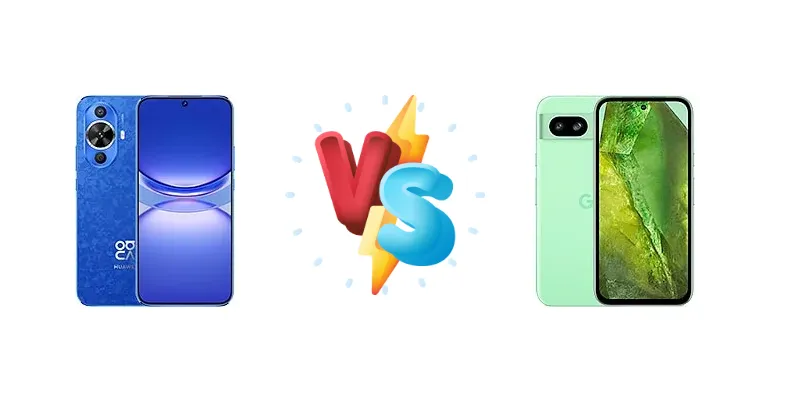
The Google Pixel 8a and Huawei nova 12 Lite represent distinct approaches to the mid-range smartphone market. The Pixel 8a brings Google’s renowned computational photography and AI features to a more accessible price point, while the nova 12 Lite focuses on delivering a stylish design and rapid charging capabilities. This comparison dissects their key differences to determine which device best suits your needs.
🏆 Quick Verdict
For most users, the Google Pixel 8a is the superior choice, thanks to its significantly more powerful Tensor G3 chipset, exceptional camera capabilities, and guaranteed software updates. However, the Huawei nova 12 Lite’s 66W charging is a compelling advantage for those prioritizing speed over all else.
| Network |
|---|
| 2G bands | GSM 850 / 900 / 1800 / 1900 | GSM 850 / 900 / 1800 / 1900 |
| 3G bands | HSDPA 800 / 850 / 900 / 1700(AWS) / 1900 / 2100 | HSDPA 800 / 850 / 900 / 1700(AWS) / 1900 / 2100 |
| 4G bands | LTE | 1, 2, 3, 4, 5, 7, 8, 12, 17, 18, 19, 20, 26, 28, 32, 38, 40, 41, 42, 66 - G6GPR (International) |
| 5G bands | - | 1, 2, 3, 5, 7, 8, 12, 20, 26, 28, 38, 40, 41, 66, 75, 76, 77, 78 SA/NSA/Sub6 - G6GPR (International) |
| Speed | HSPA, LTE | HSPA, LTE, 5G |
| Technology | GSM / CDMA / HSPA / CDMA2000 / LTE | GSM / HSPA / LTE / 5G |
| Launch |
|---|
| Announced | 2023, December 26 | 2024, May 07 |
| Status | Available. Released 2024, January 05 | Available. Released 2024, May 14 |
| Body |
|---|
| Build | - | Glass front (Gorilla Glass 3), aluminum frame, plastic back |
| Dimensions | 161.3 x 75 x 6.9 mm (6.35 x 2.95 x 0.27 in) | 152.1 x 72.7 x 8.9 mm (5.99 x 2.86 x 0.35 in) |
| SIM | · Nano-SIM· Nano-SIM + Nano-SIM | Nano-SIM + eSIM |
| Weight | 168 g (5.93 oz) | 188 g (6.63 oz) |
| Display |
|---|
| Protection | - | Corning Gorilla Glass 3, Mohs level 5 |
| Resolution | 1084 x 2412 pixels, 20:9 ratio (~395 ppi density) | 1080 x 2400 pixels, 20:9 ratio (~430 ppi density) |
| Size | 6.7 inches, 108.3 cm2 (~89.5% screen-to-body ratio) | 6.1 inches, 90.3 cm2 (~81.6% screen-to-body ratio) |
| Type | OLED, 1B colors, HDR, 120Hz | OLED, HDR, 120Hz, 2000 nits (peak) |
| Platform |
|---|
| CPU | Octa-core (4x2.4 GHz Kryo 670 & 4x1.8 GHz Kryo 670) | Nona-core (1x3.0 GHz Cortex-X3 & 4x2.45 GHz Cortex-A715 & 4x2.15 GHz Cortex-A510) |
| Chipset | Qualcomm SM7325 Snapdragon 778G 4G (6 nm) | Google Tensor G3 (4 nm) |
| GPU | Adreno 642L | Immortalis-G715s MC10 |
| OS | HarmonyOS 4.0 | Android 14, upgradable to Android 16, up to 7 major Android upgrades |
| Memory |
|---|
| Card slot | No | No |
| Internal | 256GB 8GB RAM, 512GB 8GB RAM | 128GB 8GB RAM, 256GB 8GB RAM |
| Main Camera |
|---|
| Dual | 50 MP, f/1.9, (wide), PDAF
8 MP, f/2.2, 112˚ (ultrawide), AF | 64 MP (16 MP eff.), f/1.9, 26mm (wide), 1/1.73", 0.8µm, dual pixel PDAF, OIS
13 MP, f/2.2, 120˚ (ultrawide), 1.12µm |
| Features | Laser AF, color spectrum sensor, LED flash, panorama, HDR | Dual-LED flash, Pixel Shift, Ultra HDR, panorama, Best Take |
| Video | 4K, 1080p, 720p@960fps | 4K@30/60fps, 1080p@30/60/120/240fps, OIS |
| Selfie camera |
|---|
| Features | HDR, panorama | HDR, panorama |
| Single | 60 MP, f/2.4, 17mm, 100˚ (ultrawide) | 13 MP, f/2.2, 20mm (ultrawide), 1.12µm |
| Video | 4K@30fps, 1080p@30fps | 4K@30fps, 1080p@30/60fps |
| Sound |
|---|
| 35mm jack | No | No |
| Loudspeaker | Yes | Yes, with stereo speakers |
| Comms |
|---|
| Bluetooth | 5.2, A2DP, LE | 5.3, A2DP, LE |
| NFC | Yes | Yes |
| Positioning | GPS (L1+L5), GLONASS, BDS (B1I+B1c+B2a), GALILEO (E1+E5a), QZSS (L1+L5), NavIC | GPS, GLONASS, GALILEO, BDS, QZSS, NavIC |
| Radio | No | No |
| USB | USB Type-C 2.0, OTG | USB Type-C 3.2 |
| WLAN | Wi-Fi 802.11 a/b/g/n/ac/6, dual-band, Wi-Fi Direct | Wi-Fi 802.11 a/b/g/n/ac/6e, dual/tri-band (market/region dependent) |
| Features |
|---|
| Sensors | Fingerprint (under display, optical), accelerometer, gyro, compass | Fingerprint (under display, optical), accelerometer, gyro, proximity, compass, barometer |
| Battery |
|---|
| Charging | 66W wired, 3-60% in 31 min
5W reverse wired | 18W wired, PD3.0
7.5W wireless
Bypass charging |
| Type | 4500 mAh | Li-Po 4492 mAh |
| Misc |
|---|
| Colors | Black, Blue, White | Obsidian, Porcelain, Bay, Aloe |
| Models | FIN-AL60, FIN-AL60a | GKV4X, G6GPR, G8HHN, G576D |
| Price | About 320 EUR | $ 229.98 / C$ 417.99 / £ 279.00 / € 299.99 / ₹ 33,300 |
| EU LABEL |
|---|
| Battery | - | 40:06h endurance, 1000 cycles |
| Energy | - | Class B |
| Free fall | - | Class A (270 falls) |
| Repairability | - | Class B |
Huawei nova 12 Lite
- Superior performance with the Google Tensor G3
- Exceptional camera quality and image processing
- Long-term software support and updates
- Slower charging speeds (18W)
- Potentially higher price point
Google Pixel 8a
- Extremely fast 66W wired charging
- Sleek and stylish design
- Potentially more affordable price
- Less powerful Snapdragon 778G chipset
- Uncertainty regarding long-term software support
Display Comparison
The Pixel 8a boasts a measured peak brightness of 1508 nits, significantly outshining the nova 12 Lite (brightness data unavailable). This translates to superior visibility in direct sunlight. While the nova 12 Lite’s panel specifics are unknown, the Pixel 8a’s OLED display delivers vibrant colors and deep blacks. The Pixel 8a’s display is likely to have a higher refresh rate, contributing to smoother scrolling and animations, a feature not confirmed for the nova 12 Lite.
Camera Comparison
The Pixel 8a’s camera system is a clear standout. While specific sensor details are missing for the nova 12 Lite, the Pixel 8a leverages Google’s renowned computational photography algorithms. This results in superior image quality, particularly in low-light conditions. The Pixel 8a’s image processing excels in dynamic range and detail preservation. The nova 12 Lite likely relies more on hardware specifications, and without knowing those, it's difficult to assess its capabilities beyond basic photography. We can assume the Pixel 8a's software will provide a more consistent and refined experience.
Performance
The Google Pixel 8a’s Google Tensor G3, built on a 4nm process, offers a substantial performance advantage over the Huawei nova 12 Lite’s Qualcomm Snapdragon 778G 4G (6nm). The Tensor G3’s nona-core architecture (1x3.0 GHz Cortex-X3, 4x2.45 GHz Cortex-A715, 4x2.15 GHz Cortex-A510) provides more processing power for demanding tasks like video editing and gaming. The Snapdragon 778G, while capable, is geared towards efficient everyday use. The 4nm node of the Tensor G3 also contributes to better thermal efficiency, potentially reducing throttling during sustained workloads.
Battery Life
The Google Pixel 8a demonstrates impressive battery endurance, achieving 40:06 hours of endurance and an active use score of 11:25 hours. While the nova 12 Lite’s battery capacity is unknown, the Pixel 8a’s longevity is a significant advantage. However, the nova 12 Lite compensates with its 66W wired charging, capable of charging from 30-60% in just 31 minutes. The Pixel 8a’s 18W charging is considerably slower. The Pixel 8a also supports 7.5W wireless charging and 'bypass charging', a feature absent on the nova 12 Lite.
Buying Guide
Buy the Huawei nova 12 Lite if you prioritize extremely fast charging and a sleek design, and are comfortable with Huawei’s ecosystem and potential limitations regarding Google Mobile Services. Buy the Google Pixel 8a if you value a superior camera experience, long-term software support, and access to Google’s AI-powered features, even if it means slower charging speeds.
Frequently Asked Questions
❓ Does the Huawei nova 12 Lite support Google Mobile Services (GMS)?
The Huawei nova 12 Lite, like many recent Huawei devices, does not natively support Google Mobile Services. It relies on Huawei Mobile Services (HMS) and the AppGallery. While many popular apps are available through HMS and workarounds, some Google apps may require sideloading or alternative solutions.
❓ How does the Snapdragon 778G in the nova 12 Lite handle graphically intensive games like PUBG or Genshin Impact?
The Snapdragon 778G is capable of running PUBG and Genshin Impact, but you'll likely need to lower graphics settings to achieve a consistently smooth frame rate. The Tensor G3 in the Pixel 8a will provide a noticeably better gaming experience with higher settings and more stable performance.
❓ What type of charging protocol does the Pixel 8a use, and is a fast charger included in the box?
The Pixel 8a supports USB Power Delivery 3.0 (PD3.0) for 18W wired charging. A charging cable is included in the box, but a wall adapter is *not* included, meaning you'll need to use an existing USB-PD charger or purchase one separately.
❓ How long will the Pixel 8a receive software and security updates?
Google guarantees 7 years of software and security updates for the Pixel 8a, starting from its release date. This is a significant advantage over the Huawei nova 12 Lite, where long-term software support is less certain.