
Huawei nova 11 vs Xiaomi 13 Lite: A Detailed Comparison of Mid-Range Powerhouses
| Phones Images | |||||
|---|---|---|---|---|---|
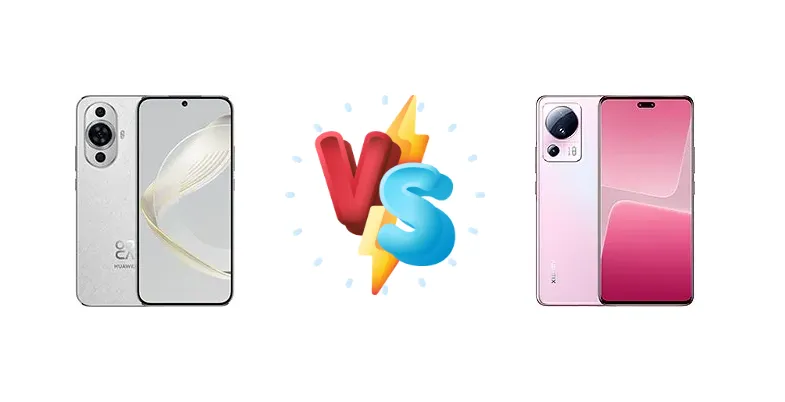
|
🏆 Quick Verdict
For most users, the Xiaomi 13 Lite is the stronger choice. Its Snapdragon 7 Gen 1 provides a noticeable performance uplift over the nova 11’s 778G, and the brighter 938 nit display enhances outdoor visibility. While charging speeds are comparable, the 13 Lite’s overall efficiency and display quality give it the edge.
| PHONES | ||
|---|---|---|
| Phone Names | Huawei nova 11 | Xiaomi 13 Lite |
| Network | ||
|---|---|---|
| 2G bands | GSM 850 / 900 / 1800 / 1900 | GSM 850 / 900 / 1800 / 1900 |
| 3G bands | HSDPA 800 / 850 / 900 / 1700(AWS) / 1900 / 2100 | HSDPA 800 / 850 / 900 / 1700(AWS) / 1900 / 2100 |
| 4G bands | 1, 2, 3, 4, 5, 7, 8, 12, 13, 17, 18, 19, 20, 26, 28, 38, 40, 41, 66 - International | 1, 2, 3, 4, 5, 7, 8, 12, 13, 17, 18, 19, 20, 26, 28, 32, 38, 40, 41, 42, 66 |
| 5G bands | - | 1, 3, 5, 7, 8, 20, 28, 38, 40, 41, 66, 77, 78 SA/NSA |
| Speed | HSPA, LTE | HSPA, LTE, 5G |
| Technology | GSM / CDMA / HSPA / CDMA2000 / LTE | GSM / HSPA / LTE / 5G |
| CDMA2000 1x | - | |
| Launch | ||
|---|---|---|
| Announced | 2023, April 17 | 2023, February 26 |
| Status | Available. Released 2023, April 27 | Available. Released 2023, March 08 |
| Body | ||
|---|---|---|
| Build | - | Glass front (Gorilla Glass 5), glass back, plastic frame |
| Dimensions | 161.3 x 75 x 6.9 mm (6.35 x 2.95 x 0.27 in) | 159.2 x 72.7 x 7.2 mm (6.27 x 2.86 x 0.28 in) |
| SIM | · Nano-SIM· Nano-SIM + Nano-SIM | · Nano-SIM + eSIM· Nano-SIM + Nano-SIM |
| Weight | 168 g (5.93 oz) | 171 g (6.03 oz) |
| - | IP53, dust and splash resistant | |
| Display | ||
|---|---|---|
| Protection | Kunlun Glass | Corning Gorilla Glass 5 |
| Resolution | 1084 x 2412 pixels, 20:9 ratio (~391 ppi density) | 1080 x 2400 pixels, 20:9 ratio (~402 ppi density) |
| Size | 6.7 inches, 110.5 cm2 (~91.4% screen-to-body ratio) | 6.55 inches, 103.6 cm2 (~89.5% screen-to-body ratio) |
| Type | OLED, 1B colors, HDR10, 120Hz | AMOLED, 68B colors, Dolby Vision, HDR10+, 120Hz, 500 nits (typ), 1000 nits (peak) |
| Platform | ||
|---|---|---|
| CPU | Octa-core (4x2.4 GHz Kryo 670 & 4x1.8 GHz Kryo 670) | Octa-core (1x2.4 GHz Cortex-A710 & 3x2.36 GHz Cortex-A710 & 4x1.8 GHz Cortex-A510) |
| Chipset | Qualcomm SM7325 Snapdragon 778G 4G (6 nm) | Qualcomm SM7450-AB Snapdragon 7 Gen 1 (4 nm) |
| GPU | Adreno 642L | Adreno 644 |
| OS | HarmonyOS 3.0 | Android 12, MIUI 14 |
| Memory | ||
|---|---|---|
| Card slot | No | No |
| Internal | 128GB 8GB RAM, 256GB 8GB RAM, 512GB 8GB RAM | 64GB 8GB RAM, 128GB 8GB RAM, 256GB 8GB RAM |
| - | UFS 2.2 | |
| Main Camera | ||
|---|---|---|
| Dual | 50 MP, f/1.9, (wide), PDAF 8 MP, f/2.2, 112˚ (ultrawide) | - |
| Features | Color spectrum sensor, LED flash, panorama, HDR | Dual-LED dual-tone flash, HDR, panorama |
| Triple | - | 50 MP, f/1.8, 23mm (wide), 1/1.56", 1.0µm, PDAF 8 MP, f/2.2, 119˚ (ultrawide), 1/4.0", 1.12µm 2 MP (macro) |
| Video | 4K, 1080p, 720p@960fps, gyro-EIS | 4K@30fps, 1080p@30/60/120fps, 720p@960fps |
| Selfie camera | ||
|---|---|---|
| Dual | 60 MP, f/2.4, 100˚ (ultrawide) | 32 MP, f/2.4, 100˚ (ultrawide), 1/2.74", 0.8µm 8 MP, f/2.3, (depth) |
| Features | HDR | Dual-LED flash, HDR |
| Video | 4K@30fps, 1080p@30fps, gyro-EIS | 1080p@30/60fps |
| Sound | ||
|---|---|---|
| 3.5mm jack | No | No |
| 35mm jack | No | No |
| Loudspeaker | Yes, with stereo speakers | Yes |
| - | 24-bit/192kHz audio | |
| Comms | ||
|---|---|---|
| Bluetooth | 5.2, A2DP, LE | 5.2, A2DP, LE |
| Infrared port | - | Yes |
| NFC | Yes | Yes (market/region dependent) |
| Positioning | GPS (L1+L5), GLONASS (L1), BDS (B1I+B1c+B2a), GALILEO (E1+E5a), QZSS (L1+L5), NavIC | GPS (L1), GLONASS (G1), BDS (B1I+B1c), GALILEO (E1), QZSS (L1) |
| Radio | No | No |
| USB | USB Type-C 2.0, OTG | USB Type-C 2.0, OTG |
| WLAN | Wi-Fi 802.11 a/b/g/n/a/6, dual-band, Wi-Fi Direct | Wi-Fi 802.11 a/b/g/n/ac/6, dual-band |
| Features | ||
|---|---|---|
| Sensors | Fingerprint (under display, optical), accelerometer, gyro, compass | Fingerprint (under display, optical), accelerometer, gyro, proximity, compass |
| Virtual proximity sensing | - | |
| Battery | ||
|---|---|---|
| Charging | 66W wired, 100% in 31 min Reverse wired | 67W wired, 100% in 40 min |
| Type | Li-Po 4500 mAh | Li-Po 4500 mAh |
| Misc | ||
|---|---|---|
| Colors | Black, Green, White, Gold | Black, Lite Blue, Lite Pink |
| Models | FOA-AL00, FOA-LX9 | - |
| Price | About 310 EUR | About 180 EUR |
| Tests | ||
|---|---|---|
| Battery life | - | Endurance rating 93h |
| Camera | - | Photo / Video |
| Display | - | Contrast ratio: Infinite (nominal) |
| Loudspeaker | - | -28.5 LUFS (Average) |
| Performance | - | AnTuTu: 534143 (v9) GeekBench: 2936 (v5.1), 2434 (v6) GFXBench: 33fps (ES 3.1 onscreen) |
Huawei nova 11
- Faster wired charging (31 minutes vs 40 minutes)
- Reverse wired charging for accessories
- Proven Snapdragon 778G chipset reliability
- Older Snapdragon 778G chipset offers less performance
- 4G connectivity only
- Display brightness likely lower than Xiaomi 13 Lite
Xiaomi 13 Lite
- More powerful Snapdragon 7 Gen 1 processor
- Significantly brighter display (938 nits)
- More efficient 4nm process node
- Slightly slower charging time (40 minutes)
- MIUI software can be polarizing
- No reverse wireless charging
Display Comparison
The Xiaomi 13 Lite immediately stands out with its significantly brighter display, reaching a measured peak of 938 nits compared to an unspecified brightness for the nova 11. This difference is crucial for usability in direct sunlight. Both displays boast an 'infinite' (nominal) contrast ratio, typical for OLED panels. While neither specification details refresh rate or panel technology (LTPO is absent), the brightness advantage clearly favors the Xiaomi 13 Lite for users who spend significant time outdoors.
Camera Comparison
Both phones are listed as having 'Photo / Video' capabilities, lacking specific details. Without sensor size or aperture information, a direct comparison is difficult. However, focusing on the chipset’s ISP capabilities, the Snapdragon 7 Gen 1 in the Xiaomi 13 Lite benefits from newer image processing algorithms, potentially leading to better dynamic range and low-light performance. The absence of details regarding OIS (Optical Image Stabilization) on either device suggests reliance on software stabilization, which can introduce artifacts. We can assume both phones will offer a standard set of camera modes, but the 13 Lite’s processor gives it an edge in computational photography.
Performance
The core difference lies in the chipsets. The Xiaomi 13 Lite’s Snapdragon 7 Gen 1 (4nm) represents a generational leap over the Huawei nova 11’s Snapdragon 778G (6nm). The 7 Gen 1 features a more modern CPU configuration – 1x2.4 GHz Cortex-A710, 3x2.36 GHz Cortex-A710, and 4x1.8 GHz Cortex-A510 – compared to the 778G’s Octa-core (4x2.4 GHz Kryo 670 & 4x1.8 GHz Kryo 670). The 4nm process node of the 7 Gen 1 also translates to improved thermal efficiency, potentially reducing throttling during sustained workloads. While both are capable of handling everyday tasks, the 13 Lite will offer a smoother experience in demanding games and applications.
Battery Life
Both devices share an endurance rating of 93 hours, suggesting similar real-world battery life despite unspecified battery capacities. However, the charging speeds differ slightly. The Huawei nova 11 charges at 66W, reaching 100% in 31 minutes, while the Xiaomi 13 Lite charges at 67W, taking 40 minutes for a full charge. The slightly slower charging time on the 13 Lite is likely due to the more efficient Snapdragon 7 Gen 1 requiring less aggressive charging curves to preserve battery health. The inclusion of reverse wired charging on the nova 11 is a useful feature for topping up accessories.
Buying Guide
Buy the Huawei nova 11 if you prioritize a familiar, well-established chipset with a strong track record and are comfortable with the potential limitations of 4G connectivity. Buy the Xiaomi 13 Lite if you prefer a more modern processor, a significantly brighter display for outdoor use, and don't mind the potential software quirks sometimes associated with Xiaomi's MIUI.