
Google Pixel 7a vs. Huawei nova 11: A Detailed Comparison of Mid-Range Champions
| Phones Images | |||||
|---|---|---|---|---|---|
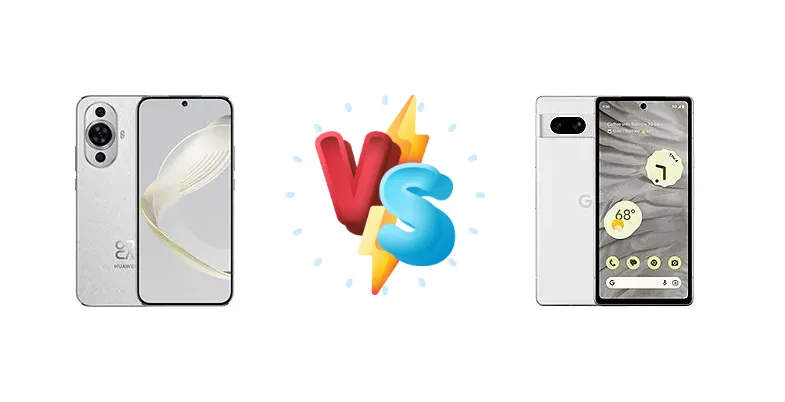
|
🏆 Quick Verdict
For most users, the Google Pixel 7a emerges as the stronger choice. Its Tensor G2 chipset delivers superior processing power and AI capabilities, coupled with Google’s exceptional camera software. While the Huawei nova 11 boasts faster charging, the Pixel 7a’s overall package offers a more refined and feature-rich experience.
| PHONES | ||
|---|---|---|
| Phone Names | Huawei nova 11 | Google Pixel 7a |
| Network | ||
|---|---|---|
| 2G bands | GSM 850 / 900 / 1800 / 1900 | GSM 850 / 900 / 1800 / 1900 |
| 3G bands | HSDPA 800 / 850 / 900 / 1700(AWS) / 1900 / 2100 | HSDPA 800 / 850 / 900 / 1700(AWS) / 1900 / 2100 |
| 4G bands | 1, 2, 3, 4, 5, 7, 8, 12, 13, 17, 18, 19, 20, 26, 28, 38, 40, 41, 66 - International | 1, 2, 3, 4, 5, 7, 8, 12, 13, 14, 17, 20, 25, 26, 28, 29, 30, 38, 40, 41, 48, 66, 71 - GWKK3, G0DZQ |
| 5G bands | - | 1, 2, 3, 5, 7, 8, 12, 14, 20, 25, 28, 30, 38, 41, 48, 66, 71, 77, 78 SA/NSA/Sub6 - GWKK3 |
| Speed | HSPA, LTE | HSPA, LTE, 5G |
| Technology | GSM / CDMA / HSPA / CDMA2000 / LTE | GSM / HSPA / LTE / 5G |
| CDMA2000 1x | 1, 2, 3, 5, 7, 8, 12, 20, 25, 28, 38, 40, 41, 66, 75, 76, 77, 78, 79 SA/NSA/Sub6 - GHL1X, G82U8 | |
| Launch | ||
|---|---|---|
| Announced | 2023, April 17 | 2023, May 10 |
| Status | Available. Released 2023, April 27 | Available. Released 2023, May 10 |
| Body | ||
|---|---|---|
| Build | - | Glass front (Gorilla Glass 3), aluminum frame, plastic back |
| Dimensions | 161.3 x 75 x 6.9 mm (6.35 x 2.95 x 0.27 in) | 152 x 72.9 x 9 mm (5.98 x 2.87 x 0.35 in) |
| SIM | · Nano-SIM· Nano-SIM + Nano-SIM | Nano-SIM + eSIM |
| Weight | 168 g (5.93 oz) | 193.5 g (6.84 oz) |
| - | IP67 dust/water resistant (up to 1m for 30 min) | |
| Display | ||
|---|---|---|
| Protection | Kunlun Glass | Corning Gorilla Glass 3 |
| Resolution | 1084 x 2412 pixels, 20:9 ratio (~391 ppi density) | 1080 x 2400 pixels, 20:9 ratio (~429 ppi density) |
| Size | 6.7 inches, 110.5 cm2 (~91.4% screen-to-body ratio) | 6.1 inches, 90.7 cm2 (~81.8% screen-to-body ratio) |
| Type | OLED, 1B colors, HDR10, 120Hz | OLED, HDR, 90Hz |
| - | Always-on display | |
| Platform | ||
|---|---|---|
| CPU | Octa-core (4x2.4 GHz Kryo 670 & 4x1.8 GHz Kryo 670) | Octa-core (2x2.85 GHz Cortex-X1 & 2x2.35 GHz Cortex-A78 & 4x1.80 GHz Cortex-A55) |
| Chipset | Qualcomm SM7325 Snapdragon 778G 4G (6 nm) | Google Tensor G2 (5 nm) |
| GPU | Adreno 642L | Mali-G710 MP7 |
| OS | HarmonyOS 3.0 | Android 13, upgradable to Android 15, up to 5 major Android upgrades |
| Memory | ||
|---|---|---|
| Card slot | No | No |
| Internal | 128GB 8GB RAM, 256GB 8GB RAM, 512GB 8GB RAM | 128GB 8GB RAM |
| - | UFS 3.1 | |
| Main Camera | ||
|---|---|---|
| Dual | 50 MP, f/1.9, (wide), PDAF 8 MP, f/2.2, 112˚ (ultrawide) | 64 MP, f/1.9, 26mm (wide), 1/1.73", 0.8µm, dual pixel PDAF, OIS 13 MP, f/2.2, 120˚ (ultrawide), 1.12µm |
| Features | Color spectrum sensor, LED flash, panorama, HDR | Dual-LED flash, Pixel Shift, Auto-HDR, panorama |
| Video | 4K, 1080p, 720p@960fps, gyro-EIS | 4K@30/60fps, 1080p@30/60/120/240fps, OIS |
| Selfie camera | ||
|---|---|---|
| Dual | 60 MP, f/2.4, 100˚ (ultrawide) | - |
| Features | HDR | HDR, panorama |
| Single | - | 13 MP, f/2.2, 20mm (ultrawide), 1.12µm |
| Video | 4K@30fps, 1080p@30fps, gyro-EIS | 4K@30fps, 1080p@30fps |
| Sound | ||
|---|---|---|
| 3.5mm jack | No | No |
| 35mm jack | No | No |
| Loudspeaker | Yes, with stereo speakers | Yes, with stereo speakers |
| Comms | ||
|---|---|---|
| Bluetooth | 5.2, A2DP, LE | 5.3, A2DP, LE |
| NFC | Yes | Yes |
| Positioning | GPS (L1+L5), GLONASS (L1), BDS (B1I+B1c+B2a), GALILEO (E1+E5a), QZSS (L1+L5), NavIC | GPS, GLONASS, GALILEO, BDS, QZSS, NavIC |
| Radio | No | No |
| USB | USB Type-C 2.0, OTG | USB Type-C 3.2 |
| WLAN | Wi-Fi 802.11 a/b/g/n/a/6, dual-band, Wi-Fi Direct | Wi-Fi 802.11 a/b/g/n/ac/6e, tri-band |
| Features | ||
|---|---|---|
| Sensors | Fingerprint (under display, optical), accelerometer, gyro, compass | Fingerprint (under display, optical), accelerometer, gyro, proximity, compass, barometer |
| Virtual proximity sensing | - | |
| Battery | ||
|---|---|---|
| Charging | 66W wired, 100% in 31 min Reverse wired | 18W wired, PD3.0 7.5W wireless |
| Type | Li-Po 4500 mAh | Li-Po 4385 mAh |
| Misc | ||
|---|---|---|
| Colors | Black, Green, White, Gold | Charcoal, Snow, Sea, Coral |
| Models | FOA-AL00, FOA-LX9 | GWKK3, GHL1X, G0DZQ, G82U8 |
| Price | About 310 EUR | € 179.90 / $ 150.00 / £ 170.00 / ₹ 25,980 |
Huawei nova 11
- Superior performance with the Google Tensor G2 chip
- Exceptional camera quality and image processing
- Long-term software support and Google ecosystem integration
- Slower charging speeds (18W)
- May lack some advanced features found on higher-end Pixels
Google Pixel 7a
- Incredibly fast 66W wired charging
- Sleek and stylish design
- Competitive price point
- Less powerful Snapdragon 778G 4G chipset
- Limited access to Google Mobile Services
Display Comparison
The Pixel 7a boasts a measured peak brightness of 1070 nits, significantly outshining the likely lower peak brightness of the nova 11 (Huawei doesn't publish this spec). This translates to better visibility in direct sunlight. While both likely utilize OLED panels, the Pixel 7a’s display is known for its color accuracy and responsiveness. The nova 11’s display specs are less detailed, making a direct comparison of color gamut coverage and panel technology difficult, but it likely targets a similar vibrant aesthetic.
Camera Comparison
The Pixel 7a’s camera system is a major strength, leveraging Google’s computational photography expertise. While specific sensor sizes aren’t provided, the Pixel 7a’s image processing algorithms excel in dynamic range, detail, and low-light performance. The nova 11’s camera specs are less detailed, and while it likely offers a competent imaging experience, it won’t reach the Pixel 7a’s level of sophistication. The Pixel 7a’s video capabilities are also superior, benefiting from the Tensor G2’s image signal processor.
Performance
The core difference lies in the chipsets. The Google Pixel 7a’s Tensor G2, built on a 5nm process, features a tri-cluster configuration with 2x2.85 GHz Cortex-X1 cores for peak performance, 2x2.35 GHz Cortex-A78 cores for sustained tasks, and 4x1.80 GHz Cortex-A55 cores for efficiency. This contrasts with the Huawei nova 11’s Snapdragon 778G 4G (6nm), which uses a more conventional octa-core setup. The Tensor G2’s architectural advantages and 5nm fabrication process provide a clear performance edge, particularly in AI-driven tasks like image processing and voice recognition. The Snapdragon 778G is still a capable chip, but it won’t match the Pixel 7a’s processing prowess.
Battery Life
The Huawei nova 11’s 66W wired charging is its standout feature, achieving a full charge in just 31 minutes. The Pixel 7a’s 18W charging, while supporting PD3.0, is considerably slower. However, the Pixel 7a’s reported 76-hour endurance rating suggests efficient power management. The nova 11’s battery capacity isn’t specified, but the faster charging mitigates concerns about potential capacity limitations. The trade-off is convenience versus longevity – the nova 11 for quick top-ups, the Pixel 7a for potentially longer runtimes between charges.
Buying Guide
Buy the Huawei nova 11 if you prioritize incredibly fast charging and a sleek aesthetic, and aren't reliant on Google Mobile Services. Its 66W charging will get you from 0-100% in just over half an hour. Buy the Google Pixel 7a if you value a superior camera experience, smooth performance thanks to the Tensor G2, and seamless integration with the Google ecosystem, even if it means slower charging speeds.