
Huawei nova 11 Ultra vs Xiaomi 13 Pro: A Detailed Comparison of Flagship Features
| Phones Images | |||||
|---|---|---|---|---|---|
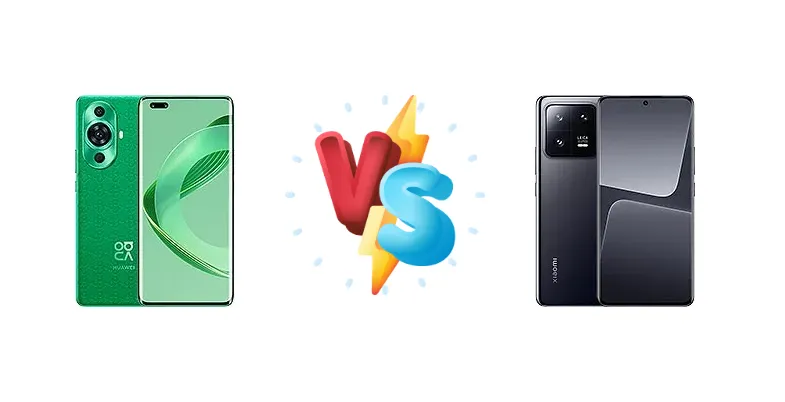
|
🏆 Quick Verdict
For the average user prioritizing raw performance and a top-tier camera experience, the Xiaomi 13 Pro is the clear winner. Its Snapdragon 8 Gen 2 chipset and superior battery endurance justify the higher price. However, the Huawei nova 11 Ultra offers compelling value with its fast 100W charging and stylish design.
| PHONES | ||
|---|---|---|
| Phone Names | Huawei nova 11 Ultra | Xiaomi 13 Pro |
| Network | ||
|---|---|---|
| 2G bands | GSM 850 / 900 / 1800 / 1900 | GSM 850 / 900 / 1800 / 1900 |
| 3G bands | HSDPA 800 / 850 / 900 / 1700(AWS) / 1900 / 2100 | HSDPA 800 / 850 / 900 / 1700(AWS) / 1900 / 2100 |
| 4G bands | 1, 3, 4, 5, 8, 18, 19, 26, 34, 38, 39, 40, 41 | 1, 2, 3, 4, 5, 7, 8, 12, 13, 17, 18, 19, 20, 25, 26, 28, 32, 38, 39, 40, 41, 42, 48, 66 - International |
| 5G bands | - | 1, 3, 5, 7, 8, 20, 28, 38, 40, 41, 66, 71, 75, 77, 78 SA/NSA - International |
| Speed | HSPA, LTE | HSPA, LTE, 5G |
| Technology | GSM / CDMA / HSPA / CDMA2000 / LTE | GSM / CDMA / HSPA / CDMA2000 / LTE / 5G |
| CDMA2000 1x | 1, 3, 5, 8, 28, 38, 40, 41, 77, 78, 79 SA/NSA - China | |
| Launch | ||
|---|---|---|
| Announced | 2023, April 17 | 2022, December 11 |
| Status | Available. Released 2023, April 27 | Available. Released 2022, December 14 |
| Body | ||
|---|---|---|
| Build | - | Glass front (Gorilla Glass Victus), ceramic back or silicone polymer back, aluminum frame |
| Dimensions | 164.3 x 74.4 x 7.9 mm (6.47 x 2.93 x 0.31 in) | 162.9 x 74.6 x 8.4 mm or 8.7 mm |
| SIM | Nano-SIM + Nano-SIM | · Nano-SIM + eSIM· Nano-SIM + Nano-SIM |
| Weight | 188 g (6.63 oz) | 210 g or 229 g (7.41 oz) |
| - | IP68 dust/water resistant (up to 1.5m for 30 min) | |
| Display | ||
|---|---|---|
| Protection | Kunlun Glass | Corning Gorilla Glass Victus |
| Resolution | 1200 x 2652 pixels (~429 ppi density) | 1440 x 3200 pixels, 20:9 ratio (~522 ppi density) |
| Size | 6.78 inches, 111.4 cm2 (~91.1% screen-to-body ratio) | 6.73 inches, 108.9 cm2 (~89.6% screen-to-body ratio) |
| Type | OLED, 1B colors, HDR10, 120Hz | LTPO AMOLED, 1B colors, 120Hz, Dolby Vision, HDR10+, 1200 nits (HBM), 1900 nits (peak) |
| Platform | ||
|---|---|---|
| CPU | Octa-core (4x2.4 GHz Kryo 670 & 4x1.8 GHz Kryo 670) | Octa-core (1x3.2 GHz Cortex-X3 & 2x2.8 GHz Cortex-A715 & 2x2.8 GHz Cortex-A710 & 3x2.0 GHz Cortex-A510) |
| Chipset | Qualcomm SM7325 Snapdragon 778G 4G (6 nm) | Qualcomm SM8550-AB Snapdragon 8 Gen 2 (4 nm) |
| GPU | Adreno 642L | Adreno 740 |
| OS | HarmonyOS 3.0 | Android 13, upgradable to Android 14, HyperOS |
| Memory | ||
|---|---|---|
| Card slot | No | No |
| Internal | 512GB 12GB RAM | 128GB 8GB RAM, 256GB 8GB RAM, 256GB 12GB RAM, 512GB 12GB RAM |
| - | UFS 3.1 - 128GB UFS 4.0 - 256/512GB | |
| Main Camera | ||
|---|---|---|
| Dual | 50 MP, f/1.4-f/4.0, 25mm (wide), PDAF 8 MP, f/2.2, 112˚ (ultrawide), AF | - |
| Features | Laser AF, color spectrum sensor, LED flash, panorama, HDR | Laser AF, color spectrum sensor, Leica lens, Dual-LED dual-tone flash, HDR, panorama |
| Triple | - | 50.3 MP, f/1.9, 23mm (wide), 1.0"-type, 1.6µm, dual pixel PDAF, OIS 50 MP, f/2.0, 75mm (telephoto), PDAF (10cm - ∞), 3.2x optical zoom 50 MP, f/2.2, 14mm, 115˚ (ultrawide), AF |
| Video | 4K, 1080p, 720p@960fps, gyro-EIS | 8K@24fps (HDR), 4K@24/30/60fps (HDR10+, 10-bit Dolby Vision HDR, 10-bit LOG), 1080p@30/120/240/960fps, 1080p@1920fps, gyro-EIS |
| Selfie camera | ||
|---|---|---|
| Dual | 8 MP, f/2.2, 52mm (telephoto), AF, 2x optical zoom 60 MP, f/2.4, 17mm, 100˚ (ultrawide), AF | - |
| Features | HDR | HDR, panorama |
| Single | - | 32 MP, f/2.0, 22mm (wide), 1/3.14", 0.7µm |
| Video | 4K@30fps, 1080p@30fps, gyro-EIS | 1080p@30fps |
| Sound | ||
|---|---|---|
| 3.5mm jack | No | No |
| 35mm jack | No | No |
| Loudspeaker | Yes, with stereo speakers | Yes, with stereo speakers |
| - | 24-bit/192kHz audio | |
| Comms | ||
|---|---|---|
| Bluetooth | 5.2, A2DP, LE | 5.3, A2DP, aptX HD, aptX Adaptive |
| Infrared port | - | Yes |
| NFC | Yes | Yes |
| Positioning | GPS (L1+L5), GLONASS (L1), BDS (B1I+B1c+B2a), GALILEO (E1+E5a), QZSS (L1+L5), NavIC | GPS (L1+L5), GLONASS (G1), BDS (B1I+B1c+B2a), GALILEO (E1+E5a), QZSS (L1+L5), NavIC (L5) |
| Radio | No | No |
| USB | USB Type-C 2.0, OTG | USB Type-C 2.0, OTG |
| WLAN | Wi-Fi 802.11 a/b/g/n/a/6, dual-band, Wi-Fi Direct | Wi-Fi 802.11 a/b/g/n/ac/6e, dual-band, Wi-Fi Direct |
| Features | ||
|---|---|---|
| Sensors | Fingerprint (under display, optical), accelerometer, gyro, compass | Fingerprint (under display, optical), accelerometer, proximity, gyro, compass, barometer |
| Virtual proximity sensing BDS Satellite Message (Emergency SOS service) | - | |
| Battery | ||
|---|---|---|
| Charging | 100W wired, 20-80% in 10 min Reverse wired | 120W wired, PD3.0, QC4, 100% in 19 min 50W wireless, 100% in 36 min 10W reverse wireless |
| Type | Li-Po 4500 mAh | Li-Po 4820 mAh |
| Misc | ||
|---|---|---|
| Colors | Black, Green | Ceramic White, Ceramic Black, Ceramic Flora Green, Mountain Blue |
| Models | GOA-AL80U | 2210132G, 2210132C |
| Price | About 590 EUR | About 750 EUR |
| Tests | ||
|---|---|---|
| Battery life | - | Endurance rating 115h |
| Camera | - | Photo / Video |
| Display | - | Contrast ratio: Infinite (nominal) |
| Loudspeaker | - | -25.6 LUFS (Very good) |
| Performance | - | AnTuTu: 1281666 (v9) GeekBench: 5087 (v5.1), 5323 (v6) GFXBench: 64fps (ES 3.1 onscreen) |
Huawei nova 11 Ultra
- 100W fast charging provides quick top-ups.
- Potentially more affordable price point.
- Stylish design and build quality.
- Limited to 4G connectivity.
- Significantly less powerful Snapdragon 778G chipset.
- Camera performance likely inferior to the Xiaomi 13 Pro.
Xiaomi 13 Pro
- Flagship Snapdragon 8 Gen 2 delivers exceptional performance.
- Excellent battery life and fast charging (wired and wireless).
- Superior camera system with advanced image processing.
- Higher price tag.
- May be larger and heavier than the nova 11 Ultra.
- Software experience may vary based on MIUI version.
Display Comparison
The Xiaomi 13 Pro boasts a significantly brighter display, reaching a measured 1253 nits, compared to an unspecified peak brightness for the nova 11 Ultra. While both likely utilize AMOLED panels for vibrant colors, the Xiaomi’s higher peak brightness translates to better visibility in direct sunlight. The 'Infinite' contrast ratio on the Xiaomi 13 Pro is typical for AMOLED displays, offering deep blacks. The absence of refresh rate data for the nova 11 Ultra suggests it may not match the smoothness of a high-refresh-rate panel found in many flagship competitors.
Camera Comparison
Both devices are advertised as having strong camera capabilities, but the Xiaomi 13 Pro likely holds a considerable advantage. While both feature 'Photo/Video' capabilities, the Xiaomi 13 Pro benefits from a more powerful image signal processor (ISP) integrated within the Snapdragon 8 Gen 2. This allows for more advanced image processing, better low-light performance, and potentially more sophisticated video recording features. Without specific sensor details for the nova 11 Ultra, it’s difficult to assess its capabilities beyond marketing claims. The Xiaomi 13 Pro’s larger sensor (likely) and advanced processing will result in superior image quality and detail.
Performance
The performance gap is substantial. The Xiaomi 13 Pro’s Snapdragon 8 Gen 2 (4nm) is a generational leap ahead of the Huawei nova 11 Ultra’s Snapdragon 778G 4G (6nm). The 8 Gen 2’s Cortex-X3 prime core, coupled with its more efficient 4nm process, delivers significantly faster CPU and GPU performance. This translates to smoother multitasking, faster app loading times, and a superior gaming experience. The 778G is capable, but will struggle with the most demanding titles at maximum settings. Crucially, the nova 11 Ultra is limited to 4G connectivity, a significant drawback for users in areas with 5G coverage.
Battery Life
The Xiaomi 13 Pro demonstrates a clear advantage in battery endurance, achieving an impressive 10:55h of active use and an endurance rating of 115 hours. While the nova 11 Ultra’s battery capacity is unknown, the Xiaomi’s larger battery and more efficient chipset contribute to its longer runtime. Charging speeds are competitive, with the Xiaomi 13 Pro’s 120W wired charging (0-100% in 19 minutes) outpacing the nova 11 Ultra’s 100W (20-80% in 10 minutes). The Xiaomi also offers 50W wireless charging, a feature absent on the nova 11 Ultra.
Buying Guide
Buy the Huawei nova 11 Ultra if you need a stylish, fast-charging phone with a good camera for social media and everyday use, and are comfortable with the limitations of a 4G-only chipset. Buy the Xiaomi 13 Pro if you demand the absolute best performance for gaming and demanding applications, require 5G connectivity, and prioritize a class-leading camera system with extended battery life.