
Huawei nova 11 Ultra vs. Samsung Galaxy S23 Ultra: A Detailed Comparison
| Phones Images | |||||
|---|---|---|---|---|---|
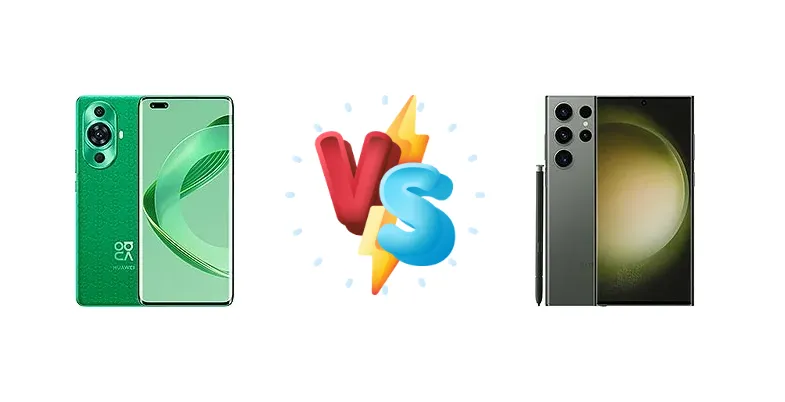
|
🏆 Quick Verdict
For the average user prioritizing raw power, camera versatility, and long-term software support, the Samsung Galaxy S23 Ultra is the clear winner. However, the Huawei nova 11 Ultra offers a compelling alternative for those who value incredibly fast charging and a potentially lower price point.
| PHONES | ||
|---|---|---|
| Phone Names | Huawei nova 11 Ultra | Samsung Galaxy S23 Ultra |
| Network | ||
|---|---|---|
| 2G bands | GSM 850 / 900 / 1800 / 1900 | GSM 850 / 900 / 1800 / 1900 |
| 3G bands | HSDPA 800 / 850 / 900 / 1700(AWS) / 1900 / 2100 | HSDPA 850 / 900 / 1700(AWS) / 1900 / 2100 |
| 4G bands | 1, 3, 4, 5, 8, 18, 19, 26, 34, 38, 39, 40, 41 | 1, 2, 3, 4, 5, 7, 8, 12, 13, 17, 18, 19, 20, 25, 26, 28, 32, 38, 39, 40, 41, 66 - International |
| 5G bands | - | 1, 2, 3, 5, 7, 8, 12, 20, 25, 28, 38, 40, 41, 66, 75, 77, 78 SA/NSA/Sub6 - International |
| Speed | HSPA, LTE | HSPA, LTE (up to 7CA), 5G |
| Technology | GSM / CDMA / HSPA / CDMA2000 / LTE | GSM / CDMA / HSPA / EVDO / LTE / 5G |
| CDMA2000 1x | 1, 7, 28, 41, 66, 71, 78, 258, 260, 261 SA/NSA/Sub6/mmWave - USA | |
| Launch | ||
|---|---|---|
| Announced | 2023, April 17 | 2023, February 01 |
| Status | Available. Released 2023, April 27 | Available. Released 2023, February 17 |
| Body | ||
|---|---|---|
| Build | - | Glass front (Gorilla Glass Victus 2), glass back (Gorilla Glass Victus 2), aluminum frame |
| Dimensions | 164.3 x 74.4 x 7.9 mm (6.47 x 2.93 x 0.31 in) | 163.4 x 78.1 x 8.9 mm (6.43 x 3.07 x 0.35 in) |
| SIM | Nano-SIM + Nano-SIM | · Nano-SIM + eSIM· Nano-SIM + Nano-SIM + eSIM (max 2 at a time) |
| Weight | 188 g (6.63 oz) | 234 g (8.25 oz) |
| - | IP68 dust/water resistant (up to 1.5m for 30 min) Armor aluminum frame with tougher drop and scratch resistance (advertised) Stylus (Bluetooth integration, accelerometer, gyro) | |
| Display | ||
|---|---|---|
| Protection | Kunlun Glass | Corning Gorilla Glass Victus 2 |
| Resolution | 1200 x 2652 pixels (~429 ppi density) | 1440 x 3088 pixels, 19.3:9 ratio (~500 ppi density) |
| Size | 6.78 inches, 111.4 cm2 (~91.1% screen-to-body ratio) | 6.8 inches, 114.7 cm2 (~89.9% screen-to-body ratio) |
| Type | OLED, 1B colors, HDR10, 120Hz | Dynamic AMOLED 2X, 120Hz, HDR10+, 1200 nits (HBM), 1750 nits (peak) |
| - | Always-on display | |
| Platform | ||
|---|---|---|
| CPU | Octa-core (4x2.4 GHz Kryo 670 & 4x1.8 GHz Kryo 670) | Octa-core (1x3.36 GHz Cortex-X3 & 2x2.8 GHz Cortex-A715 & 2x2.8 GHz Cortex-A710 & 3x2.0 GHz Cortex-A510) |
| Chipset | Qualcomm SM7325 Snapdragon 778G 4G (6 nm) | Qualcomm SM8550-AC Snapdragon 8 Gen 2 (4 nm) |
| GPU | Adreno 642L | Adreno 740 |
| OS | HarmonyOS 3.0 | Android 13, up to 4 major Android upgrades, One UI 8 |
| Memory | ||
|---|---|---|
| Card slot | No | No |
| Internal | 512GB 12GB RAM | 256GB 8GB RAM, 256GB 12GB RAM, 512GB 12GB RAM, 1TB 12GB RAM |
| - | UFS 4.0 | |
| Main Camera | ||
|---|---|---|
| Dual | 50 MP, f/1.4-f/4.0, 25mm (wide), PDAF 8 MP, f/2.2, 112˚ (ultrawide), AF | - |
| Features | Laser AF, color spectrum sensor, LED flash, panorama, HDR | Laser AF, LED flash, auto-HDR, panorama |
| Quad | - | 200 MP, f/1.7, 24mm (wide), 1/1.3", 0.6µm, multi-directional PDAF, OIS 10 MP, f/2.4, 70mm (telephoto), 1/3.52", 1.12µm, PDAF, OIS, 3x optical zoom 10 MP, f/4.9, 230mm (periscope telephoto), 1/3.52", 1.12µm, PDAF, OIS, 10x optical zoom 12 MP, f/2.2, 13mm, 120˚ (ultrawide), 1/2.55", 1.4µm, dual pixel PDAF, Super Steady video |
| Single | - | 12 MP, f/2.2, 26mm (wide), Dual Pixel PDAF |
| Video | 4K, 1080p, 720p@960fps, gyro-EIS | 8K@24/30fps, 4K@30/60fps, 1080p@30/60/120/240fps, HDR10+, stereo sound rec., gyro-EIS |
| Selfie camera | ||
|---|---|---|
| Dual | 8 MP, f/2.2, 52mm (telephoto), AF, 2x optical zoom 60 MP, f/2.4, 17mm, 100˚ (ultrawide), AF | - |
| Features | HDR | HDR, HDR10+ |
| Single | - | 12 MP, f/2.2, 26mm (wide), 1/3.2", 1.12µm, dual pixel PDAF |
| Video | 4K@30fps, 1080p@30fps, gyro-EIS | 4K@30/60fps, 1080p@30fps |
| Sound | ||
|---|---|---|
| 3.5mm jack | No | No |
| 35mm jack | No | No |
| Loudspeaker | Yes, with stereo speakers | Yes, with stereo speakers |
| - | 32-bit/384kHz audio Tuned by AKG | |
| Comms | ||
|---|---|---|
| Bluetooth | 5.2, A2DP, LE | 5.3, A2DP, LE |
| NFC | Yes | Yes |
| Positioning | GPS (L1+L5), GLONASS (L1), BDS (B1I+B1c+B2a), GALILEO (E1+E5a), QZSS (L1+L5), NavIC | GPS, GALILEO, GLONASS, BDS, QZSS |
| Radio | No | No |
| USB | USB Type-C 2.0, OTG | USB Type-C 3.2, OTG |
| WLAN | Wi-Fi 802.11 a/b/g/n/a/6, dual-band, Wi-Fi Direct | Wi-Fi 802.11 a/b/g/n/ac/6e, tri-band, Wi-Fi Direct |
| Features | ||
|---|---|---|
| Sensors | Fingerprint (under display, optical), accelerometer, gyro, compass | Fingerprint (under display, ultrasonic), accelerometer, gyro, proximity, compass, barometer |
| Virtual proximity sensing BDS Satellite Message (Emergency SOS service) | Samsung DeX, Samsung Wireless DeX (desktop experience support) Bixby natural language commands and dictation Samsung Pay (Visa, MasterCard certified) Ultra Wideband (UWB) support | |
| Battery | ||
|---|---|---|
| Charging | 100W wired, 20-80% in 10 min Reverse wired | 45W wired, PD3.0, 65% in 30 min 15W wireless (Qi) 4.5W reverse wireless |
| Type | Li-Po 4500 mAh | Li-Ion 5000 mAh |
| Misc | ||
|---|---|---|
| Colors | Black, Green | Phantom Black, Green, Cream, Lavender, Graphite, Sky Blue, Lime, Red, BMW M Edition |
| Models | GOA-AL80U | SM-S918B, SM-S918B/DS, SM-S918U, SM-S918U1, SM-S918W, SM-S918N, SM-S9180, SM-S918E, SM-S918E/DS |
| Price | About 590 EUR | € 549.90 / $ 454.99 / £ 433.00 |
| SAR | - | 1.12 W/kg (head) 0.92 W/kg (body) |
| SAR EU | - | 0.96 W/kg (head) 1.40 W/kg (body) |
| Tests | ||
|---|---|---|
| Battery life | - | Endurance rating 126h |
| Camera | - | Photo / Video |
| Display | - | Contrast ratio: Infinite (nominal) |
| Loudspeaker | - | -25.6 LUFS (Very good) |
| Performance | - | AnTuTu: 1241531 (v9) GeekBench: 4927 (v5.1) GFXBench: 67fps (ES 3.1 onscreen) |
Huawei nova 11 Ultra
- Incredibly fast 100W wired charging
- Potentially more affordable price point
- Stylish and modern design
- Less powerful Snapdragon 778G chipset
- Likely inferior camera performance
- Limited software update support compared to Samsung
Samsung Galaxy S23 Ultra
- Flagship Snapdragon 8 Gen 2 performance
- Best-in-class camera system
- Long-term software support and updates
- Slower 45W wired charging
- Higher price tag
- Larger and heavier form factor
Display Comparison
The Samsung Galaxy S23 Ultra boasts a significantly brighter display, reaching a measured 1274 nits, compared to an unspecified peak brightness for the nova 11 Ultra. While both likely utilize high-quality OLED panels, the S23 Ultra’s higher brightness translates to better visibility in direct sunlight. The S23 Ultra’s ‘Infinite’ contrast ratio, typical of OLED technology, provides deeper blacks and more vibrant colors. The absence of LTPO information for the nova 11 Ultra suggests it may lack the adaptive refresh rate capabilities of the S23 Ultra, potentially impacting battery efficiency during dynamic content viewing.
Camera Comparison
Both devices feature capable camera systems, but the S23 Ultra is expected to have a more versatile and advanced setup. While specific sensor details for the nova 11 Ultra are missing, the S23 Ultra’s camera benefits from Samsung’s extensive image processing expertise and likely includes features like advanced computational photography and 8K video recording. The S23 Ultra’s larger sensor size (assumed, based on its flagship status) will capture more light, resulting in better low-light performance. The absence of details regarding OIS on the nova 11 Ultra suggests it may not match the S23 Ultra’s stabilization capabilities.
Performance
The core difference lies in the chipsets: the Huawei nova 11 Ultra utilizes the Qualcomm SM7325 Snapdragon 778G 4G (6 nm), while the Samsung Galaxy S23 Ultra is powered by the flagship Qualcomm SM8550-AC Snapdragon 8 Gen 2 (4 nm). This represents a substantial leap in performance. The 4nm process node of the 8 Gen 2 offers superior power efficiency and thermal management compared to the 6nm 778G. The S23 Ultra’s CPU, featuring a Cortex-X3 prime core, delivers significantly faster processing speeds (3.36 GHz vs 2.4 GHz) and a more complex core configuration optimized for demanding tasks. The 778G is capable for everyday use, but the S23 Ultra will excel in gaming, video editing, and multitasking.
Battery Life
The Samsung Galaxy S23 Ultra achieves an impressive endurance rating of 126 hours and a 13:24h active use score, demonstrating excellent battery life. While the nova 11 Ultra’s battery capacity is unknown, its 100W wired charging is a significant advantage, capable of charging from 20-80% in just 10 minutes. The S23 Ultra’s 45W charging, while supporting PD3.0, takes 30 minutes to reach 65%. This difference in charging speed caters to different user preferences – the S23 Ultra prioritizes longevity, while the nova 11 Ultra focuses on quick top-ups.
Buying Guide
Buy the Huawei nova 11 Ultra if you need blazing-fast 100W charging and prioritize style over absolute performance. It’s ideal for users who frequently top up their phones and appreciate a sleek design. Buy the Samsung Galaxy S23 Ultra if you prefer a best-in-class camera system, unmatched processing power for demanding tasks like gaming and video editing, and a longer software support lifecycle.